


CME "the sixth margin increase in this round," gold and silver continue to plunge, with silver falling below the $70 mark
On February 5th local time, the Chicago Mercantile Exchange Group announced that it would raise the initial margin for its COMEX 100 gold futures from 8% to 9%, and increase the initial margin ratio for its COMEX 5000 silver futures from 15% to 18%
CME has raised margin requirements again, and silver has fallen below the $67 mark.
On February 5th local time, the Chicago Mercantile Exchange Group announced that it would raise the initial margin for its COMEX 100 gold futures from 8% to 9%, and the initial margin ratio for its COMEX 5000 silver futures from 15% to 18%.
During the Asia-Pacific session on Friday, spot silver continued the sharp decline from the previous day, breaking through several key levels, with a drop of over 5% at one point during the day. Spot gold also fell more than 1.5%, approaching the $4,700 mark.
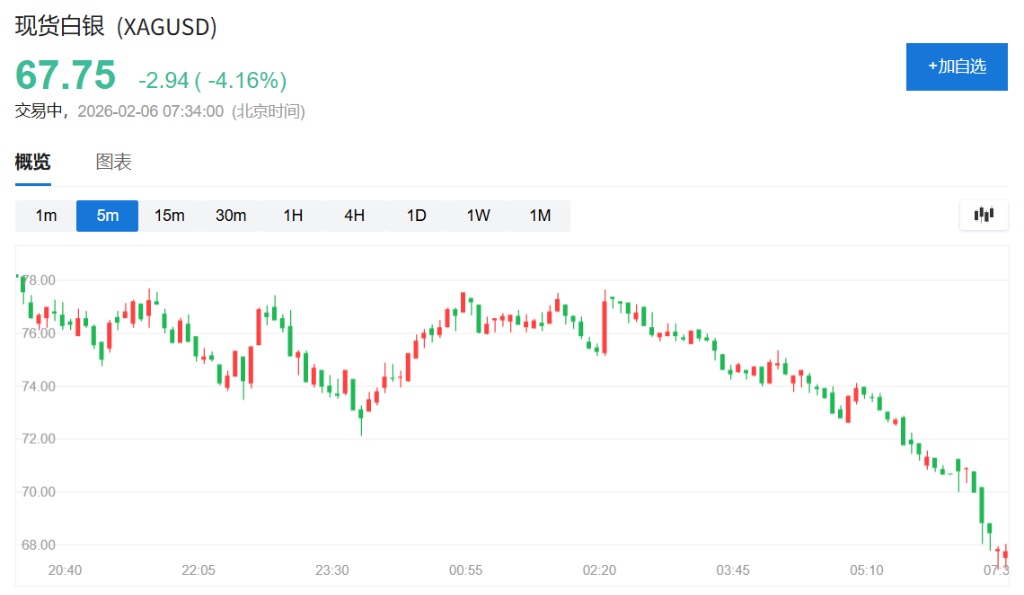
In the past week, spot silver has fallen more than 40% from the historical high reached on January 29. On Thursday, silver plummeted 19%, erasing all gains made this year, with unprecedented market volatility, marking the highest level since 1980.
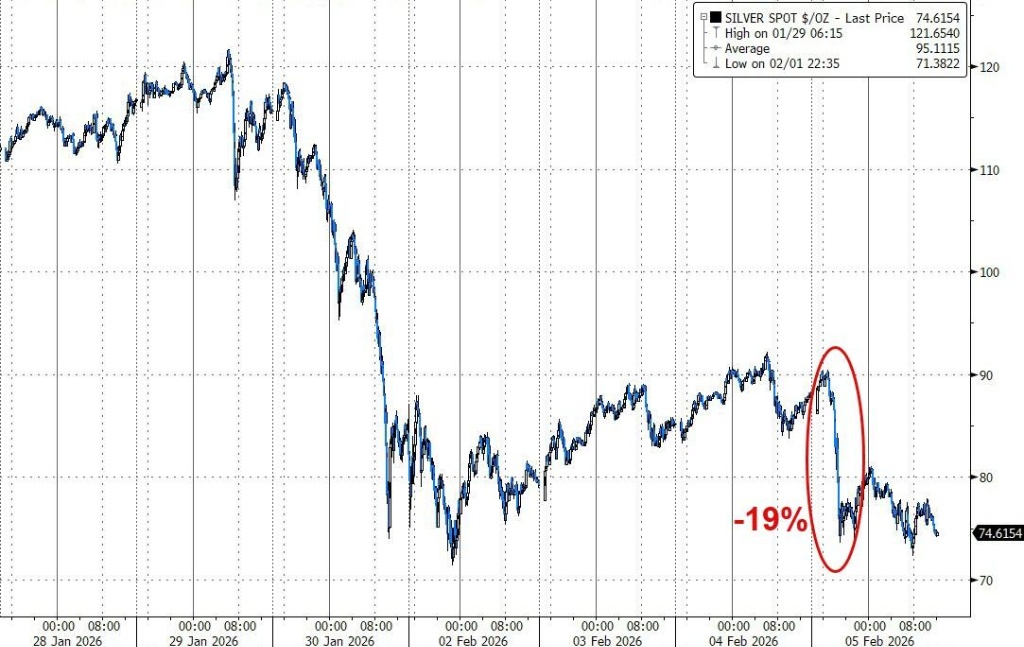
Wall Street Insight previously mentioned that when silver peaks, it is often accompanied by exchanges continuously raising margin requirements and other historical key indicators. In this round of silver market fluctuations, CME's regulatory intervention willingness is extremely strong.
In just the past month, CME has raised margin requirements five times in a row, a frequency that is quite rare:
- December 12, 2025: Announced the first margin increase, raising the initial margin from 22,000 to 24,200.
- December 29, 2025: Second margin increase, raising the initial margin from 24,200 to 25,000.
- December 31, 2025: Third margin increase, significantly raising from 25,000 to 32,500.
- January 28, 2026: Fourth margin increase, changing to a percentage system, raising from 9% to 11% (high-risk category from 9.9% to 12.1%).
- January 31, 2026: Fifth margin increase, continuing to raise from 11% to 15% (high-risk category from 12.1% to 16.5%).
From a technical perspective, silver has not yet reached an "oversold" state.
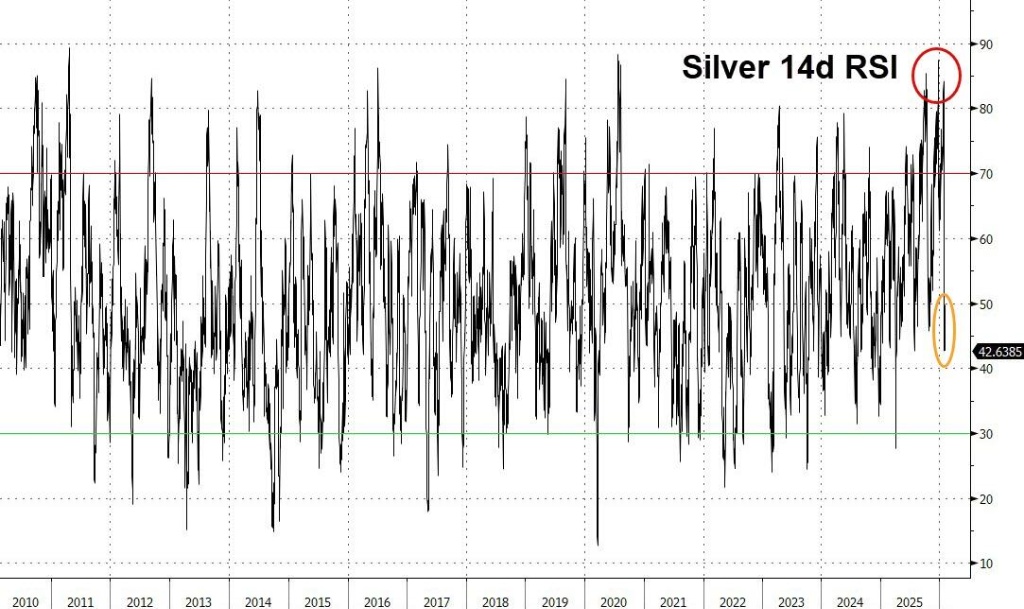
(Silver 14-day Relative Strength Index)
The big top of silver is not "created by rising," but "suffocated."
Historically, the sharp decline in silver has never been due to "rising too high," but rather the inevitable result of high volatility, high leverage, and regulatory brakes colliding.
The "electricity cut" crash of 1980 is the most representative. On January 21 of that year, the day silver reached its historical high, was precisely when the New York Mercantile Exchange (COMEX) announced "liquidation only, no new positions allowed."Prior to this, the exchange had repeatedly raised margin requirements and tightened position limits. When the bulls could no longer leverage to push prices higher, the game abruptly ended—silver prices plummeted 67% in the following four months.
The crash in 2011 adopted a "boiling frog" strategy. The CME raised margin requirements in a staggered manner five times within nine days. Although it did not "cut off power" all at once, the logic was the same: the cost of holding positions increased exponentially, leading to a break in the funding chain for the bulls. Silver prices peaked after the second margin increase and fell 36% over the next 16 months.
Both crashes share common characteristics:
- Volatility soared to extreme levels, currently reaching 1800%, while historically, it has been below 200% for 93% of the time.
- Price ratios became severely distorted, with the current silver-to-oil ratio breaking 1.8, far exceeding the historical range of 0.2-0.5.
The key point is that the confirmation of a peak usually involves a sudden change in rules. When the exchange forces "de-leveraging" by raising margin requirements, the frenzied bullish capital can no longer sustain itself, and prices collapse like a building that has lost its support.
When the market shifts from orderly trading to a chaotic casino, regulation becomes the last straw that breaks the camel's back
