


Bitcoin has halved, altcoins have collapsed, and retail investors who believe in the "Trump market" are "footing the bill."
The "Trump market" has ended, with Bitcoin halving from its peak to $61,000, and altcoins also plummeting over 50%, resulting in a market evaporation of over $700 billion in a week. Although Wall Street's ETFs have entered the market in compliance, the regulatory green light has not eliminated high volatility risks, leaving many retail investors who chased the highs trapped in losses. While policy dividends can bring legitimacy, they cannot provide a price floor
After the Trump administration's high-profile promise to build a crypto capital and the rapid rollout of compliant products on Wall Street, retail investors betting on the "Trump market" are suffering heavy losses. Cryptocurrency prices have rapidly declined, and the volatility of the assets themselves has not decreased due to compliance.
As of the time of writing, Bitcoin is priced at $61,000, having fallen over 50% from its peak, erasing all gains accumulated before and after Trump's return to the White House. Other altcoins, excluding BTC, have seen their market value drop by 51% from the peak in October last year ( considering the inflated market value due to token inflation, the actual price decline is even greater.). In the past week, the cryptocurrency market has lost at least $700 billion in market value.
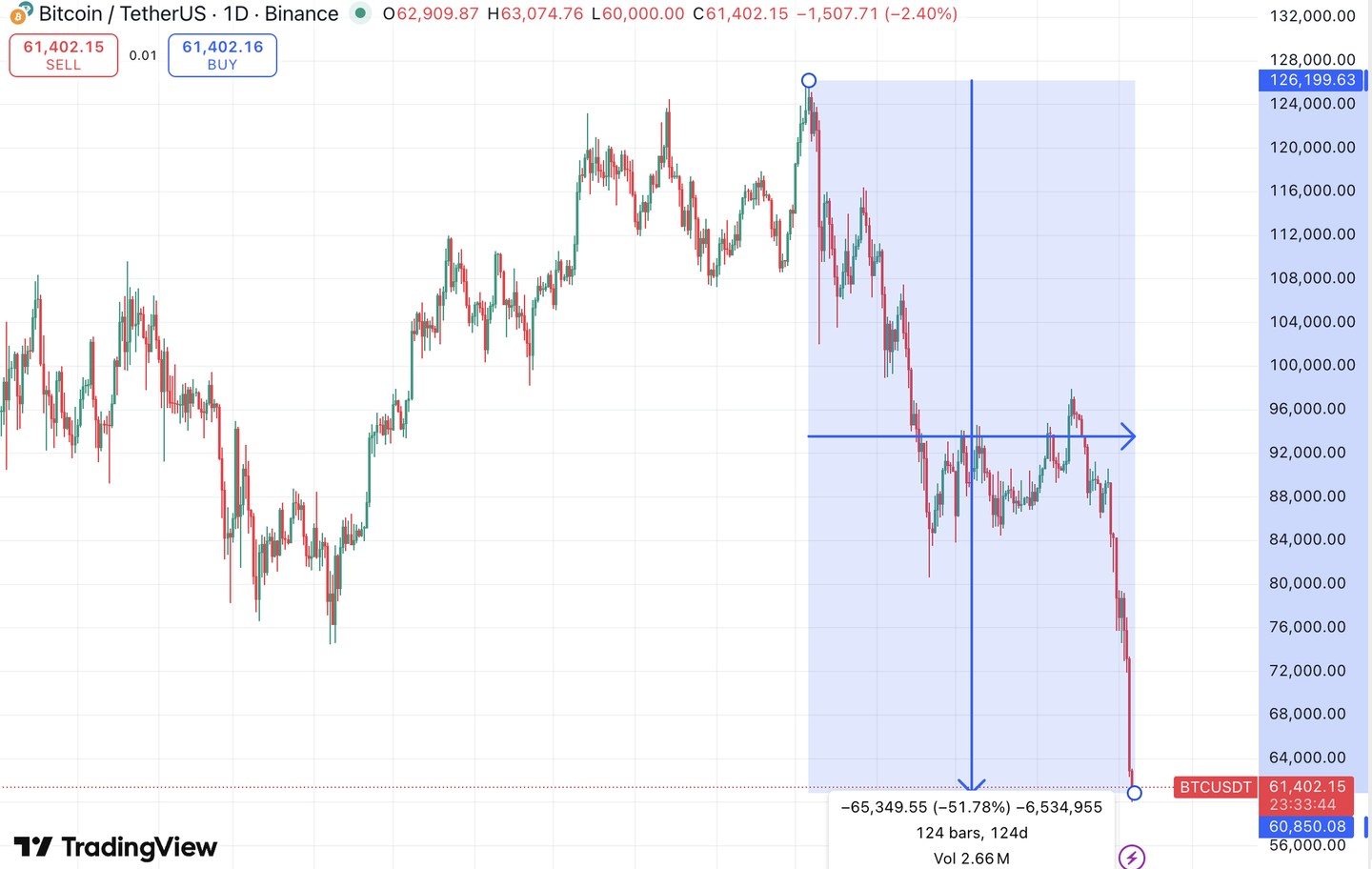
(BTC price has dropped 51.78% from its peak, chart source: TradingView)
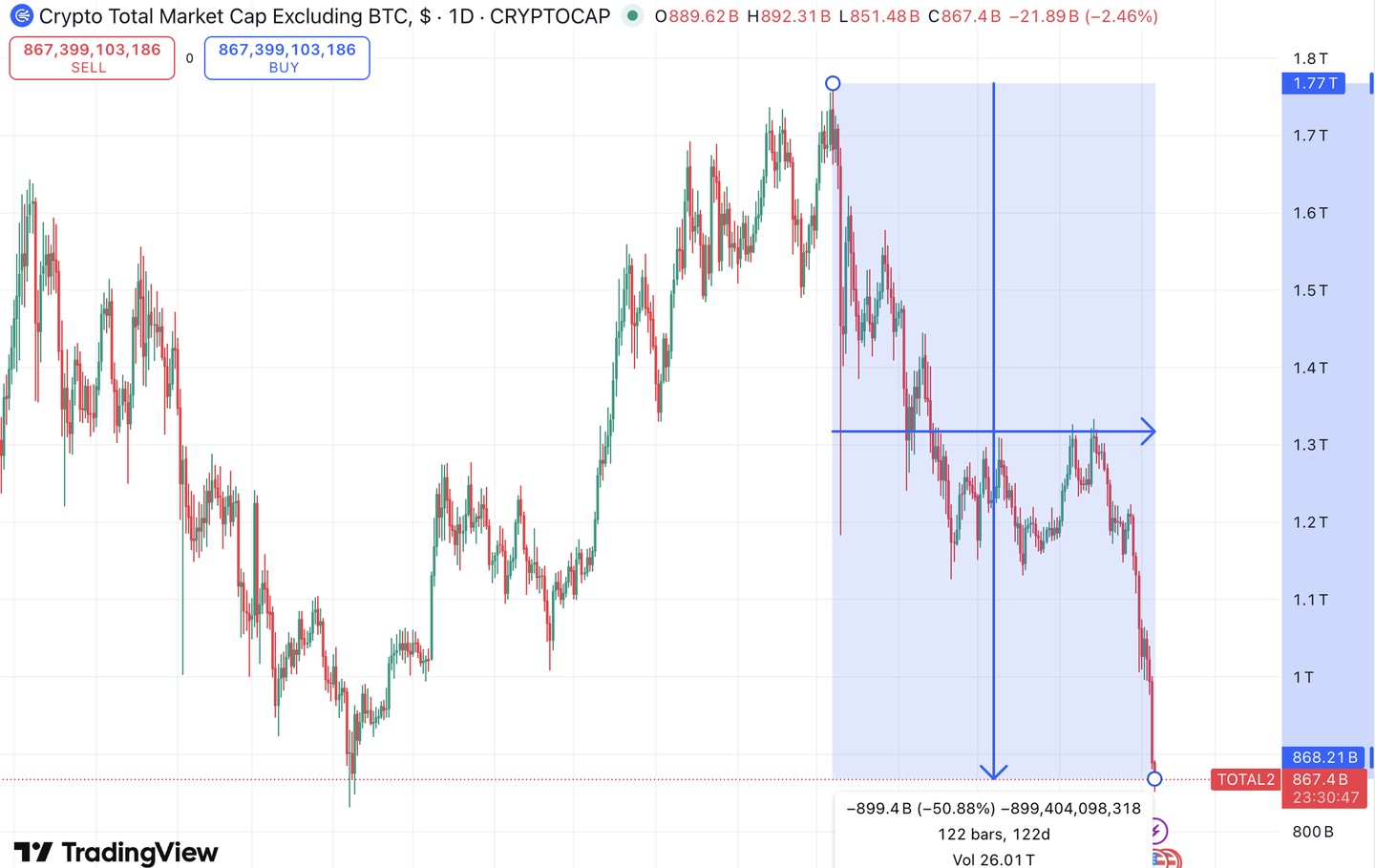
(The market value of altcoins, excluding BTC, has dropped 50.88% from its peak, chart source: TradingView)
Funds are simultaneously withdrawing. According to Bloomberg data, over $740 million flowed out of more than 140 crypto-themed ETFs in a single day on Wednesday, with a cumulative net outflow of nearly $4 billion over the past three months. Glassnode states that the average cost for holders of the U.S. spot Bitcoin ETF is about $84,100, meaning that a large number of investors are currently in a state of unrealized losses at the current price level.
Market participants emphasize that "pro-crypto" policies do not equate to a price bottom. Nate Geraci, president of NovaDius Wealth Management, stated that a government supportive of crypto "will not magically eliminate downward volatility." Peter Atwater, founder of Financial Insyghts, pointed out that Washington often embraces regulatory relaxation when market sentiment is at its peak, so a subsequent sharp decline is not surprising.
The premium of the "Trump market" is retreating, and compliant products have failed to "navigate" volatility
The contrast in this round of pullback is that retail investors are not only facing risks directly through exchanges but are also entering the market through "Wall Street-approved" fund products. Driven by the White House's pro-digital asset directives, regulators have allowed a large number of exchange-traded products, and asset managers have quickly launched various ETFs covering mainstream tokens and higher-risk tokens, including thematic bets, speculative strategies, and yield packaging.
However, the result is that institutional endorsement has provided more tradability and compliance channels but has not changed the high volatility characteristics of the assets themselves. As the market reverses, the speculative premium originally supported by optimistic policy sentiment has been squeezed, and retail investors have borne the majority of the repricing costs. As of the time of writing, Bitcoin has fallen over 50% from its peak, hovering around $61,000. Meanwhile, according to TradingView data, the market capitalization of altcoins has dropped 51% from its October high, and considering the inflated market cap due to token inflation, the actual price decline is even greater.
On a more macro level, the overall market capitalization of the cryptocurrency market has decreased by at least $700 billion in the past week. Bloomberg points out that this round of decline not only erases the gains made before and after Trump’s potential return to the White House, but also ends the previous narrative of rising prices fueled by policy expectations and regulatory green lights.
Prices fall below ETF cost lines, market begins capitulation selling
The funding situation has provided a more direct pressure signal. According to Bloomberg data, over $740 million was withdrawn from more than 140 cryptocurrency-themed ETFs in a single day on Wednesday, with a cumulative net outflow of nearly $4 billion over three months. This outflow is not limited to spot Bitcoin funds; Ether, XRP, Solana, and multi-currency products have also seen significant outflows and net value declines.
The cost of holdings has amplified the pain. Glassnode states that the average cost for holders of U.S. spot Bitcoin ETFs is about $84,100, significantly higher than the current price, which means many retail investors who entered through ETFs are now in a loss position on paper.
Bloomberg notes that as funds dry up, liquidity thins, and narratives stagnate, the market is entering a stalemate of “waiting for a new story or waiting for capitulation selling.”
Unlike seasoned players who have experienced multiple cycles, this new influx of buyers entered the market after institutionalization and regulatory validation, with expectations closer to mainstream asset experiences. Now, the ETF, once seen as a game-changer, has instead accelerated the erosion of confidence.
Cryptocurrency investor Bruno Ver stated that the speed of the crash caught many off guard, noting that investors who bought at high levels are under greater pressure. In contrast, some ETF supporters still emphasize that this is a “normal retracement cycle” for crypto assets, and the role of ETFs is to provide transparent, regulated access, not to eliminate risk.
Market conclusion: Washington can provide “legitimacy,” but not a “price floor”
In this rapid retracement, the most straightforward message from the market is: policy can drive product supply, improve trading channels, and bring temporary emotional premiums, but it cannot prevent the cyclical deep retracement of high-volatility assets. As Nate Geraci stated, downward volatility cannot be “eliminated” by the White House or regulators.
Peter Atwater interprets this round of market activity by pointing out that politics and regulation often follow the heightened market sentiment, tending to increase easing measures when “the party is at its liveliest.” The current sharp decline is less of an accident and more a return to risk pricing as speculative premiums recede
