


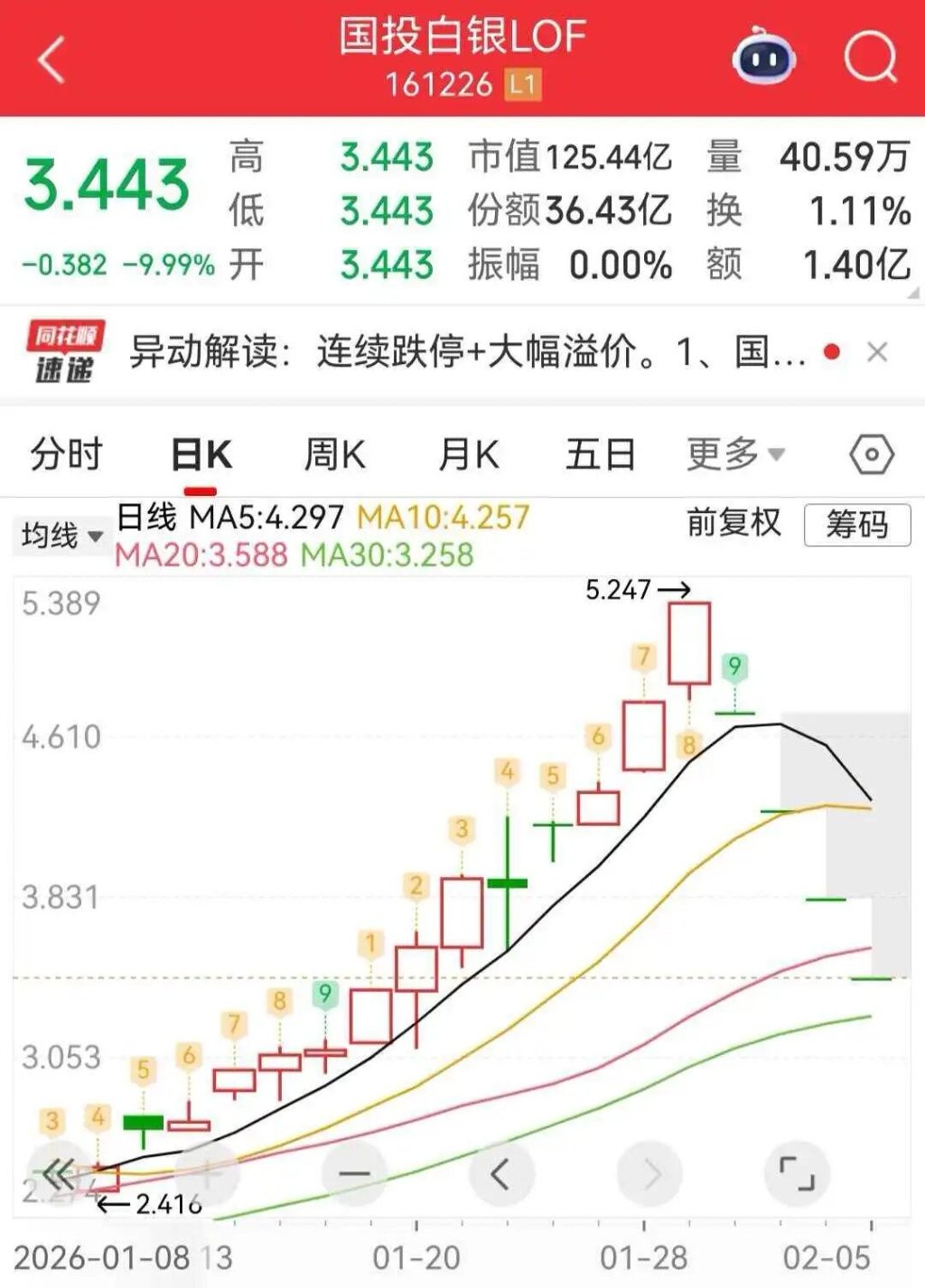
After four consecutive limit-downs, there is still a 37% premium! The sharp decline of the silver LOF questions the product design logic, and can it withstand pressure again in the face of extreme market conditions?
The UBS SDIC Silver Futures Fund (LOF) has faced questions regarding its product design due to a net value drop of over 30%. Investors hope that the fund company can temporarily break conventions and use derivatives for hedging to mitigate losses, but industry insiders believe that achieving this is difficult, mainly due to product positioning, risk matching, and operational restrictions. The fund has experienced four consecutive daily limit downs since February, and the current premium rate is 37.12%
The net asset value of UBS SDIC Silver LOF plummeted over 30% in a single day, deeply questioning the underlying design logic of this product.
In the face of heavy losses, some investors proposed an intuitive "self-rescue" plan: to temporarily break the norms and use derivatives for hedging to "patch" the product against declines. But can this seemingly beautiful wish be realized in reality? Are there similar products in overseas markets that can be referenced?
A reporter from the Daily Economic News found that the answer given by industry insiders is "difficult," mainly stuck on three barriers: product positioning, risk matching, and practical operation.
It is worth mentioning that since February, UBS SDIC Silver LOF has experienced four consecutive daily limit downs, reporting a price of 3.443 yuan, with the latest premium rate at 37.12%.
The Beautiful Wish for a "Patch" Against Declines and Three Real Barriers
A widely discussed suggestion on platforms like Xiaohongshu is: "In such extreme circumstances, can UBS SDIC Fund apply for a temporary breakthrough of position or derivative investment restrictions and utilize hedging tools?"
The prospectus of the UBS SDIC Silver Fund shows that the fund holds silver futures contracts valued at no less than 90% and no more than 110% of the fund's net asset value. At the same time, the investment proportion in warrants (including options) is limited to no more than 3% of the fund's net asset value.
This demand is intuitive and simple: since the product suffers heavy losses during declines, can it be "patched" through technical means to make it more resilient? In response, a research analyst from a public fund provided a layered analysis based on industry realities in an interview with the Daily Economic News.
First Layer: Change of Goals—What Exactly Do You Want to Invest In?
In answering investors' questions, the fund research analyst first returned to the essence of the product and posed a core question: when investing in silver products, the primary clarification is what exactly do you want to invest in?
He explained the original intention of the product design: "Most investors participate in silver product investments with the initial intention of tracking silver price trends. UBS SDIC Silver LOF chooses to invest in futures precisely because the main contracts of silver futures on the Shanghai Futures Exchange are relatively active, capable of supporting a certain scale of capital inflow and outflow; whereas the trading activity in the silver spot market is limited, and the market depth is insufficient to accommodate corresponding scales of capital inflow and outflow."
He further explained that the strict stipulations of the product contract clarify its pure tool attributes—the product strives to achieve an average daily tracking deviation of no more than 0.5% and an annualized tracking error of no more than 7%. Attempting to achieve "rising with the rise, not falling with the fall" through hedging operations would transform the product from a passive tracking tool into a subjective product with active management characteristics, fundamentally deviating from the original intention of the product's establishment.
Second Layer: Investor Suitability Principle—Can Current Fund Holders Bear the Risks of Hedging Strategies? At the same time, the investment researcher raised a second question: If a hedging mechanism is introduced, can investors bear the risks brought by the hedging strategy itself?
He further explained: "Risk hedging is an investment objective, but it does not mean that the hedging strategy will not bring new risks; in fact, it may further amplify losses due to the failure of the hedging strategy. Currently, the holders of this fund, which exceeds 10 billion in scale, have a risk tolerance that basically matches the medium to high-risk level of product R4; however, once more complex strategies are introduced, the direct consequence is a disconnect with the risk tolerance of existing holders."
In his view, regardless of whether it can be realized in practice, the investment strategy of public funds cannot be adjusted arbitrarily. Introducing complex strategies will inevitably lead to a mismatch between the product's risk and the risk tolerance of existing investors. Regardless of the subjective intentions, this essentially constitutes a risk mismatch.
Third Layer: Scarcity of tools and doubts about practical feasibility—It is also difficult to find similar strategy products in overseas public offerings
Finally, the investment researcher returned to the practical level and analyzed the feasibility of implementation.
He believes that investing solely in silver while wanting to perfectly hedge through derivative tools to control volatility, even idealistically requiring "to rise with the rise and not to fall with the fall," is too detached from reality. Even looking at overseas markets, it is difficult to find mature products that can achieve this goal.
The reporter noted that among the silver-related products launched overseas, the one closest to the UBS SDIC Silver LOF is the PowerShares DB Silver Fund (DBS) in the United States, which primarily invests in silver futures. Generally, products investing in silver futures are affected by factors such as the roll yield from futures contract rollovers and futures premiums/discounts, especially under extreme market volatility, where these negative impacts may be further amplified. DBS completed its last trading day in March 2023 and subsequently completed fund liquidation. Currently, the largest silver product in the global market is the iShares Silver Trust (SLV), which invests in physical silver and experienced a significant drop of 28.54% on January 30, 2026.
In addition, the aforementioned fund researcher pointed out that all product designs have their historical limitations. At the time of design, no one could foresee that such extreme market conditions would occur in the next decade. The fundamental risk of this model, which tracks international prices through domestic futures contracts, lies in the unpredictability of the market itself, rather than purely human operational errors.
International Reference: Physical Silver ETFs are more valuable for reference
The UBS SDIC Silver Fund is scarce; it is almost the only LOF fund in the domestic public market that directly invests in silver futures. So, what investment products for silver exist in the international market?
A fund professional who wished to remain anonymous pointed out that among the mainstream silver investment products in the international market, physical silver ETFs, silver futures, and silver mining ETFs are the core mainstream, along with bank paper silver, physical silver bars/coins, etc. Among them, silver futures focus on short-term speculation and hedging, while mining ETFs are more volatile and suitable for risk-tolerant funds. Paper silver and physical silver are more focused on retail small-scale operations or traditional allocation needs Multiple fund research professionals interviewed indicated that for China's public fund industry, investing in physical silver products is the most instructive.
In the view of these fund professionals, products like physical silver ETFs, with their "physical anchoring + share-based" design, can address the pain points of high thresholds and high storage costs for silver investment in China. The standardized shares align with the public fund's inclusive positioning, and the physical custody mechanism ensures fair net value. At the same time, the "physical subscription and redemption + secondary market arbitrage" mechanism can suppress premiums and discounts, enhance tracking accuracy, and the low-cost operational strategy meets the needs of domestic investors. This model not only fills the gap of domestic public products for physical silver but also adapts to regulatory requirements and investor risk preferences, helping to improve the commodity product line and demonstrating strong feasibility for implementation.
Can UBS SDIC Silver Fund Transition to QDII-FOF Model?
2025 is expected to be a year of development for commodity funds. These funds can be roughly divided into four categories, each with different investment targets and risk management logic.
The largest and most mainstream category is represented by various gold ETFs, such as Huaan Gold ETF and Bosera Gold ETF. Their assets are almost entirely invested in spot gold contracts on the Shanghai Gold Exchange. The risk of these funds is relatively singular, namely the fluctuation of gold prices, without involving leverage or complex factors like futures rollovers.
Secondly, there are funds that directly invest in domestic commodity futures contracts, covering various subcategories such as silver, non-ferrous metals, soybean meal, and energy chemicals. These tools provide exposure to futures prices, and their risk control mechanisms are more complex. As mentioned by the aforementioned fund research professionals: "Typically, these funds have a contractual upper limit on the proportion of investment in the underlying futures contracts (e.g., 90%), retaining some cash to cope with fluctuations. There are limits on positions for single contracts or maturities to avoid excessive concentration risk."
Taking the Da Cheng Non-Ferrous Metals Futures ETF as an example, its Q4 2025 report shows that the investment portfolio strictly follows the fund contract stipulations, with the total value of the index component commodity futures contracts held (calculated by buying and selling netting) not less than 90% and not more than 110% of the fund's net asset value, while its investment portfolio tracks the price trends of six non-ferrous metal futures contracts: copper, aluminum, lead, zinc, nickel, and tin on the Shanghai Futures Exchange.
In addition to having clear restrictions on investment scope and position management, these funds also manage risks and tracking errors through various mechanisms such as cash management in their daily operations.
The third category consists of cross-border commodity funds operating through the QDII channel. It is worth noting that although they all contain terms like LOF in their names, there are fundamental differences in the underlying logic of product design between mainstream commodity LOF funds in the market and UBS SDIC Silver LOF.
A researcher from a certain fund company pointed out that currently, the commodity LOFs familiar to domestic investors, such as Harvest Oil and E Fund Gold Theme, mostly belong to the QDII-FOF model. Their operational chain can be summarized as domestic funds investing in overseas funds, which then invest in underlying assets. The core responsibility of fund managers is to select and manage these overseas tools, while complex market rule issues such as dealing with futures price limits and handling contract rollovers have actually been resolved by the managers of these overseas tools In short, mainstream QDII commodity LOFs achieve partial risk isolation by introducing overseas instruments as a buffer layer.
So, is it possible for the UBS SDIC Silver LOF to convert into a QDII-FOF model?
A person from a large fund company pointed out to the Daily Economic News that even if the silver LOF is converted to a QDII model, it must face a fundamental question: what should the underlying investment be, futures contracts or spot contracts? If it still invests in futures contracts, there will be no essential improvement compared to the existing model.
This person further clarified the core constraint: it is not possible to directly launch a silver ETF in China, with the core obstacle being taxation—spot silver investments are subject to tax, while gold enjoys a tax exemption policy.
The last category is commodity resource stock funds, such as gold stock ETFs, coal ETFs, etc. They invest in the stocks of related listed companies and essentially belong to equity investments, with their performance being a dual reflection of commodity prices and stock market logic. Therefore, their risk control mechanisms are more similar to those of equity funds, focusing on industry diversification, stock selection, and prevention of systemic market risks, with commodity price fluctuations being just one of the factors affecting their net value.
How Limited Measures Address Infinite Market Conditions
The valuation event of the UBS SDIC Silver LOF has attracted significant attention within the public fund circle. Through multiple inquiries, several investment research personnel from fund companies believe that the product design has historical limitations, as its framework is based on the understanding at that time and cannot foresee extreme market conditions in the future.
When this greatest risk source arrives, fund companies are essentially using limited measures to respond to infinite market conditions, so the optimizations and improvements that can be made afterward are often partial and cannot meet investors' expectations of not incurring any losses.
Currently, the improvements that can be discussed within the industry mostly belong to the category of process optimization, such as advancing the timing of risk announcements, for example, from Monday to the weekend. However, some seemingly direct suggestions to protect investors, such as suspending subscriptions and redemptions during extreme volatility, are generally considered unlikely to be realized under the existing regulatory framework.
It can be anticipated that this event, as an extreme precedent, is expected to prompt the industry to conduct a thorough review and reflection on this product category. In the future, the design concepts and risk control standards of new products may be adjusted as a result of this stress test.
Risk Warning and Disclaimer
The market has risks, and investment should be cautious. This article does not constitute personal investment advice and does not take into account the specific investment goals, financial conditions, or needs of individual users. Users should consider whether any opinions, views, or conclusions in this article align with their specific circumstances. Investing based on this is at their own risk
