"Is a rate hike on the way?" Bank of Japan board member sends hawkish signals, market expects action in April

Wallstreetcn
2026.02.06 06:57
portai
I'm PortAI, I can summarize articles.

A member of the Bank of Japan's board clearly supports further interest rate hikes to achieve policy normalization and emphasizes that timely action is crucial to curb potential inflation, driving market expectations for an interest rate hike before April to soar to 74%. The market is highly focused on the policy meeting on March 19, anticipating that the timing of the interest rate hike will be significantly advanced compared to previous forecasts

Kazuyuki Masu, a member of the Bank of Japan's board, spoke on Friday, clearly stating the need for further interest rate hikes to complete the normalization of monetary policy, adding momentum to the market's increasingly warming expectations for rate increases.

According to Bloomberg, Masu stated during a speech to local business leaders in Ehime Prefecture, western Japan, "I am confident that we need to continue further interest rate hikes to complete the normalization of Japan's monetary policy." He emphasized that raising interest rates would help end the divergence between Japan and other major economies in terms of interest rate policies, and pointed out that it is crucial to keep the potential inflation rate below 2% through timely and appropriate rate hikes.

Masu's remarks continue the hawkish stance of the Bank of Japan since the policy meeting in January, pushing market expectations for a rate hike before April to 74%. Overnight index swap market pricing shows that most economists previously predicted the next rate hike would occur in June or July, but current market expectations have significantly advanced.

This is Masu's first public speech since joining the Bank of Japan's nine-member decision-making committee in July last year. Previously, he described his policy stance as being "in the middle" between hawkish and dovish, which sharply contrasts with the hawkish signals released in his speech on Friday.

Significant Shift in Policy Stance

Masu's remarks mark a significant shift in his policy inclination. As a former executive at the major trading company Mitsubishi Corporation, he had indicated a neutral stance when joining the central bank's board, but his speech on Friday clearly exhibited hawkish tones.

He pointed out that the divergence in interest rate direction between Japan and other major economies needs to change. Although he did not elaborate in detail, the interest rate gap between Japan and other major economies has long been viewed as a key reason for the continued weakness of the yen, and the depreciation of the yen has put pressure on businesses and households by increasing import costs.

Masu emphasized that the key moving forward is to ensure that the potential inflation rate remains below 2% through timely and appropriate interest rate hikes. He also noted that it is essential to avoid excessive rate hikes to prevent undermining the trend of moderate wage and inflation increases.

He stated that current price trends are "very close" to the Bank of Japan's 2% target, and as food inflation is expected to weaken, the potential inflation rate will become a key indicator determining the policy path. Data released on Friday showed that the proportion of food spending in Japanese household expenditures reached a historical high in 2025, a trend that limits consumers' ability to make discretionary purchases.

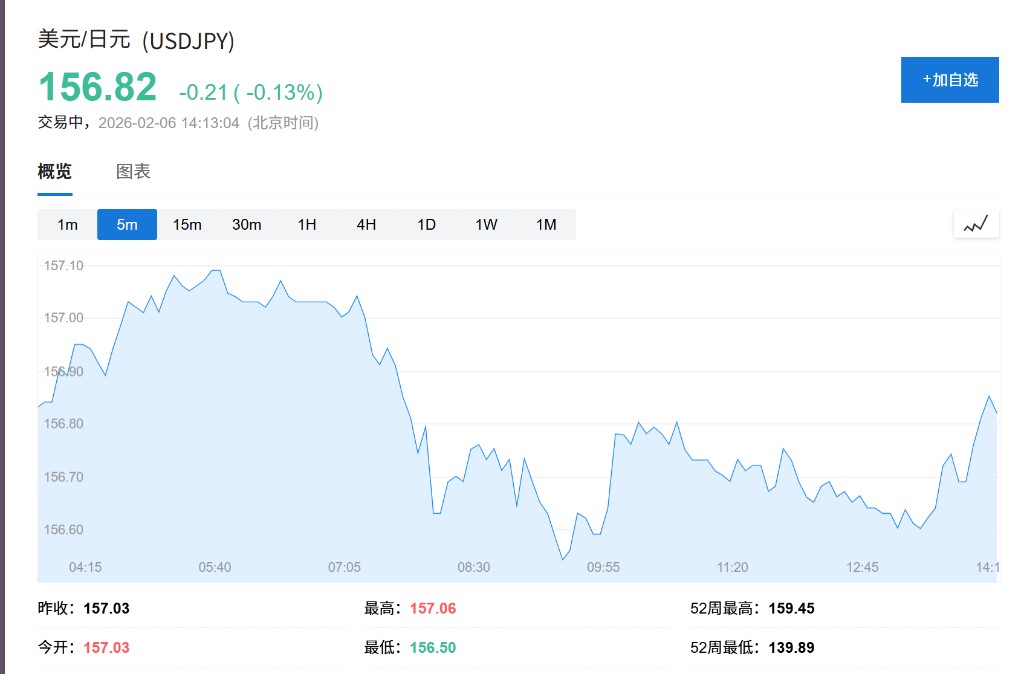
After Masu's speech, the yen traded around 156.82 against the dollar. The Bank of Japan has recently expressed increasing concerns about the impact of currency weakness on inflation, as the trend of yen depreciation continues.

According to overnight index swap market pricing, traders believe there is about a 74% probability that the Bank of Japan will raise interest rates before April. The Bank of Japan will announce its next policy decision on March 19. After raising rates in December last year, most economists initially predicted that the next action would wait until June or July this year, but recent hawkish signals from the central bank have significantly advanced market expectations