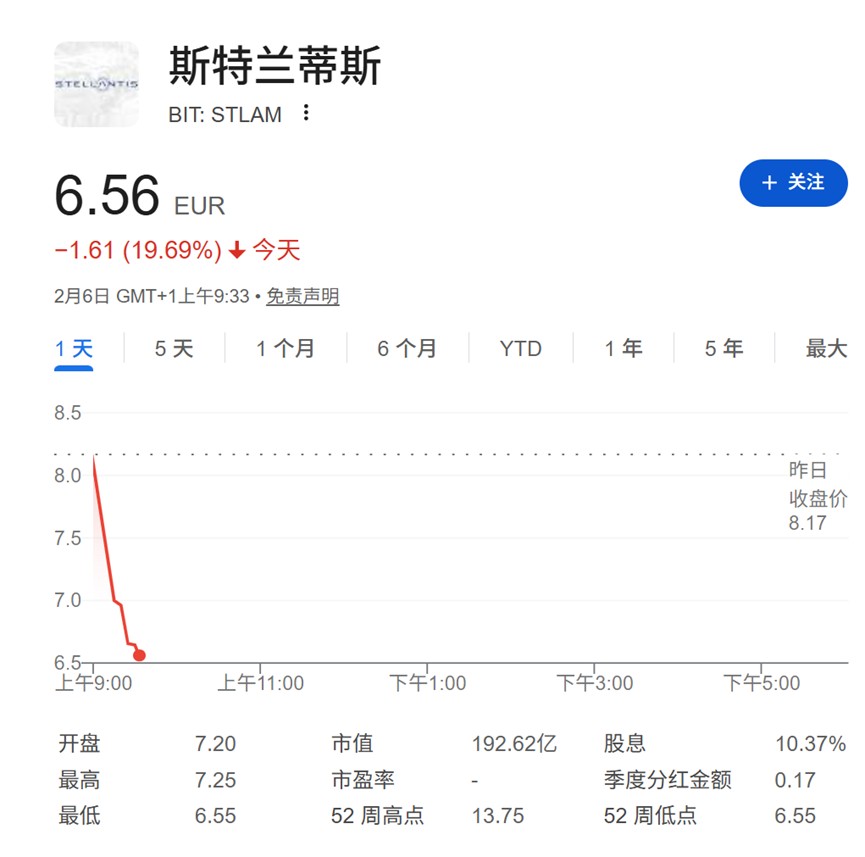
Plummeting 20%! Stellantis announces "mass withdrawal from electric vehicles," provisions for a massive loss of 22 billion

Wallstreetcn
2026.02.06 08:41
portai
I'm PortAI, I can summarize articles.

Stellantis announced a massive write-down of €22 billion, projecting a loss of €21 billion in 2025 and canceling dividends. The company is fully retracting its electrification strategy, exiting battery joint ventures, and restarting large displacement engines. This move marks the end of its aggressive transformation, aimed at addressing cost pressures and slowing demand, resulting in a nearly 20% plunge in its stock price

In the face of high costs and weak electric vehicle sales, Stellantis, the world's fourth-largest automaker, is acknowledging a strategic misjudgment with a massive write-down of approximately €22 billion. The automotive giant, which owns 14 brands, announced a comprehensive adjustment to its operational strategy on Friday, ranging from exiting battery joint ventures to halting production of pure electric pickups, marking a substantial retreat from its aggressive electrification plans.

According to Bloomberg, Stellantis expects a net loss of up to €21 billion in the second half of 2025, with an annual operating profit margin of only low single digits, and will cancel this year's dividend distribution. This write-down includes approximately €6.5 billion in cash payments, primarily for compensating suppliers, with related costs to be accounted for in the second half of the 2025 fiscal year, but will not affect adjusted operating income.

"These changes largely reflect the cost of overestimating the speed of the energy transition," said CEO Antonio Filosa in a statement. He attributed the write-down to "the impact of previously poor operational execution, which our new team is gradually addressing."

Following the announcement, Stellantis's stock price plummeted by as much as 19%, with the scale of the write-down exceeding analysts' expectations. The stock has fallen more than 40% over the past year.

Comprehensive Shrinkage of Electrification Strategy

Stellantis is systematically cutting back on its electric vehicle business layout. The company announced its exit from the joint venture with South Korean battery manufacturer LG Energy Solution Ltd. in Canada, with LG acquiring its shares. In 2022, Stellantis had stated it would jointly invest over CAD 5 billion (USD 3.7 billion) with LG Energy to establish the first large electric vehicle battery factory in Windsor, Ontario.

In terms of product lines, the company has eliminated several pure electric vehicle models, including halting production of the RAM 1500 pure electric pickup in the U.S. market and delaying Alfa Romeo's electric vehicle projects in Europe. This stands in stark contrast to the aggressive targets set by former CEO Carlos Tavares—who had promised to sell only electric vehicles in Europe by 2030, with electric vehicle sales accounting for 50% of the U.S. market.

As part of the strategic adjustment, Filosa also decided to abandon certain investment projects, including a planned hydrogen energy joint venture.

Stellantis is not the only automaker paying the price for slowing electric vehicle demand. According to Bloomberg, Ford Motor Company stated last December that it would incur $19.5 billion in costs due to adjustments in its electric vehicle business; General Motors' write-down has ballooned to $7.6 billion; Porsche lowered its performance outlook four times last year due to adjustments in its electric vehicle strategy.

This wave of write-downs highlights the common challenges faced by traditional automakers in the electrification transition: on one hand, they need to invest heavily in building capacity and supply chains, while on the other hand, consumer acceptance is lower than expected, leading to a prolonged wait for investment returns

Financial Pressure and Fundraising

In addition to an expected net loss of €21 billion, Stellantis's operating profit margin this year is also facing erosion from tariff costs. The company anticipates a low single-digit operating profit margin for the year, including approximately €1.6 billion in tariff-related expenses.

To strengthen its balance sheet, Stellantis plans to issue up to €5 billion in bonds. This is a financial self-rescue measure taken by the company after experiencing a significant loss of market share—buyers left during the tenure of the former CEO due to price increases, product gaps, and quality issues.

The company is scheduled to release detailed annual financial results on February 26 and plans to present its strategic plan to investors in May.

Since taking over in June last year, Filosa has been implementing comprehensive reforms at this 14-brand automaker, aiming to regain market share while scaling back electric vehicle ambitions and addressing U.S. tariff costs. In the key profit-generating market of the U.S., Filosa has committed to investing $13 billion, reintroducing the V8 engine, and delaying electric vehicle projects. He has also sought to regain market share through significant price reductions