


HSBC firmly "reduces holdings" in Korean stocks: a highly consensus trade with significant risks
As the entire market cheers for the significant rise of the South Korean stock market this year, HSBC Bank warns against the trend, stating that the current market situation has become a highly crowded consensus trade. Despite strong earnings expectations and an AI narrative dominating, the almost unanimous bullish ratings and the funding structure driven by local retail investors have led to a sharp accumulation of risks. HSBC maintains a "reduce" stance, believing that any negative catalyst could trigger significant market volatility and concentrated sell-offs
As the market cheers the nearly 20% rise in the South Korean stock market this year, HSBC issues a warning: the extremely crowded consensus trade is brewing significant risks.
On February 6, Herald van der Linde, Head of Asia Pacific Equity Strategy at HSBC, stated in a report that the current optimism towards South Korean stocks is nearing a dangerous edge, with liquidity masking structural risks. The HSBC team admitted that their "underweight" strategy on South Korean stocks has missed significant gains, but the bank insists that the key issue is not questioning the prospects of AI, chip demand, or improvements in corporate governance, but rather the excessive concentration of trades and extreme optimism in sentiment.
Data shows that the current market consensus is highly uniform: out of 44 analysts covering SK Hynix, 41 have given a "buy" rating; Samsung Electronics has not received any "sell" ratings. HSBC warns that this almost unanimous bullish situation often signals that risks are approaching. The report cautions:
"If the AI narrative falters, investors may rush to exit simultaneously. Even though the market has risen since the beginning of the year, we must highlight this risk. For this reason, we can only grit our teeth and endure this pain."
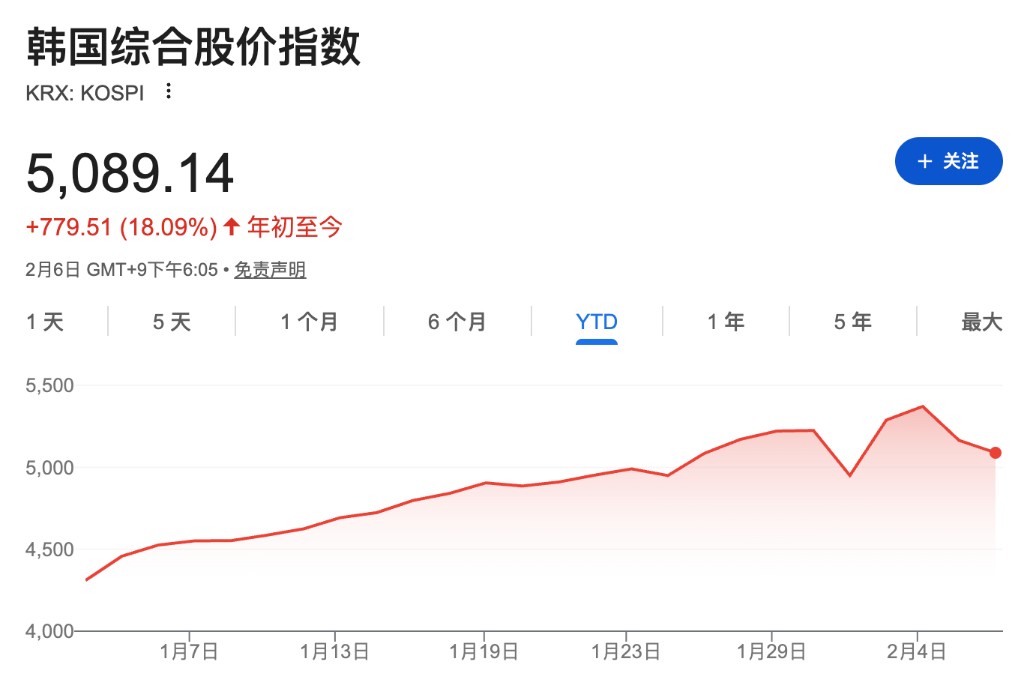
Foreign Capital Quietly Exits, Local Retail Investors Drive Up Korean Stocks
Despite strong fundamental data, HSBC warns that the positives for the South Korean stock market may have been overvalued, and there is a dangerous divergence in capital flows. According to the HSBC report, the earnings of the FTSE Korea Index constituents are expected to double by 2026, primarily driven by memory chip giants, with growth also seen in shipbuilding, defense, and other industrial sectors. However, these positive factors have already been fully reflected in stock prices.
A more critical signal comes from the capital front: foreign capital is taking the opportunity to reduce holdings, with the momentum of this round of market rally almost entirely coming from local investors. The report points out:
"Who is buying? Foreign funds are actually selling, while domestic investors are pushing the market higher."
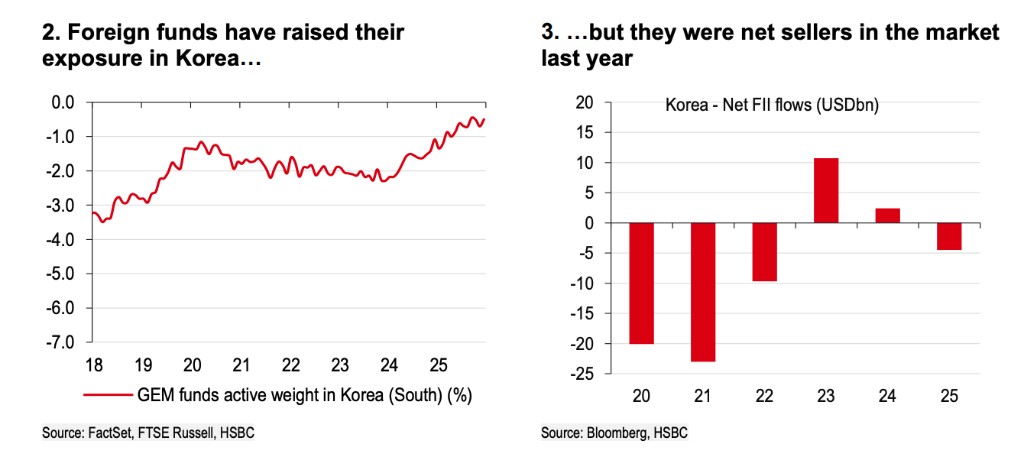
The main force driving the market up is retail funds, especially individual investors entering through ETFs. Although the National Pension Service (NPS) of South Korea has raised the domestic stock allocation limit, its impact is relatively limited. Meanwhile, while South Korea's "Corporate Value Enhancement Plan" has made progress in areas such as dividend tax incentives and board independence, companies still have significant room for improvement in increasing dividend payout rates and reducing cash hoarding.
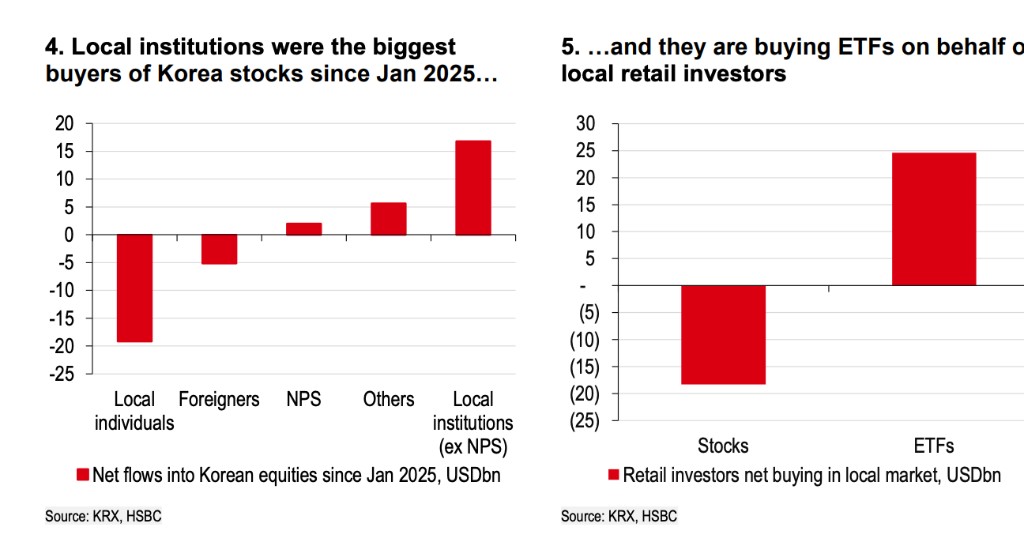
Against this backdrop, HSBC maintains its underweight view on South Korean stocks. The report warns that in a market environment where daily fluctuations can reach 5-6%, due to the extreme over-allocation of fund positions, any negative catalyst could trigger concentrated selling Although the current valuation (approximately 10 times the forward price-to-earnings ratio) seems reasonable, the overly crowded trading structure indicates that the risk-reward ratio is deteriorating.
