HSBC China Wealth Insights: The upgrade of AI technology triggers a sharp decline in software stocks, and the future development of the software sector may diverge | Hotspot Tracking

Wallstreetcn
2026.02.06 11:09
portai
I'm PortAI, I can summarize articles.

Recently, global software stocks have faced significant sell-offs due to the disruptive impact of artificial intelligence technology. The S&P North American Software Index has fallen for three consecutive weeks, with a year-to-date decline of over 15%. There are concerns in the market regarding the future development of traditional software companies, and some institutions have begun to adjust their ratings for software companies. Although AI tools may reshape the way software is used, tech industry insiders believe that AI will not completely replace software tools. There is uncertainty in the future development of the software industry, and investors need to distinguish between potential winners and losers amid the impact of AI

Global Software Stocks Encounter Significant Sell-off

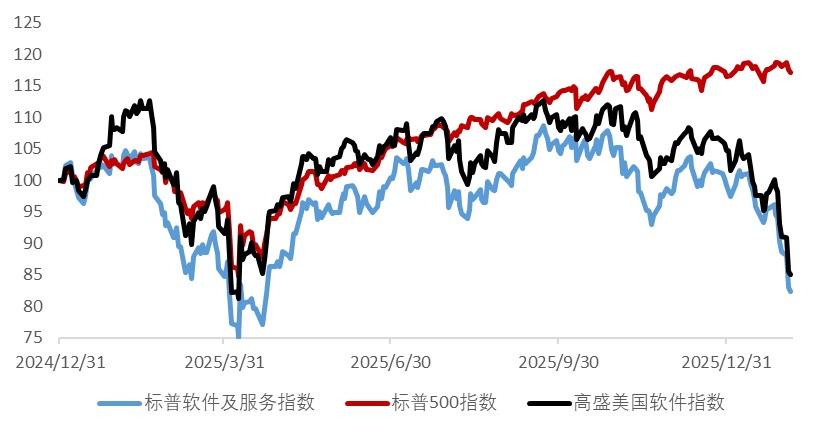
Recently, the disruptive impact of artificial intelligence (AI) technology has raised concerns in the market regarding the development of traditional software companies, leading to a sell-off in the software sector. The S&P North American Software Index has fallen for three consecutive weeks, with a cumulative decline of over 15% year-to-date, marking the worst monthly performance since 2008. Many leading stocks in the Asia-Pacific market have also experienced sharp declines.

S&P North American Software Index Plummets

Source: Bloomberg, HSBC Private Banking and Wealth Management, as of February 4, 2026

What Happened?

An AI startup released an automation tool for corporate legal teams in early February, raising market concerns that AI will disrupt traditional software business models. This tool can cover the workflow of corporate legal departments, including contract review, classification of non-disclosure agreements, compliance checks, briefing, and templated responses. The market fears that AI tools will significantly lower the programming threshold and can reconstruct traditional software workflows in a faster and cheaper way, shaking the subscription pricing model and product logic of SaaS (Software as a Service).

Currently, institutions have differing views on the substantive impact of AI technology changes on the future of software stocks. Some institutions have begun to adjust their ratings for software companies, while some leading figures in the tech industry point out that AI will not replace software tools but will reshape the way software tools are used.

The Future Development of the Software Sector May Face Divergence, but Short-term Market Panic May Be Overdone

This sell-off highlights the internal divergence within tech stocks, as investors are urgently trying to distinguish potential "winners" and "losers" under the impact of AI. We believe that although the AI era is still in its early stages, the boundaries of AI tools are continuously expanding and gradually encroaching on the market of traditional data analysis tools. The development of the software industry carries uncertainty and a trend of divergence, with the key judgment resting on whether companies can prove through performance that AI is a driving force for their growth, rather than facing resistance under the pressure of being "replaced." Traditional software companies are indeed continuously impacted by AI innovations, especially those software tools whose functions can be easily replicated by AI, which will be more easily replaced. However, some software companies still possess advantages such as data accumulation, compliance improvement, and ecosystem binding, which may experience less impact in the short term from deep business process tools tailored for niche markets. Meanwhile, the software industry remains a crucial part of enterprises' AI integration and productivity enhancement Recent financial reports from some leading software companies indicate that the fundamentals remain robust, while stock price reactions are more emotional rather than reflecting the long-term value of the companies. As an application of artificial intelligence, the performance of winners and losers will diverge, making the ability to select future development targets an important standard and significance for asset managers.

The trend of sector rotation in the U.S. stock market is evident, and the importance of diversified allocation remains

Additionally, we have observed the emergence of sector rotation trends in the U.S. stock market. Despite significant volatility, the S&P 500 index rose 1.4% in January, approaching historical highs. The energy and materials sectors led the market, driven by strong increases in commodity prices, while funds are rotating from the technology sector to commodities and industrial sectors.

In the fourth quarter of 2025, corporate performance during the U.S. earnings season remained strong. So far, about 40% of S&P 500 constituent companies have released their earnings reports, with 76% of these companies exceeding earnings per share expectations, in line with the five-year average. This has resulted in an 11% year-on-year growth rate for the S&P 500 index's EPS (earnings per share), higher than the general expectation of 8% before the earnings season began, achieving double-digit growth for the fifth consecutive quarter. Looking ahead, given the favorable macroeconomic environment, we maintain a positive outlook on the U.S. stock market. Currently, the market's general expectation for GDP (Gross Domestic Product) growth in 2026 is 2.4%, slightly adjusted upward from the previous expectation of just below 2% a few months ago, while inflation and labor market data remain relatively stable. Nevertheless, we will continue to closely monitor risks related to geopolitics and domestic policies in the U.S. In terms of sector allocation, while we are overweight in information technology and communication services sectors to capture AI-driven returns, we still plan to diversify stock risks by allocating to utilities, industrials, materials, and financial sectors, thereby reducing concentration and valuation risks. The acceleration of sector rotation in the U.S. stock market also underscores the importance of diversified investment and active management.

The above content is from HSBC China Wealth Insights. For more content, click on [HSBC China Wealth Insights Column].

Note: Past data does not represent future performance.

Data source: Bloomberg, Wind, HSBC Global Investment Research, HSBC Private Banking and Wealth Management, as of February 5, 2026.

Risk warning and disclaimer

The market has risks, and investment requires caution. This article does not constitute personal investment advice and does not take into account individual users' specific investment objectives, financial conditions, or needs. Users should consider whether any opinions, views, or conclusions in this article align with their specific circumstances. Investment based on this is at one's own risk