Comparable to "ChatGPT" moments! SemiAnalysis in-depth interpretation: Claude Code will be a turning point for AI "intelligent agents"

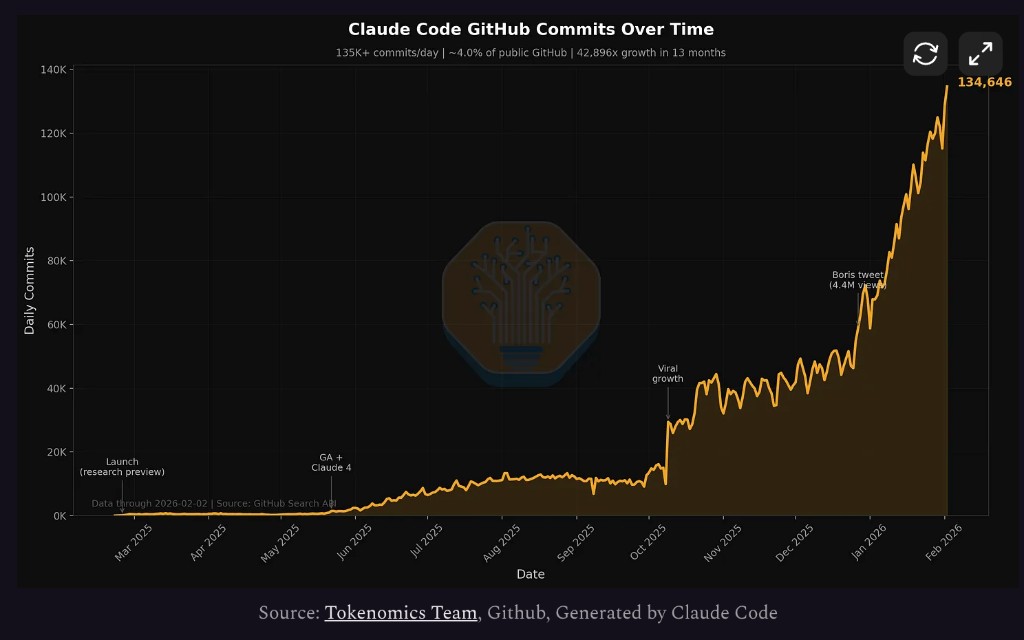
Anthropic's AI programming tool Claude Code has accounted for 4% of public code submissions on GitHub, and it is expected to exceed 20% by the end of 2026. SemiAnalysis analysis indicates that Claude Code is a turning point for AI agents, changing the nature of programming and reshaping the global information work market worth approximately $15 trillion. Anthropic is achieving rapid revenue growth based on this technology, with ARR growth surpassing that of OpenAI. Accenture plans to train 30,000 professionals to use Claude, as traditional software and SaaS business models face challenges. The commercialization path of AI agents reconstructs the value distribution logic of the digital economy, and tech giants need to adjust their strategies to cope with the impact of AI agent tools
Anthropic's AI programming tool Claude Code has accounted for 4% of public code submissions on GitHub, and it is expected to exceed 20% by the end of 2026. The latest analysis from research firm SemiAnalysis points out that Claude Code is a turning point for AI "agents."

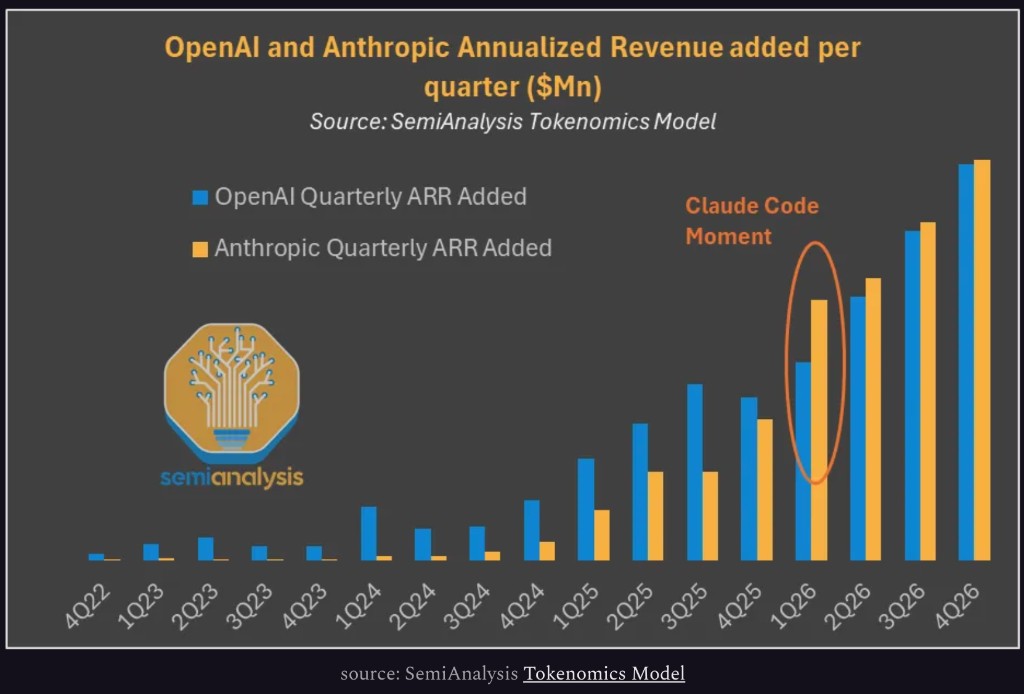
The report emphasizes that Claude Code not only changes the form of programming but also indicates that AI agents will reshape the global information work market worth approximately $15 trillion. Currently, Anthropic is leveraging this technology to achieve rapid revenue growth, with its quarterly annual recurring revenue (ARR) increment surpassing that of OpenAI, reflecting a structural change in the competitive landscape of the AI agent sector.
This trend has triggered a deep response from the industry chain. Accenture has signed an agreement to train 30,000 professionals in finance, healthcare, and the public sector to use Claude, becoming the largest enterprise-level deployment case to date. Meanwhile, traditional software and SaaS business models face fundamental challenges.
Analysis indicates that a considerable number of fields will be affected. With the rise of Claude Code (and Cowork), the total market size for agents is much larger than that of large language models themselves. It is gradually extending from current vertical scenarios like customer support and software development to high-value professional service industries such as financial services, legal compliance, and strategic consulting. This is also the core proposition that the research firm continues to track: the commercialization path of agents is reconstructing the value distribution logic of the entire digital economy.
For tech giants, strategic balance has become more complex. Microsoft not only provides computing power support for OpenAI, Anthropic, and others through Azure but also needs to defend against the impact of AI agent tools on its core products like Office 365. It is reported that CEO Satya Nadella has personally participated in the strategic adjustment of AI products, indicating the profound impact of this field on the company's future development.
As AI agent tools like Claude Code continue to penetrate, the intelligent reconstruction process from development processes to enterprise operations is accelerating comprehensively.
Claude Code and the Future of Agents
Agents will become the primary way for humans to interact with artificial intelligence. The emergence of Claude Code not only demonstrates how humans guide AI but also reveals the potential of agents to reshape workflows in reverse.
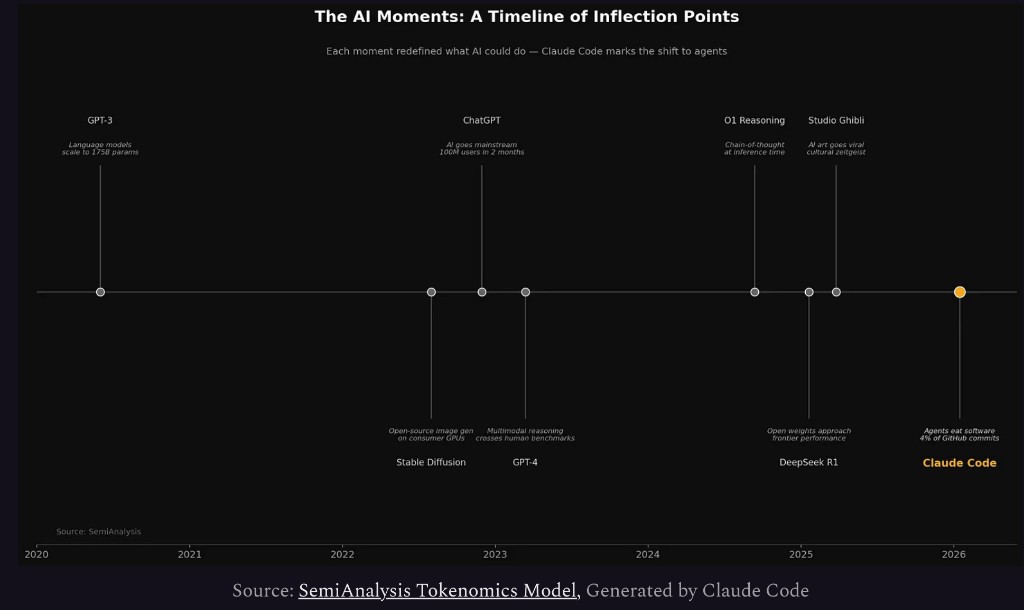
SemiAnalysis points out that we are currently at a new critical point in AI evolution following the ChatGPT moment of 2023. Previous milestones have gradually validated the boundaries of AI: GPT-3 established the effectiveness of scaling, ChatGPT proved terminal market demand, and DeepSeek showcased efficient small-scale implementation paths On top of these linear breakthroughs, Claude Code represents a more fundamental paradigm evolution: it is not merely an enhancement of generation quality, but rather organizes model capabilities into executable complex tasks and continuously interactive digital work entities through an agent architecture. This marks a shift in AI from providing "responses" to delivering "outcomes" in a system context.

What is Claude Code?
Claude Code is a terminal-native AI agent whose design logic transcends traditional IDE enhancement tools or chat assistant models. As a command-line tool, it achieves a paradigm shift from "code generator" to "system-level operational agent" by directly reading code repositories, autonomously planning multi-step tasks, and executing them.
More accurately, Claude Code should be viewed as a "Claude computer," capable of comprehensively perceiving the local environment, formulating dynamic plans, and achieving complex goals through iterative execution, provided it has user authorization. Users only need to describe task objectives in natural language (e.g., "analyze this data table and generate a trend report"), and the system can autonomously complete the entire process from understanding context, breaking down steps, to validating output.
Redefining Software Development, from Writing Code to Ambient Programming
Claude Code is redefining the core profession of programmers: transforming from code writers to task planners. Its fundamental breakthrough lies in engineering feasibility, as it can directly understand developer intentions through the command-line interface, break down complex goals, and autonomously complete the entire process from environmental perception to execution validation.
The magic of Claude Code lies in its effectiveness; many renowned programmers have ultimately embraced a new round of ambient programming and realized that programming has essentially approached a solved problem, better supported by agents than completed by humans.
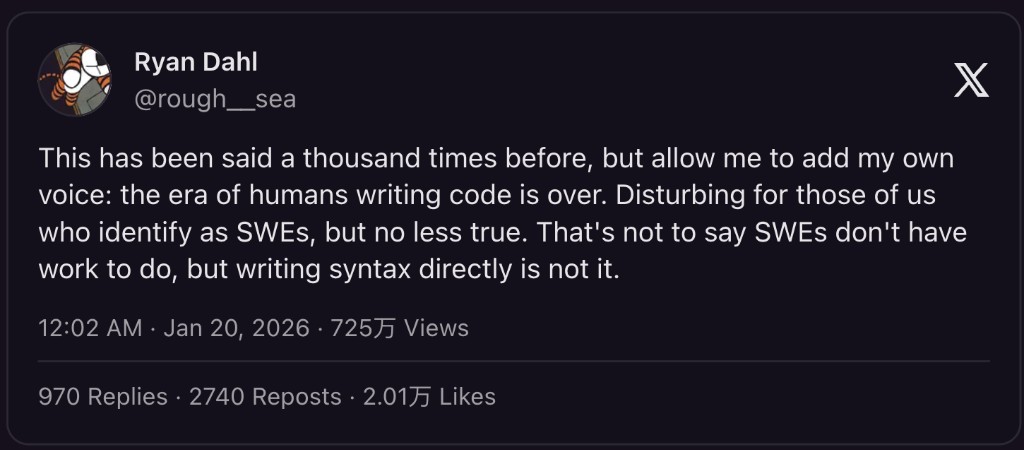
Its influence has penetrated the top technology practitioner community. Andrej Karpathy, a former scientist at OpenAI who coined the term "ambient programming" a year ago, admitted that long-term use of AI coding has led to a gradual decline in his manual programming abilities. Vercel's Chief Technology Officer Malte Ubl stated that his core work has shifted to "correcting AI errors," while NodeJS founder Ryan Dahl bluntly remarked that "the era of humans writing code is over." Tool creator Boris Cherny revealed that nearly 100% of the team's code is completed by Claude Code in conjunction with Opus 4.5, and Linux founder Linus Torvalds has also become an active user of such tools.

Beyond Programming: Comprehensive Automation of Information Work
Analysis indicates that the global market of approximately 1 billion information workers, valued at $15 trillion, is undergoing systemic transformation due to Claude Code, and this is just the beginning.
The value of Claude Code is extending into non-programming fields. According to the SemiAnalysis team, this tool has been systematically applied in hundreds of document reviews, thousands of bill of materials analyses, and real-time predictive model construction scenarios. From regulatory compliance to technical document processing, the paradigm of human-computer interaction is undergoing structural changes.
Claude Code has validated a replicable agent work paradigm: reading unstructured information, applying specialized knowledge, generating structured output, and autonomously verifying results. This "perception-thought-output-verification" process aligns closely with the core aspects of most knowledge work.
Notably, its newly launched general tool "Cowork" further enhances this generalization capability, developed by just four engineers in ten days, and can perform a series of office automation tasks ranging from organizing receipts and classifying documents to drafting reports. This case illustrates that AI agents have evolved from coding-specific tools to programmable general work engines.
Currently, task processing time is a key bottleneck limiting technological penetration. Industry data shows that the doubling cycle for autonomous task processing time has shortened to about four months. From minutes of code generation to hours of module reconstruction, and to days-long audit process automation, each breakthrough in duration will open up a brand new scalable application scenario.
Dramatic Drop in Intelligent Costs Reshaping Business Models
As a benchmark field for information work, software engineering has witnessed a structural reversal in productivity relationships. As the quality of AI code generation crosses critical thresholds, programmers are evolving from direct writers to target definers and black-box tool managers. Behind this shift is not only a breakthrough in technical capabilities but also a fundamental change in economic models.
Currently, the monthly fee for advanced AI tools like Claude Pro is only $20, compared to the total daily cost of $350-500 for knowledge workers in the U.S., making its cost advantage extremely significant. Even if AI agents only complete a small portion of daily tasks, an average daily cost of about $6-7 can achieve a 10-30 times return on investment, providing strong economic motivation for large-scale deployment.
Although a 2025 survey by Stack Overflow shows that 84% of programmers have used AI tools, only 31% have adopted programming agents, indicating that current technological penetration is still in its early stages, with ample room for future growth.
The sharp decline in intelligent costs is systematically reshaping the profit structure of the information industry. The enterprise software industry is at the forefront, as traditional SaaS, relying on data migration costs, workflow lock-in, and integration complexity to build its moat, is gradually being eroded by AI agents. These agents can migrate data across systems, free themselves from reliance on human-friendly workflows, and reduce integration difficulties through standardized protocols. In this context, the SaaS industry's gross margin of up to 75% has become a clear signal attracting the wave of AI replacement
Companies Have Started Taking Action
Analysis indicates that the large-scale cost reduction by intelligent agents has prompted many companies to take action. Marked by Accenture's plan to train 30,000 professionals to deploy Claude Code, the information automation process in key areas such as financial services and life sciences has entered a scaling phase, further confirmed by OpenAI's simultaneous launch of the Frontier enterprise program.
Enterprise software has become the primary target of this round of transformation. The traditional SaaS business model, which relies on data migration costs, workflow habit cultivation, and system integration difficulties to build its moat, is gradually being dismantled by intelligent agent technology. AI agents can achieve cross-system data migration at a lower cost, and their workflows do not depend on human-designed interactive interfaces, significantly lowering integration barriers through protocols like MCP. When intelligent agents can autonomously complete the entire process from database queries, chart generation to report distribution, the traditional software's gross margin of up to 75% instead reflects its vulnerabilities.
From business intelligence analysis to backend reconciliation, from data entry to basic IT operations, any repetitive workflow involving information collection, format conversion, and distribution is within the automation range of AI. This interaction paradigm, which uses natural language as an interface and is task-oriented, not only threatens specific software vendors but also poses a fundamental challenge to the entire software ecosystem built on traditional human-computer interaction paradigms, represented by Microsoft. The efficiency revolution is evolving from technological optimization to industrial value reconstruction.
Microsoft's Dilemma
The fundamental change in cost structure is dismantling the software business model centered on charging per user. Taking the large-scale deployment of Claude Code within SemiAnalysis as an example, the most affected is Microsoft's Office 365 suite.
Microsoft is facing a strategic dilemma: the rapid growth of Azure needs to meet public market expectations, while investing in the Copilot series is a necessary defense to protect the core profit source of Office 365. There is an inherent conflict between the two; breakthroughs in one area may come at the expense of retreating in another. As a major cloud service provider for leading AI companies like OpenAI and Anthropic, Microsoft is effectively supporting disruptive technologies that could undermine its core productivity software moat by renting out computing power.
The latest earnings call vividly presented the tense situation of this strategic tug-of-war. Microsoft admitted that if all newly added GPU resources in the first two quarters of this fiscal year were allocated to Azure, its key growth metrics would exceed 40%. However, the company ultimately chose to prioritize the production capacity and growth of first-party AI products like M365 Copilot and GitHub Copilot.
Interestingly, the current "Claude for Excel" developed by external teams within the Microsoft ecosystem reflects the functionality that Microsoft's own Copilot for Excel was originally supposed to achieve. This reveals a deep-seated contradiction: the company's current cash pillar still comes from Office, while long-term valuation relies more on the growth prospects of Azure To accelerate the latter, Microsoft may have to tacitly allow external innovative forces to continue eroding its traditional moat.**
Despite GitHub Copilot and Office Copilot having nearly a year of first-mover advantage, the pace of product evolution has not formed a significant barrier. In this context, CEO Satya Nadella's personal deep involvement in AI product management, temporarily stepping away from daily CEO responsibilities, clearly indicates: the current competitive landscape of AI products is closely tied to the overall future trajectory of Microsoft.
Growth Drivers of Anthropic
Based on detailed economic modeling of Anthropic, SemiAnalysis quantified its expansion's contribution to the revenues of cloud service providers such as AWS, Google Cloud, and Azure, as well as the capital expenditure pull on the Trainium, TPU, and GPU supply chains. The analysis indicates that over the next three years, Anthropic will deploy computing power comparable to OpenAI, and its growth will be directly constrained by the supply of computing power.
Currently, Anthropic's quarterly annual recurring revenue (ARR) increment has surpassed that of OpenAI, marking a key breakthrough in its commercialization process. This trend suggests that in the second half of the AI race, there is a strong coupling between computing power scale and revenue conversion.

The success of Claude Code essentially reflects the engineering capabilities of the Opus 4.5 model in complex tasks. The current industry's excessive focus on traditional linear benchmarks is gradually losing significance; in long-cycle, multi-step agent tasks, the quality of a single response is not a decisive factor. The competitive focus has shifted from "generating the best answer" to "achieving deliverable outcomes."
In the future, the core metrics for evaluating model effectiveness will gradually transform into task completion rates, system stability, and automation boundaries, with value reflected in end-to-end outputs achieved through tool invocation, memory management, sub-agent coordination, and verification loops, rather than isolated data packet quality. AI competition is shifting from the laboratory track of benchmark testing to the efficiency battlefield of real workflows.
Risk Warning and Disclaimer
The market has risks, and investment requires caution. This article does not constitute personal investment advice and does not take into account individual users' specific investment goals, financial situations, or needs. Users should consider whether any opinions, views, or conclusions in this article align with their specific circumstances. Investment based on this is at one's own risk