Is the layoff data really collapsing? JP Morgan: The data is not as severe as the headlines suggest

JP Morgan pointed out that the recent surge in unemployment claims and high layoff data in the United States are mainly influenced by seasonal factors, extreme weather, and statistical double counting distortions, and do not reflect a fundamental deterioration. For example, Amazon's layoffs were counted multiple times, and the four-week average of continued unemployment claims remains low, indicating that the labor market's resilience still exists. Investors should avoid overinterpreting short-term fluctuations
JP Morgan pointed out that although the latest labor market data appears alarming at the headline level, whether it is the surge in initial jobless claims or the record high in layoff announcements for the same period since 2009, it is actually severely distorted by seasonal factors, extreme weather, and the repeated calculation of statistical measures.
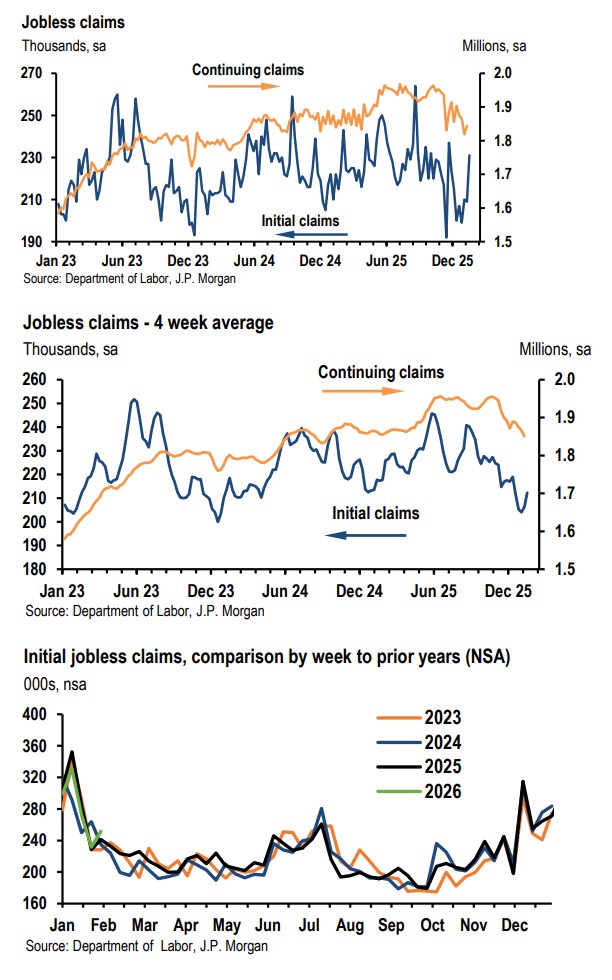
According to the latest published data, for the week ending January 31, the number of initial jobless claims in the United States surged from 209,000 the previous week to 231,000. Excluding the weeks severely distorted by seasonal factors around Thanksgiving, this figure reached its highest level since mid-October last year. This leap will undoubtedly trigger the market's sensitive nerves, but in JP Morgan's view, it is not a cause for excessive concern.

According to the Wind Trading Desk, JP Morgan's North American Economic Research Team analyzed in their latest report released on February 5 that this increase is largely expected. First, the residual seasonal factors suggest that the number of claims should begin to show an upward trend during this period. More critically, short-term disruptive factors come from the weather—“Winter Storm Fern” and the subsequent extreme cold temperatures likely temporarily inflated the number of people applying for unemployment benefits during the statistical week. Such weather-induced fluctuations are usually short-lived and do not represent a fundamental weakness in labor demand.
JP Morgan pointed out that beneath the terrifying headlines created by this series of "noise," the market fundamentals have not actually undergone structural deterioration. Investors should not be misled by the fluctuations in surface data, leading to panic selling decisions, because whether it is the rise in initial jobless claims or layoffs by tech giants, after excluding special factors, the resilience of the U.S. labor market still exists, and the current data cannot be considered conclusive evidence of an impending economic recession.
Continuing Jobless Claims Data Reveals Potential Resilience
The data on continuing jobless claims provides a more robust perspective. For the week ending January 24, the number of continuing jobless claims rose slightly from 1.819 million the previous week to 1.844 million. Although the weekly data fluctuated, JP Morgan still views this as a "good number."
More importantly, the four-week moving average, which smooths out short-term fluctuations, is currently at its lowest level since October 2024. As JP Morgan previously discussed, the decline in continuing jobless claims is a positive signal, indicating that the ability or willingness of the unemployed to re-enter the workforce still exists. Although improvements in this indicator may not immediately translate into a decrease in the unemployment rate, it effectively refutes the narrative that the labor market is rapidly collapsing.
Challenger Layoff Report is Misleading, Layoffs by Giants are Severely Repeated in Calculation
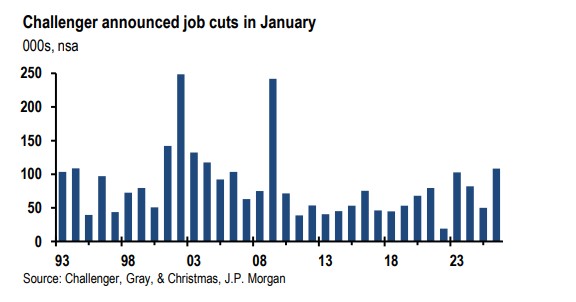
The Challenger layoff report released on the same morning with a shocking headline stated that the number of layoffs announced in January reached 108,000, the highest for the same period since 2009. However, JP Morgan bluntly pointed out that this description of severity is misleading. ** Although this is a fact from a technical statistical perspective, when comparing historical charts, the figures from January this year are closer to those of January in recent years and are far from the situation during the 2009 crisis.

Further breakdown of the data reveals that out of the total layoffs of 108,000 people, 30,000 are from UPS and 16,000 are from Amazon. The layoffs at UPS stem from the company's reduction in transportation services for Amazon, while Amazon's layoffs, although announced, are mainly concentrated among office staff, and some of the lost logistics positions may be replenished later.
More critically, this report is very likely to have "double-counted" Amazon's layoff data. Amazon announced a cumulative layoff target of 30,000 people back in October last year, and at that time, the Challenger report indicated that the tech industry had 33,000 layoffs in October, which likely included most of Amazon's layoffs. Now, counting 16,000 again in January, although this is part of the initial target of 30,000, it is treated as new layoffs. This method of statistical reporting artificially exaggerates the scale of layoffs in January, making the data appear much more severe than the actual situation