


Concerns over AI bubble trigger a wave of sell-offs, with U.S. tech giants losing over $1 trillion in market value in a week
Concerns about the capital returns from AI have triggered severe fluctuations in tech stocks, with major tech giants like Microsoft and NVIDIA losing a total market value of approximately $1.35 trillion over the past week. Investors are questioning whether the annual AI investment of $660 billion by global tech companies can translate into profits, with sentiment shifting from "fear of missing out" to "efficiency scrutiny." Amazon's aggressive capital expenditure plans have heightened market doubts, while Apple's relatively cautious strategy has gained recognition
Concerns about the return on capital for artificial intelligence are causing significant fluctuations in the U.S. tech sector. Over the past week, tech giants such as Microsoft, NVIDIA, Amazon, Alphabet, Meta, and Oracle have collectively lost about $1.35 trillion in market value, primarily due to investors increasingly questioning whether the hundreds of billions of dollars in capital expenditures in this field can translate into actual profits.
On February 6th, according to FactSet data, the aforementioned companies have all shown ongoing capital expansion plans in their recent earnings reports. According to media reports, global tech giants plan to invest approximately $660 billion in AI-related infrastructure this year, a scale that surpasses the GDP of several medium-sized economies. Investors are concerned that the massive investments may hide risks of inefficient investment and overcapacity.
Paul Markham, investment director at GAM Investments, pointed out that the current market is shrouded in an "emotional contagion effect," especially among companies involved in AI hardware and infrastructure, where stock price volatility may continue to intensify. He emphasized:
“The massive capital expenditures required for building large language models, the eventual return cycles, and concerns about potential overcapacity have become structural issues that continuously suppress market sentiment.”
Although some individual stocks saw a slight rebound in pre-market trading on Friday, Amazon still recorded a significant drop of 9% during U.S. trading hours, reflecting a shift in market judgment on the commercialization prospects of AI from optimism to caution. This sell-off, driven by anxiety over capital returns, marks a transition in the AI investment narrative from a phase of scale worship to one of efficiency evaluation. 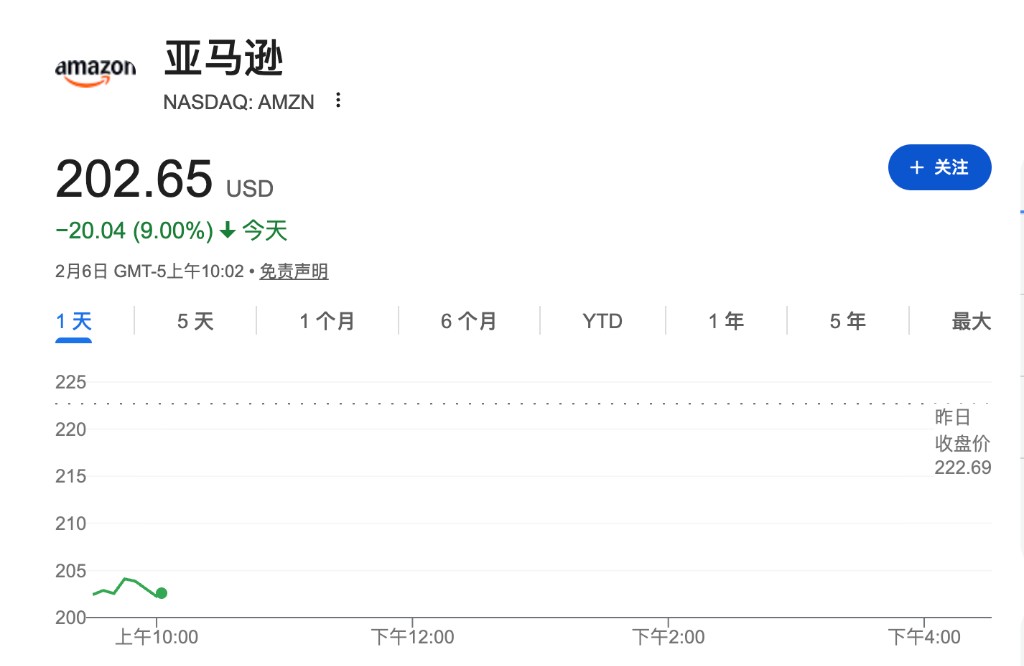
Amazon's Aggressive Bet on AI Cloud Infrastructure, Apple's Cautious Strategy Gains Market Recognition
Amazon has launched the most aggressive capital expenditure plan in the industry this earnings season, with funds primarily directed towards its cloud computing business, AWS. Quilter Cheviot consumer goods analyst Mamta Valechha noted:
“The core focus of the market is Amazon's capital expenditure guidance of up to $200 billion, a 56% year-on-year increase, which not only far exceeds expectations but also ranks first among major cloud service providers.”
She further stated that although management emphasizes the long-term strategic value, the lack of transparency regarding short-term return paths has raised concerns among investors. She said:
“Market sentiment is shifting from ‘fear of missing out on the AI wave’ to ‘scrutinizing the input-output efficiency of every aspect.’”
Unlike other tech giants, Apple's AI capital expenditure is relatively cautious, yet it has recently gained market recognition. Additionally, thanks to the "amazing" demand for the iPhone described by CEO Tim Cook, its stock price has risen 7% since Monday.
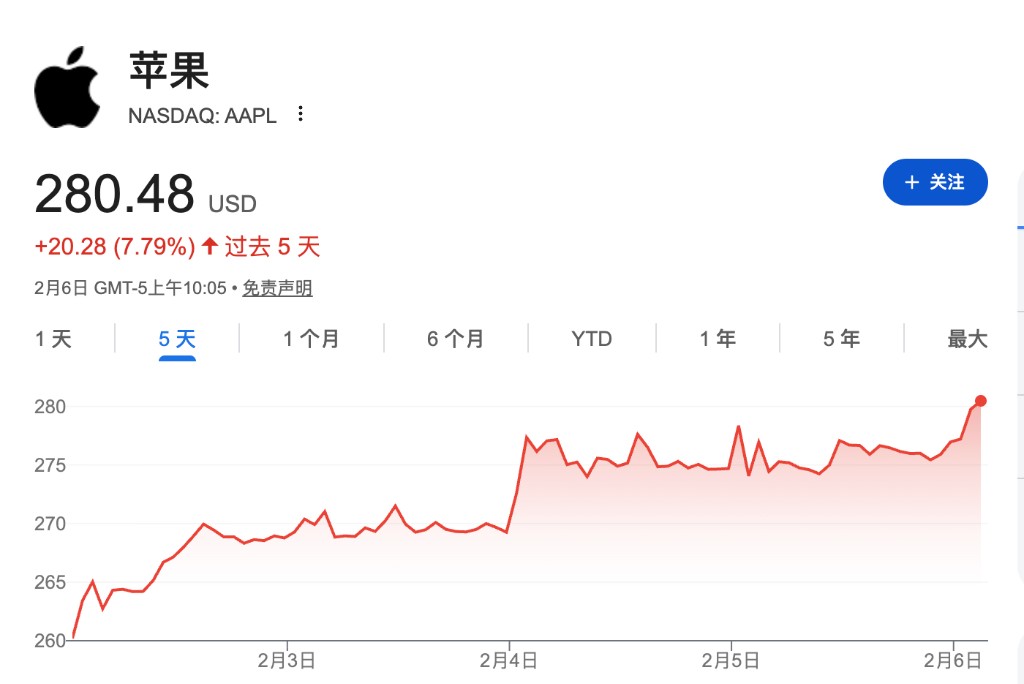 The market is undergoing a systematic reassessment of high capital expenditure models. As concerns deepen regarding the sustainability of capital and return paths in the AI sector, particularly in heavily invested areas such as hardware research and development, the stock prices of related companies are expected to continue to fluctuate and face pressure. Morningstar's Chief Equity Strategist Michael Field pointed out:
"Current investments in tech giants have become polarized, either resulting in excess returns due to AI success or causing massive capital losses due to ineffective investments."
