


After Takamatsu Sōmai's victory, Japan's foreign exchange chief warns of "closely monitoring the yen's movements"
Koshi Semae achieved a historic victory, raising market concerns that aggressive fiscal spending would put pressure on the yen, which briefly fell to 157.66 against 1 US dollar. Japan's foreign exchange authorities emphasized monitoring the market "with a high sense of urgency," while the finance minister stated readiness to communicate with the market at any time and maintain close coordination with US Treasury Secretary Janet Yellen to ensure exchange rate stability
After Japanese Prime Minister Sanae Takaichi's decisive victory in the early election last Sunday, the yen came under pressure again. Senior officials from the Japanese Ministry of Finance quickly released a "high alert" signal, attempting to stabilize the foreign exchange market's pricing expectations for fiscal expansion.
According to Bloomberg, Atsushi Mimura, Japan's Deputy Minister for International Affairs at the Ministry of Finance, stated to reporters on Monday, "As always, we are closely monitoring market movements with a sense of urgency," and mentioned that the government "maintains close communication with the market."
After the election results were announced on Sunday, Japan's Finance Minister Satsuki Katayama said in a television program that she would communicate with the market on Monday if necessary. She reiterated the close contact with U.S. Treasury Secretary Janet Yellen, stating that both sides "share the responsibility of maintaining stability in the dollar-yen exchange rate," and mentioned a memorandum of understanding signed by the two countries that allows for decisive measures in the event of "rapid fluctuations deviating from fundamentals."
On the market side, the yen briefly weakened to 157.66 yen per dollar, before returning to around 157 in Tokyo's morning session. Meanwhile, stock prices and benchmark government bond yields rose, as investors focused on the fiscal policy path with less political resistance following Takaichi's victory.
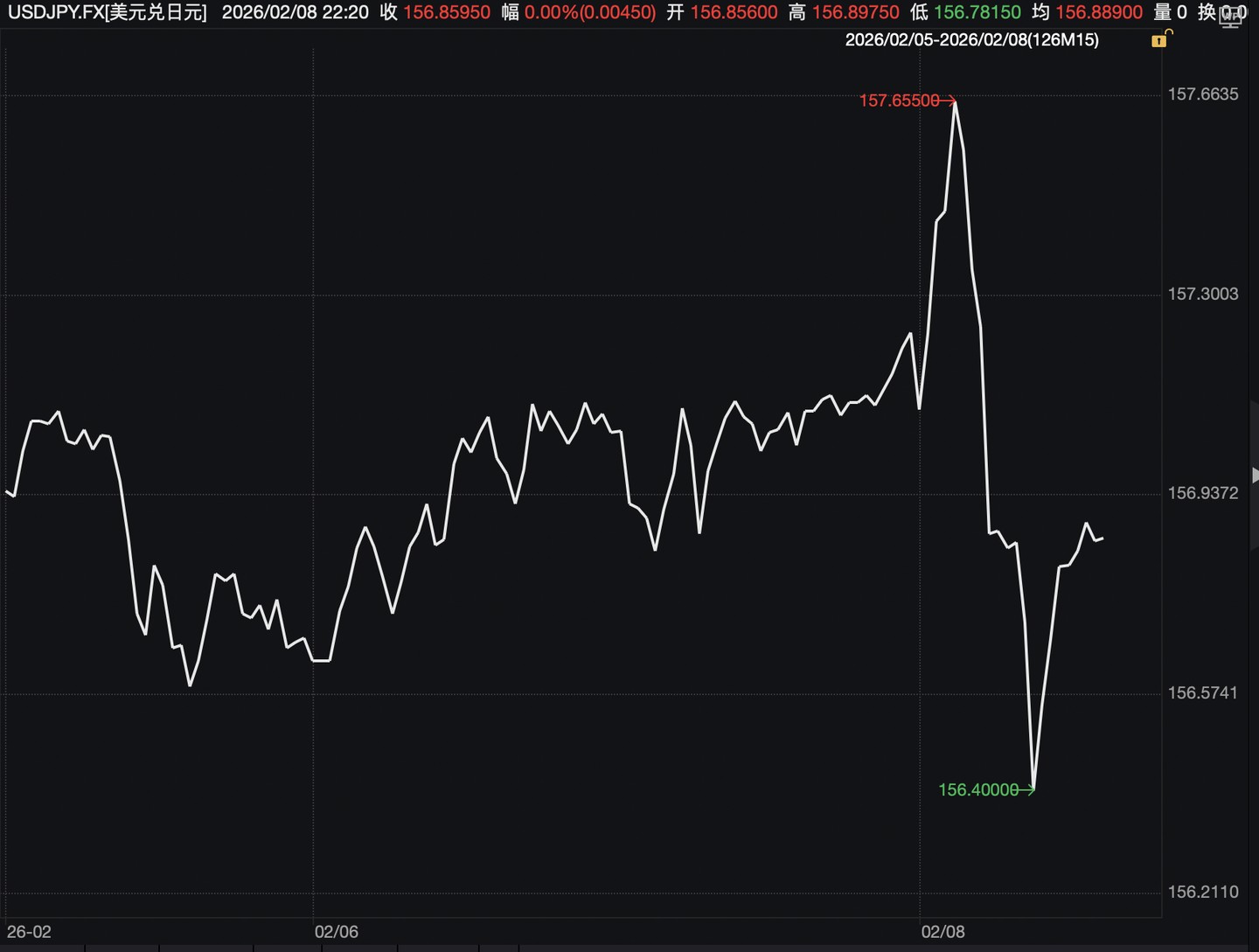
Yen Under Pressure, Market Bets on More Aggressive Fiscal Spending
Bloomberg reported that the direct trigger for the yen's weakness was the change in policy expectations following Takaichi's "clear victory." The market speculates that with a stronger political mandate, she may push for a more aggressive fiscal spending agenda, thereby increasing the pressure for reassessment of Japan's fiscal situation and asset pricing.
The election results showed that the Liberal Democratic Party led by Takaichi secured 316 seats in the 465-seat House of Representatives, marking the largest victory for a single party in a post-war Japanese election. Bloomberg pointed out that this result provides her with the "mandate" to advance several campaign promises, including a "massive spending plan" that has made investors nervous.
In a post-election press conference, Takaichi stated that the government would accelerate discussions on "possibly suspending the food sales tax for two years." This proposal is also seen by the market as one of the signals that exacerbate concerns about fiscal health, putting pressure on the yen and Japanese government bonds.
Official Statements Focus on "Close Communication" and "Intervention in Rapid Fluctuations"
Mimura's remarks continued Japan's official rhetoric framework of "being ready to respond" to the foreign exchange market: emphasizing urgency and the smooth communication channels with the market.
Katayama's statements were more of a "preemptive reassurance and warning." On one hand, she stated that she would communicate with the market if necessary, while on the other hand, she emphasized the existence of the U.S.-Japan memorandum of understanding and clearly pointed out that Japan could take decisive measures, "including intervention," in response to rapid fluctuations deviating from fundamentals.
Against the backdrop of renewed downward pressure on the yen, such statements are typically interpreted by the market as: when the speed and magnitude of fluctuations reach the policy tolerance level, the distance between verbal warnings and actual actions may shorten. **
US-Japan Coordination Becomes a Key Variable, Whether Intervention "Deterrence" Can Work Again Remains to Be Seen
Katayama repeatedly emphasized maintaining close contact with US Treasury Secretary Janet Yellen, and elevated the responsibility of stabilizing the dollar against the yen to a "joint responsibility of both sides," making US-Japan coordination an important variable when the market assesses the policy toolbox.
Bloomberg reported that last month's sharp fluctuations in the yen were initially seen as a possible intervention by Tokyo, but were later mainly confirmed to be triggered by the US's "interest rate check." Meanwhile, concerns in the market about "Washington and Tokyo possibly taking joint action or intervention" had somewhat deterred speculative forces.
However, Bloomberg also pointed out that this "deterrence strategy" may not necessarily work the same way a second time, which means that once the yen shows a new round of weakness, the risk of intervention may rise again, and Katayama's remarks may aim to delay or avoid reaching that point.
Stocks, Bonds, and Currencies Fluctuate in Sync, Investors Focus on Fiscal Sustainability Statements
As the foreign exchange market weakens, the Japanese stock market and benchmark government bond yields are rising, indicating that funds are rapidly reassessing the combined impact of growth, inflation, and fiscal expansion expectations.
In response to external speculation about "proactive fiscal policy," Katayama emphasized during the program that the Kishida government "is very concerned about fiscal sustainability and hopes to maintain it," and stated that they will cautiously observe the financial markets.
For investors, the next direct observation points will be: how fiscal stimulus commitments are implemented, the pace of discussions on tax policy, and whether yen fluctuations further accelerate and trigger stronger policy signals from officials.
