Will tariff transmission and the "January effect" push up the U.S. January CPI?
Wall Street expects that the core CPI in the U.S. for January may rebound to around 0.3% month-on-month due to the "January effect" and tariff transmission, with commodity prices rising due to price adjustments and tariffs. However, the key issue is whether inflation in the service sector will slow down; if it is weaker than seasonal trends, it may alleviate the Federal Reserve's concerns about inflation stickiness. Despite short-term data being subject to interference and upward risks, several institutions believe that if inflation remains below expectations at the beginning of the year, it will strengthen the case for interest rate cuts; in the long term, inflation is expected to gradually decline after peaking in the spring
Wall Street is closely watching the U.S. Consumer Price Index (CPI) for January, which is set to be released this Friday. Several investment banks predict that, influenced by the "January effect" of price resets at the beginning of the year and the transmission of tariff costs, the month-on-month growth rate of core inflation in January may rebound. However, a potential slowdown in service sector inflation could be seen as a positive signal by the Federal Reserve.
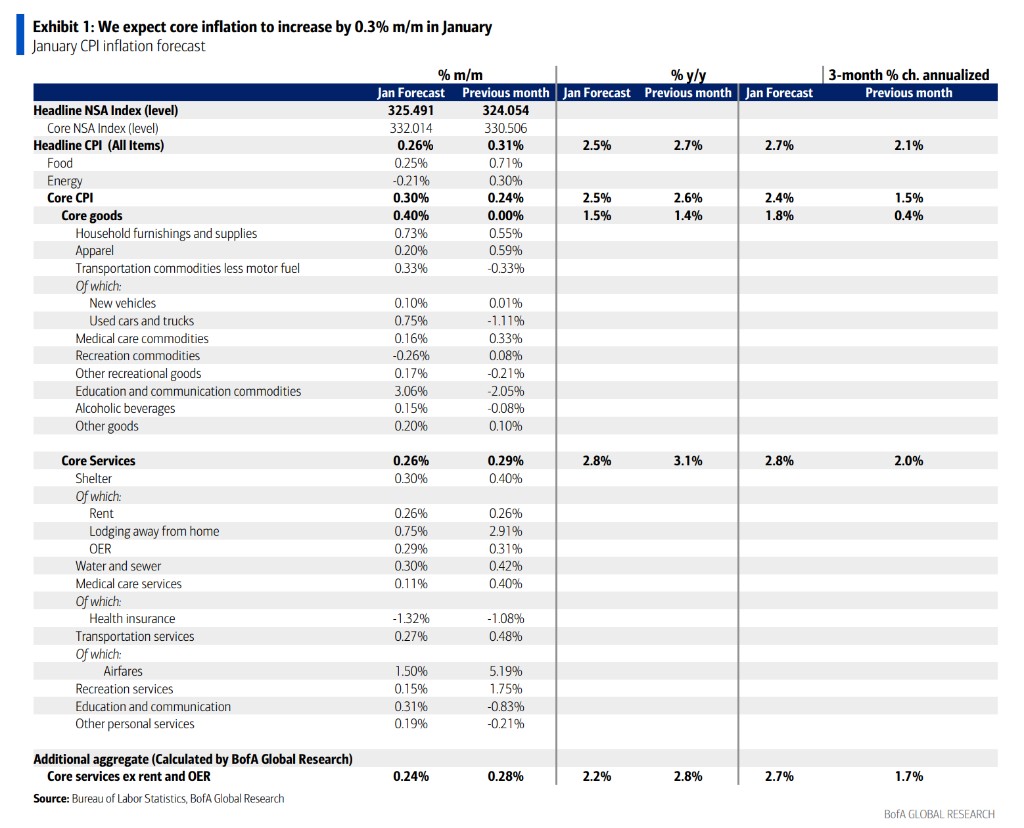
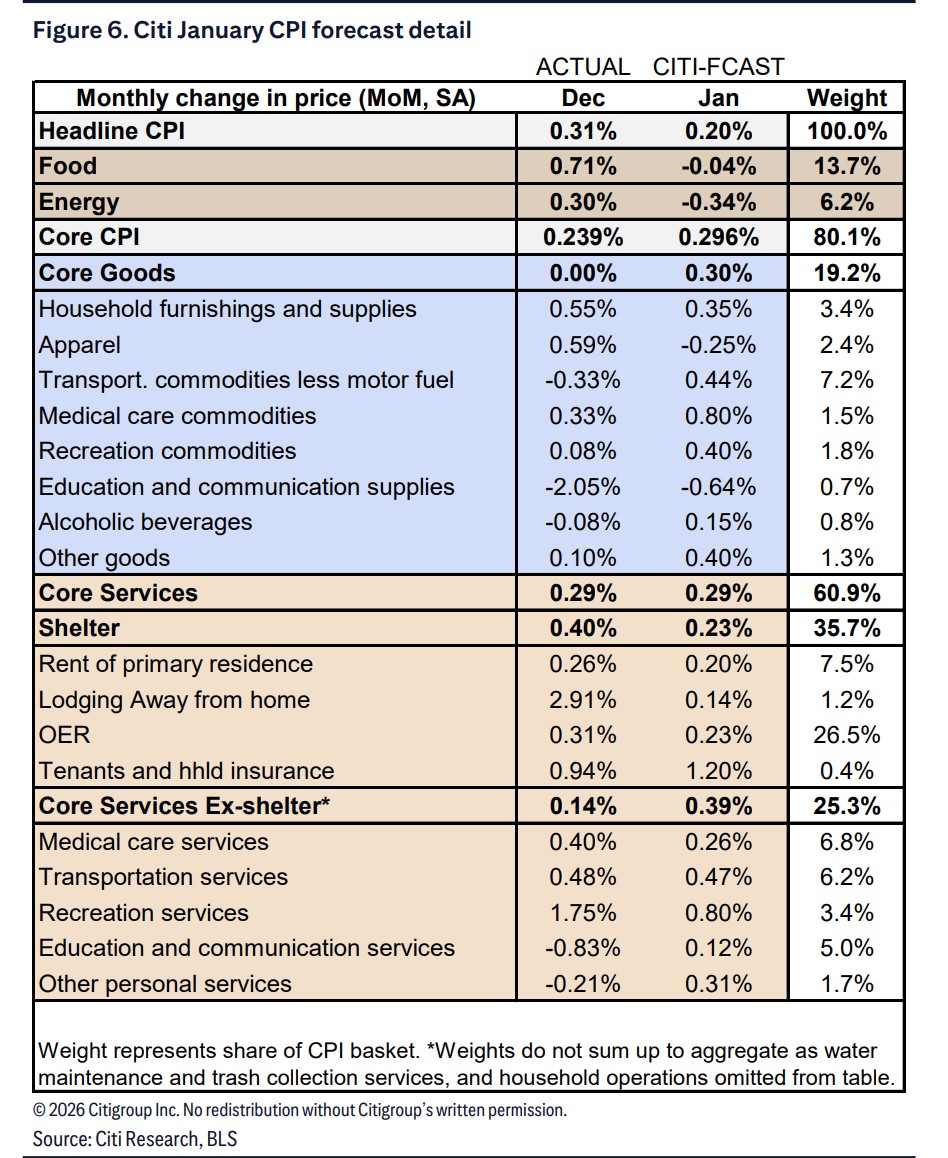
According to Wind Trading Desk, research reports from several major investment banks indicate that market predictions for the month-on-month growth rate of January's core CPI are concentrated around 0.3%. Bank of America and Citigroup both forecast a 0.3% month-on-month increase in January's core CPI, with Bank of America noting that this data reflects an acceleration of inflation at the beginning of the year, while Citigroup believes the data is on the "mild side" of market expectations. In contrast, UBS's forecast is more aggressive, predicting a month-on-month increase in core CPI of up to 0.38%, significantly exceeding the market's general expectation of 0.32%.
The focus of this data is the divergence between commodity prices and service sector inflation. On one hand, the pass-through of tariff costs is pushing up commodity prices; on the other hand, the seasonal strength of service prices is key to assessing inflation stickiness. Bank of America believes that the combination of tariff transmission and the "January effect" will support higher inflation readings. However, Citigroup points out that if the seasonal increase in service prices is weaker than in previous years, it will provide strong evidence for hawkish Federal Reserve officials regarding potential easing of inflation pressures.
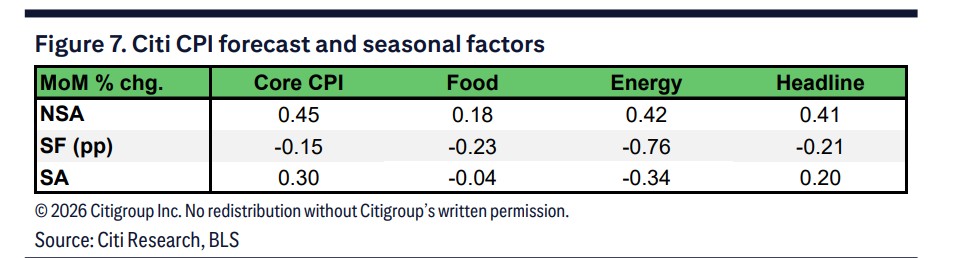
It is worth noting that due to the subsequent impacts related to the government shutdown, there is some uncertainty in the measurement and collection of recent data. Analysts warn that the annual update of seasonal factors and the lagging effects of delayed data collection for the November CPI may exacerbate the volatility of January's data, complicating the market's assessment of the inflation trajectory.
The "January Effect" of Core Inflation and Tariff Clouds
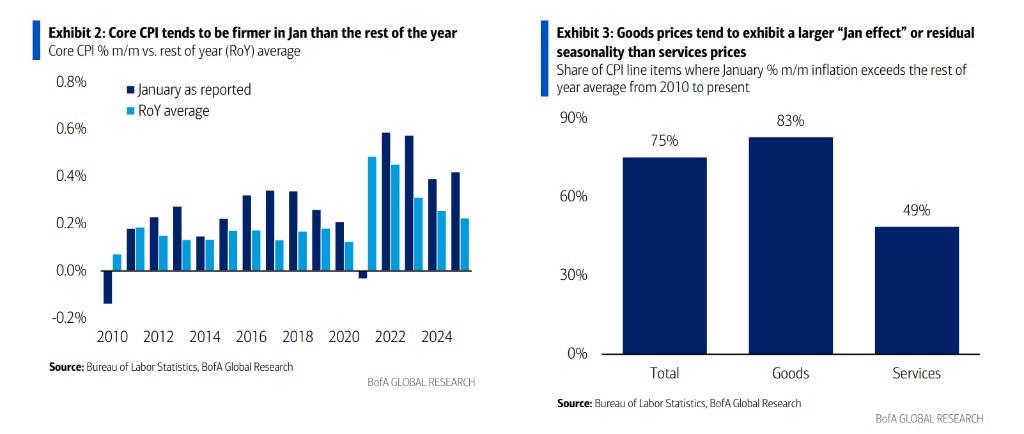
In the outlook for January's CPI, the strengthening of commodity prices is a consensus among several institutions, with the main drivers being the repricing actions of merchants at the beginning of the year (i.e., the "January effect") and the pass-through of tariff costs.
According to Bank of America’s research report, January is typically a month with hotter inflation data, with core commodity prices expected to rise by 0.40% month-on-month (0.35% excluding used cars), a significant acceleration compared to December. The institution points out that this reflects an increase in tariff transmission and the typical trend of price adjustments at the beginning of the year. Citigroup holds a similar view, forecasting a 0.31% increase in core commodity prices, marking the strongest increase since 2023. Citigroup analysts note that subcategories such as furniture (+0.35%), auto parts (+0.75%), and medical goods (+0.8%) will reflect sellers' actions to pass on tariff costs using the price adjustment window at the beginning of the year.
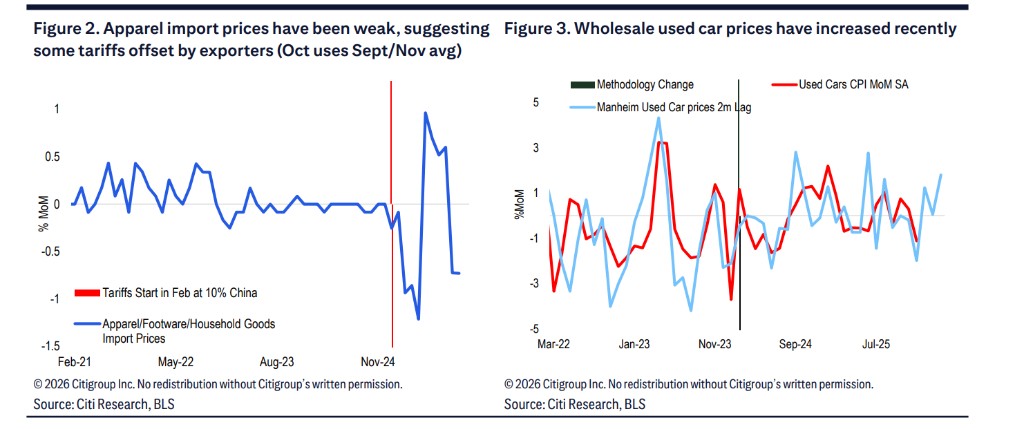
UBS's warning about the upside risks of inflation is the most significant. According to UBS's research report, data from the Adobe Digital Price Index (DPI) and Harvard Pricing Lab show that online commodity prices surged in January. Additionally, UBS emphasizes the measurement-level interference, pointing out that sampling issues caused by the late collection of November CPI data will reverse in January, potentially leading to an upward impact of about 5 basis points on core commodities and airline ticket prices UBS's current model predictions indicate that the month-on-month increase in core CPI may fall within a wide range of 0.28% to 0.56%.
However, Citigroup also mentioned that not all goods are experiencing price increases, as it expects clothing prices to decline by 0.25% month-on-month in January, partly due to falling import prices, suggesting that foreign producers may be helping to offset some tariff costs.
Service Sector Inflation: The Game of Seasonal Factors
Despite upward pressure on goods inflation, there is significant divergence in the trend of service sector inflation, which will ultimately determine the impact of January data on Federal Reserve policy expectations.
Citigroup believes that the key to January data lies in the sustained strength of service sector prices. The institution expects core service sector (excluding housing) prices to rise by 0.39% month-on-month, which, while not low, is significantly below the approximately 0.7% level seen in January over the past two years. Citigroup emphasizes that if the residual seasonal increase in service sector prices is weaker than in previous years, it will indicate that underlying inflation pressures have eased.
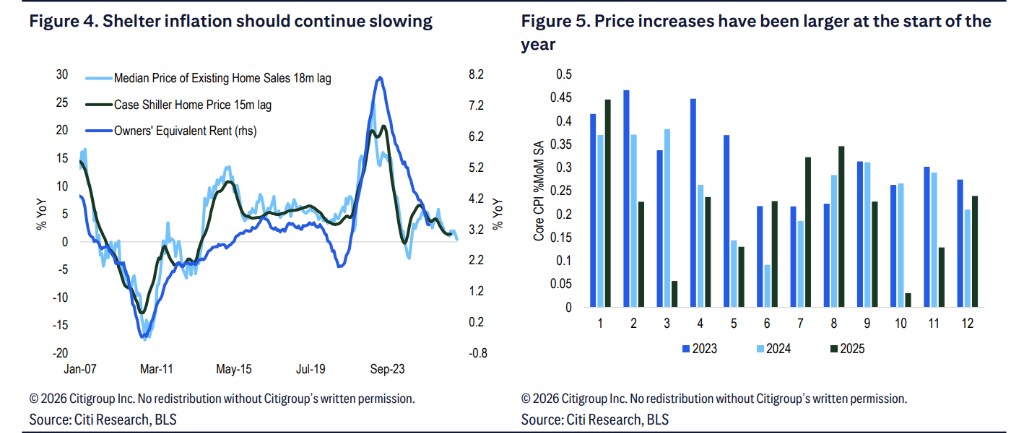
Regarding housing inflation, opinions among institutions are relatively consistent. Citigroup expects housing prices to rise moderately by 0.23%, believing that the core trend of slowing housing inflation has not changed. UBS predicts that Owners' Equivalent Rent (OER) will increase by 0.26%, which is roughly in line with pre-pandemic average levels, indicating that long-term rental trends are slowing.
Bank of America expects service sector inflation to cool slightly compared to December, mainly due to accommodation and airfare prices likely retreating after a strong increase in December. However, UBS warns investors to pay attention to the "noise" in the service sector, pointing out that unusual fluctuations in subcategories (such as a sharp drop in moving and storage services and a surge in video rental services) due to data collection issues in December may see corrective rebounds in January, thereby pushing up readings.
Policy Path and Market Impact
Different investment banks have provided varying interpretations of how the upcoming data will affect the Federal Reserve's policy path.
Bank of America believes that the current inflation situation is in a state of "neither too hot nor too cold." Although inflation has remained above the Federal Reserve's 2% target for the past five years, unless demand-driven inflation clearly accelerates again or inflation expectations spiral out of control, the Federal Reserve's recent stance will still be primarily influenced by labor market data. Based on CPI predictions, the institution estimates that the month-on-month growth rate of core PCE in January will be 0.29%, with the year-on-year growth rate remaining around 3.0%.
 Citi is more optimistic, believing that the data from January and February is crucial for changing the market's perception of inflation stickiness. The institution pointed out that if inflation data can remain below expectations during the seasonally strong early part of the year, it will help persuade hawkish officials that sticky inflation is no longer a major concern. Citi maintains its expectation that the Federal Reserve will cut interest rates by at least 75 basis points this year.
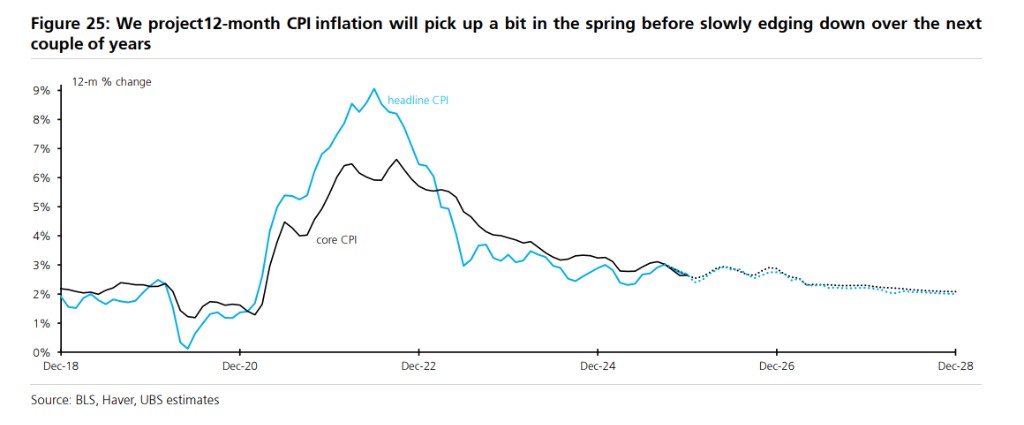
UBS, while predicting short-term data to be on the high side, believes that inflation will peak in the spring and then gradually decline over the next few years. The institution expects the overall CPI year-on-year growth rate in January to drop to 2.41%, although the core CPI year-on-year growth rate may slightly decrease to 2.57%, which is still the lowest level since March 2021.