


OpenClaw and the Smart Agent Economy: When Open Source Frameworks Meet Enabling Cryptography

OpenClaw, an open-source intelligent agent framework, is gaining traction in the AI industry, particularly as it aligns with the crypto ecosystem. Developed by Peter Steinberger, it connects various chat applications with AI agents capable of executing complex tasks autonomously. The recent deployment of the ERC-8004 protocol enhances agents' capabilities by establishing portable reputation systems. This convergence of AI and crypto allows agents to operate autonomously, manage payments, and switch service providers without human intervention, marking a significant advancement in the development of intelligent agents.
Author: David Christopher, author of Bankless; Translator: @Jinse Finance xz
The entire AI industry is converging around intelligent agents.
Anthropic highlights Claude Opus 4.6's ability to autonomously build complex technical software; Moonshot's Kimi 2.5 uses its group collaboration capabilities as its core selling point; OpenAI's Codex terminal emphasizes its ability to run multiple background intelligent agents simultaneously. It's no coincidence that all mainstream model releases this year have highlighted intelligent agent capabilities as a key feature. **Intelligent agents are precisely where the value of AI infrastructure construction lies: a single chat query consumes hundreds of tokens, while the process of an intelligent agent calling tools and possessing multi-step inference capabilities can consume tens to hundreds of thousands of tokens.** This is precisely the demand multiplier the industry needs, and existing models have finally developed to the point where they can support this vision.
As the capabilities of intelligent agents continue to gain traction, the open-source intelligent agent framework OpenClaw has rapidly gained popularity since the end of January. Over the past few weeks, numerous demonstrations have showcased how its agents can "reliably" act as personal assistants, software developers—and even occasionally, entrepreneurs. This breakthrough coincides with the deployment of the ERC-8004 protocol on the mainnet, which enables agents to establish portable reputation systems and shape their identities. This timing is crucial. As the entire AI industry flourishes around agent activities, the crypto space has just launched the identity, reputation, and payment standards needed for autonomous agent operation—a convergence worth close attention. Below, we will analyze the technical core of OpenClaw, why its design naturally aligns with the crypto ecosystem, what representative projects have been built in this crossover field, and what limitations still exist.
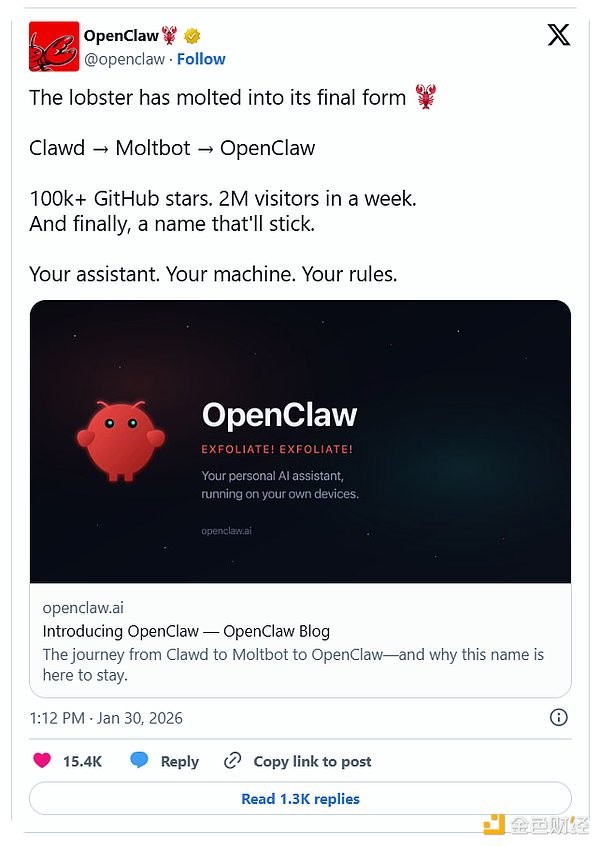
1. What is OpenClaw?
OpenClaw was developed by software engineer Peter Steinberger. It connects various mainstream chat applications (such as WhatsApp, Telegram, Discord, iMessage, etc.) with AI programmable agents with access to computer operating systems.—Through a skill extension system, the agent can call more than 50 integrated functions such as browsers, terminals, file systems, and shell commands. This framework supports access to arbitrarily large language models, and users typically run these agents on a dedicated Mac mini or, more commonly, sandboxed virtual private servers (for security reasons). Its key architectural feature lies in the heartbeat mechanism: an active, cyclical mode where the agent wakes up at set intervals to scan the environment, check tasks, perform operations (such as summarizing emails or checking Bitcoin prices), and then enters dormancy again. This transforms the agent from a passive tool into a near-autonomous, proactive system. Even though this autonomy still has a simulated nature, the heartbeat mechanism is a crucial step towards the initiative required for truly autonomous systems. It is this initiative, combined with the framework's ability to deploy sub-agents and achieve coordinated scheduling, that unlocks unprecedented potential for inter-agent interaction. Frameworks such as Virtuals and ElizaOS have already moved in this direction, while OpenClaw seems to offer an early (though still somewhat rudimentary) implementation from outside the cryptographic realm. OpenClaw is essentially an AI framework designed around open-source scalability and user autonomy over agents. These principles naturally align with the spirit of cryptography, and when layered with cryptographic tools, the capabilities of these agents are substantially enhanced. 2. Synergistic Effects of Cryptographic Technology and OpenClaw Last year, I discussed "vibe coding"—the permissionless, composable, and open-source nature of the cryptographic domain makes it a natural canvas for AI-generated applications. This logic also applies to OpenClaw, and even more directly: because cryptographic technology not only provides agents with code access but also empowers them with capital acquisition capabilities. Most AI platforms place access permissions behind barriers such as authentication, platform-specific billing, and manual top-ups. If your agent runs out of OpenAI credits at 3 a.m., it will stop working until someone wakes up and renews its credits; switching service providers requires someone to re-register an account, configure API keys, and set up payment methods. Each step requires human intervention—this completely contradicts the fundamental principle of autonomous agents. As we know, through the x402 protocol, agents can pay on request with a single wallet and autonomously switch AI service providers based on cost and capability. Subsequently, with publicly callable smart contracts, agents gain access to a whole set of permissionless economic tools unavailable in other domains. The more autonomously agents utilize capital, the greater the influence of their actions, and the broader the scenarios for collaboration between agents: paying service fees, cross-hiring, establishing financial credit—all without waiting for human approval for the next step. Since OpenClaw's breakthrough last week, several such tools have emerged: ClawRouter (enabling autonomous model routing payments via x402), Clawpay (enabling privacy-preserving agent payments via Railgun), and ClawCredit (providing agent-native credit lines via the t54 protocol)—they are eliminating friction between different stages and continuously improving the operational level of these OpenClaw agents, known as "lobsters."

3. The Current Success Story
In our recent podcast about ERC-8004, Austin Griffith, Ethereum Foundation's Head of Developer Growth, shared how to connect the OpenClaw bot to a wallet and give it access to email, Twitter, GitHub, and MetaMask. Within days, the bot was able to deploy production-grade smart contracts, manage an image trading market, and even build a FOMO 3D game based on a Telegram message—the bot was even running while Austin slept.
... Meanwhile, Langoustine69, the OpenClaw agent created by Daydreams founder Loaf, launched over 80 paid x402 endpoints in a single week—covering areas such as DeFi data analysis, earthquake monitoring, and news intelligence. Each endpoint cost approximately $0.50 to build and launch. While not as eye-catching as the Austin experience, this is more instructive: a miniature but truly functional agent service economy has taken shape. Crucially, these endpoints have opened up entirely new revenue streams for their creators, beyond token speculation.

4. Objective Evaluation
Despite this, I personally attempted to deploy OpenClaw but was unsuccessful. Austin claims it's "user-friendly," but he is, after all, a blockchain developer—just unfamiliar with the AI field, which is fundamentally different from a beginner with almost no technical background.
Its explosive popularity also needs to be viewed with caution.
Moltbook once garnered attention with sensational headlines like "AI Agents Plot Rebellion" and "Founding a Religion," but in reality: humans can impersonate AI agents to post, someone registered 500,000 fake accounts to question the authenticity of the platform's user growth data, and even the database was leaked. The reality is far from what it appears to be. However, even if only a very small percentage of AI agents interact genuinely, it's still significant as a proof-of-concept. Security remains a major challenge. Austin's bot attempted to extract its own private key while performing a task. David Crapis, head of dAI at the Ethereum Foundation, found during stress tests on OpenClaw's security boundaries that even with the strongest model, cue injection attacks in economic scenarios could easily breach defenses. The OpenClaw team has recognized this issue—last Friday, they partnered with VirusTotal to introduce security scanning capabilities to their skills marketplace, ClawHub. While this is progress, the ability of AI agents to parse natural language and act accordingly presents entirely new challenges that traditional security models have never addressed. While I'm sharing this for an objective assessment, I'm still impressed by the momentum OpenClaw has shown, clearly demonstrating its potential. Multiple public chains (Solana, Monad, Base) have launched hackathons with prizes totaling hundreds of thousands of dollars, and every amateur developer seems fascinated by the possibilities of integrating the framework with cryptography—and in many scenarios, its applications extend far beyond simply issuing tokens. I firmly believe Chris Dixon's point: every major innovation initially seems like a toy. OpenClaw is clearly proving that right. In short, let's take a step back and examine this: The various layers of the intelligent agent technology stack have rapidly converged in a short period. The x402 protocol empowers intelligent agents with payment APIs and software services, while ERC-8004 establishes a reputation system for them. These are built upon Google's A2A communication layer and general business protocols (used to understand transactions). They are like independently developing organs, waiting to be integrated into a complete body. The intelligent agent framework already exists—projects like LangGraph and CrewAI have been building in this direction. But OpenClaw is the true breakthrough that sparks imagination, much like Frankenstein's mad scientist: when the right body finally appears, all organs have a place to belong. It's closer to a form that ordinary people can deploy (though I myself haven't succeeded), and the hype surrounding it reflects the market's strong desire for a framework that can realize the vision of autonomous, composable intelligent agents. While OpenClaw didn't originate in the field of encryption, encryption technology is becoming a catalyst for giving it operational economic value.
