China's AI War: The "Hundred Models Battle" has ended, and the largest profit pool belongs to the big companies. How will KNOWLEDGE ATLAS and MiniMax break through?

The "Hundred Model War" in China's AI industry is coming to an end, with the real players reduced to 10 companies. The most striking conclusion is that the largest profit pool will belong to major companies like Tencent and Alibaba that control distribution, rather than the model companies. Among independent vendors, KNOWLEDGE ATLAS maintains a high gross margin of 59% through localized deployment, while MiniMax breaks through with 73% of overseas revenue and a full-modal product lineup. Models are no longer scarce; monetization is the key
When models are no longer scarce, what is truly scarce is the ability to turn models into cash flow.
According to news from the Chasing Wind Trading Desk, on February 9th, JP Morgan Securities (China) released a research report titled "China's Artificial Intelligence Industry: Global Layout and Model Innovation Driving a New Generation of Leaders," which is the first to cover China's independent large model manufacturers, KNOWLEDGE ATLAS and MiniMax.
The report states clearly: The Chinese artificial intelligence industry is transitioning from the "hundred model battle" stage to a phase where the ability to commercialize, model innovation strength, and global layout are the key determinants of success or failure. The Chinese AI market is rapidly consolidating, "the number of capable and well-funded model developers has decreased from over 200 to less than 10."
JP Morgan sharply points out that the largest profit pool in the domestic AI industry is likely to flow to platform giants that control distribution; the breakthrough for independent manufacturers depends on who can find survival gaps through "structural neutrality"—KNOWLEDGE ATLAS focuses on deepening high-compliance localized deployment, while MiniMax expands into high-premium global markets.
The background for this judgment is not complex. The report indicates that as the costs of model training, the barriers to obtaining computing power, and the difficulties of commercialization continue to rise, the hard constraints of capital and computing power begin to dominate the industry structure. In other words, the industry no longer rewards "whether one can make models," but rather rewards "whether one can survive long-term."
In JP Morgan's view, the core change in this phase is: model capabilities are gradually converging; capital consumption is rising exponentially; customers are beginning to pay more attention to "delivery capability, stability, and sustainability."
This means that the main line of competition for large models is shifting from a technological race to the ability to build commercial systems.

The "harshest" conclusion: The profit pool may not be in model companies
In the entire report, what is most likely to spark market discussion is not the financial forecasts for KNOWLEDGE ATLAS or MiniMax, but JP Morgan's judgment on profit attribution.
In the section titled "Long-term Profit Pool of China's Generative AI Industry," the report clearly states: The enduring profit pool of generative AI may be highly concentrated in large internet platforms.
"We still believe that the enduring profit pool of domestic generative AI will be highly concentrated in large internet platforms, especially Tencent and Alibaba, as they control nationwide distribution, monetization channels, and high-frequency consumer and merchant transaction flows."
JP Morgan provides very direct reasons.
First, platforms control distribution. The report points out that large internet companies naturally have high-frequency user touchpoints and mature application scenarios, making it easier for AI capabilities to be "internalized as functions" rather than sold as standalone products.
Second, platforms control monetization paths. Whether it is advertising, e-commerce, gaming, content payment, or enterprise services, platforms already have mature charging mechanisms, and AI is more of a tool to enhance ARPU and conversion rates Third, the platform controls high-frequency trading and consumer flow. The report emphasizes, “High-frequency usage scenarios determine the volume of inference calls and whether scale effects are realized.”
The report provides examples of platform reach:
- “WeChat is at the center of daily consumption activities, with a total of approximately 1.4 billion monthly active users.” Tencent has embedded the chatbot “Yuanbao” into WeChat, allowing “users to add it as a contact for interaction without needing to download a separate app.”
- Alibaba has integrated AI into the transaction funnel: “Alibaba has upgraded its Qwen AI application… fully integrating it with Taobao, Alipay, Fliggy, and Amap… AI compresses the funnel from browsing to payment, thereby supporting higher conversion rates and is expected to improve advertising revenue and commission rates.”
Within this framework, the model's capability does not necessarily correspond to profit capability. In the Chinese market, delivering AI capabilities to users and collecting revenue may often be more important than the model itself.
This is also a phrase that JP Morgan repeatedly emphasizes:
“The model's capability does not necessarily translate into profitability; distribution and monetization pathways are particularly critical in the Chinese market.”

Do independent model companies still have opportunities?
Given the dominance of platform giants, where is the survival space for independent model vendors like KNOWLEDGE ATLAS and MiniMax?
JP Morgan does not deny the value of independent model companies, but its judgment is clearly more realistic. The report categorizes industry players into a dual-track competitive landscape: one type consists of comprehensive tech giants with a full-stack ecosystem, while the other type includes independent model developers with leading capabilities in specific dimensions.
In JP Morgan's view, the opportunity for independent model companies lies not in competing head-on with platforms, but in providing a “structurally neutral” option.
The report mentions that the incentive structures of independent model developers are fundamentally different from those of platform companies; their goal is to empower customer applications rather than compete with customers.
“Independent providers typically monetize models directly through APIs, enterprise licensing, or privatized deployment… These channels serve the same fundamental goal—maximizing model adoption and utilization—without requiring customers to bind to a single infrastructure or software ecosystem.”
For large enterprises, adopting platform models often implies potential strategic dependency risks; independent model vendors are more likely to be seen as “tool partners.” JP Morgan emphasizes:
“Independent model providers alleviate these concerns through structural neutrality. Their business incentives depend on empowering customer applications rather than competing with customers, thereby reducing perceived strategic and execution risks.”

KNOWLEDGE ATLAS: Protecting Cash Flow with Private Deployment
Under the analysis framework of JP Morgan, KNOWLEDGE ATLAS is defined as a typical representative of "anchoring on structurally persistent localized business and welcoming a capability-oriented API business turning point."
1. Financial Truth: Localized Deployment is the Current Profit Pillar
KNOWLEDGE ATLAS's business model is clearly divided into two parts: On-premise and Cloud-based deployment.
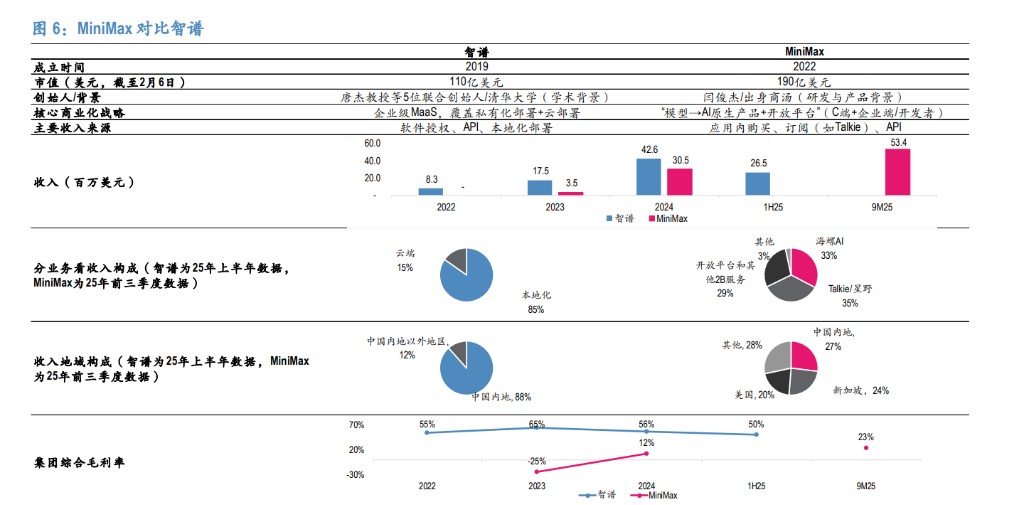
Data shows that KNOWLEDGE ATLAS's current revenue focus is on "high compliance" demands: "In the first half of the 2025 fiscal year, 85% of the company's total revenue comes from localized deployment, with this business segment achieving a substantial gross margin of 59.1%, while the gross margin for cloud-based deployment is -0.4%."
JP Morgan's analysis states that in regulated industries in China (such as government, finance, and state-owned enterprises), localized deployment is typically required.
This is not just a one-time sale. The report points out: "With the iteration of the foundational model, this installation base has the potential to evolve into upgrade-driven, recurring economic benefits." Once the model is embedded in critical workflows, the switching costs are enormous, and continuous model iterations will transform localized deployment into a type of SaaS-like recurring economic benefit.

2. Growth Turning Point: Cloud API is Gearing Up
Although localized deployment earns high gross margins, the future of scaling lies in cloud APIs. JP Morgan believes that KNOWLEDGE ATLAS is at an important turning point.
With the release of GLM-4.7, KNOWLEDGE ATLAS's strategic focus has clearly shifted towards enhancing reasoning in intelligent systems and tools. The report states: "We expect that as GLM-4.7 gains recognition in the global developer community (especially in programming workflows with high willingness to pay and usage intensity), its adoption rate will accelerate."
JP Morgan predicts that as scale effects become apparent, "we expect that from the second half of 2025, both revenue and profit margins from cloud deployment will begin to climb."
3. Valuation and Forecast
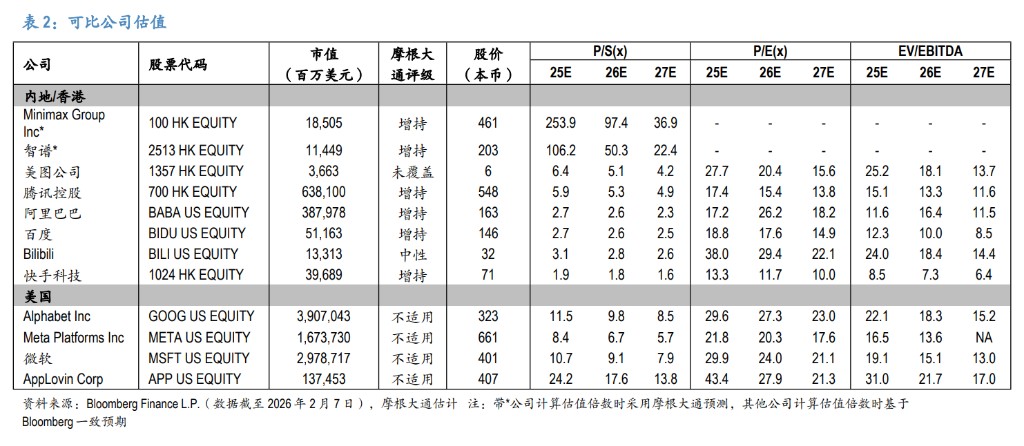
Based on its solid localized foundation and high-growth API potential, JP Morgan gives KNOWLEDGE ATLAS an "Overweight" rating with a target price of HKD 400.
-
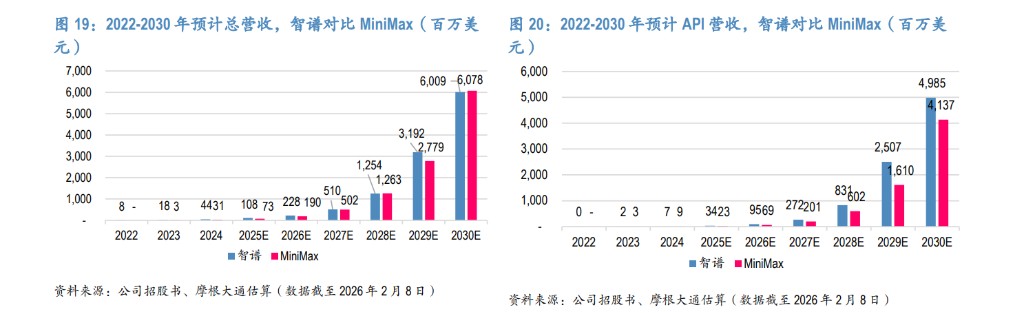
Growth Forecast: Expected compound annual growth rate (CAGR) of revenue from 2026 to 2030 is as high as 127%.
-
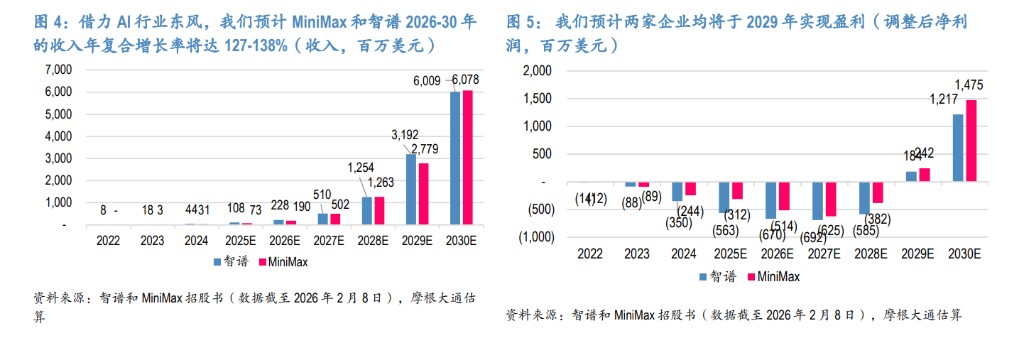
Profit Timeline: The company is expected to achieve profitability by 2029, with a normalized adjusted net profit margin of 20% in 2030.
-
Financing Needs: The company is expected to require external financing in 2026 and 2027, with an estimated annual financing amount of RMB 5 billion.

MiniMax: Running Beyond Capability Boundaries with Global ToC
If ZhiPu is a model deeply rooted in the domestic B-end, MiniMax is described by JP Morgan as "a full-spectrum AI enterprise with a scalable growth engine," its core labels are "inherently global" and "multi-modal."
1. Revenue Structure: Over 70% from Overseas, Business Divided into Three Parts
MiniMax exhibits a revenue profile that is distinctly different from other domestic vendors.
The report disclosed an astonishing figure: "In the first nine months of 2025, 73% of the company's total revenue came from markets outside China, with deployments in over 200 countries and regions."
This global layout brings significant economic flexibility. JP Morgan pointed out: "In an industry context where reasoning costs are high and domestic competition is fierce, entering international markets, a diversified customer base, and a differentiated pricing environment provide the company with structural advantages."
In terms of business composition, MiniMax has well-balanced risks: "In the first three quarters of 2025, revenue from the open platform, generative media, and AI companionship business each accounted for about one-third."
-
AI Companionship (Talkie/Xingye): Contributes 35% of revenue. JP Morgan expects that by 2030, the paid rate for this business will reach 18% (comparable to Tencent Music's level in 2023), with an annual ARPU of $31.
-
Generative Media (Hailuo AI): Contributes 33% of revenue. Provides video tools for content creators, with an annual ARPU as high as $75.
-
Open Platform (API): Contributes 29% of revenue. Serves 132,000 developers, with an annualized ARPU for paid users reaching $8,200.

2. Technical Strategy: Technology is Product
MiniMax's technical strategy is summarized as "full-stack" and "multi-modal." The report notes that MiniMax adopts a mixture of experts (MoE) architecture, with an extremely fast iteration speed: "Model iterations every two months (faster than the industry average of 3-4 months)."
This speed is attributed to its unique "dual-engine" strategy: using consumer applications as validators of technology.
"Unlike many AI labs that first build models and then search for use cases, MiniMax develops models and consumer products simultaneously... With millions of users interacting with Talkie every day, MiniMax receives real-time feedback... This proprietary interaction data is fed back into the R&D process for model fine-tuning."
3. Valuation and Forecast
Given its rare global capabilities, JP Morgan gives MiniMax an "overweight" rating with a target price of HKD 700.
-
Growth Forecast: Expected revenue CAGR from 2026 to 2030 is as high as 138%
-
Profit Timeline: The company is expected to achieve profitability starting in 2029, with the adjusted net profit margin normalizing to 24% in 2030.
-
Financing Needs: The group is expected to require external financing in 2026 and 2027, with an estimated amount of USD 700 million per year.
A Decisive Variable: Inference Costs
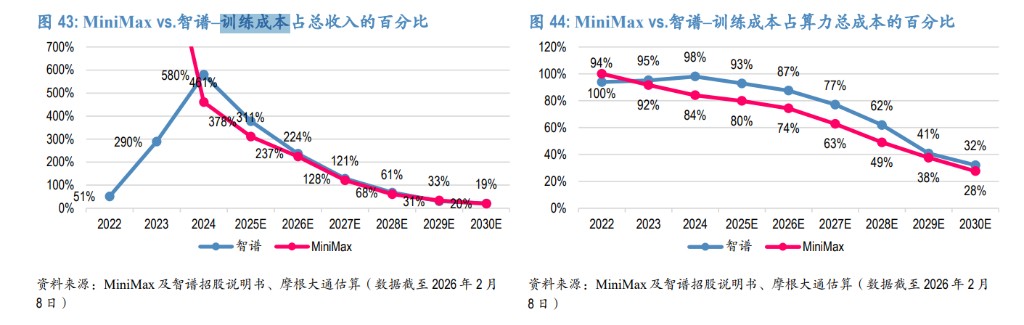
In an in-depth analysis of the two companies, JP Morgan revealed a financial turning point common to the industry, which is crucial for understanding the long-term value of AI companies: The cost structure of computing power will shift from "training-driven" to "inference-driven."
The report pointed out that while total computing power consumption will continue to expand, the "growth curves and cost drivers of training and inference will differ significantly from the expansion phase of 2022-2025."

1. Training Costs: Moving Towards "Normalization"
With the establishment of foundational model architectures, frontier expansion pre-training will become more selective. JP Morgan predicts:
-
KNOWLEDGE ATLAS: The percentage of training costs in total computing power costs will sharply decline from 93% in 2025 to 32% in 2030.
-
MiniMax: The percentage will decrease from 80% to 28% during the same period.
This means that the past "arms race" spending, which pursued parameter scale regardless of cost, will come to an end, and R&D spending will enter a more rational "normalization phase."
2. Inference Costs: Becoming the Absolute Majority of Spending
Future competition will be a competition of inference efficiency. JP Morgan predicts:
-
KNOWLEDGE ATLAS: The proportion of inference-related computing power costs will surge from 7% in 2025 to 68% in 2030.
-
MiniMax: The proportion will increase from 20% to 72% during the same period.
This change has profound implications for financial models: computing power expenditures will gradually shift from "R&D expenses" to "cost of goods sold (COGS)." This also explains why JP Morgan emphasizes the decisive role of API pricing, inference efficiency (duration of GPU calls), and utilization on gross margins.
This means that the core of future competition will no longer be "who can train a larger model," but rather: who can infer more cheaply; who has higher utilization; who can master pricing power.
In JP Morgan's view, the value of KNOWLEDGE ATLAS and MiniMax lies not in challenging platforms, but in occupying an indispensable position outside the platform.
The above content is from [Chasing Wind Trading Platform](https://mp.weixin.qq.com/s/uua05g5qk-N2J7h91pyqxQ)
For more detailed interpretations, including real-time analysis and frontline research, please join the【 [Chasing Wind Trading Platform ▪ Annual Membership](https://wallstreetcn.com/shop/item/1000309)】
[](https://wallstreetcn.com/shop/item/1000309)