When POP MART squeezes out the "bubble" - from "super IP establishment" to "global evergreen"

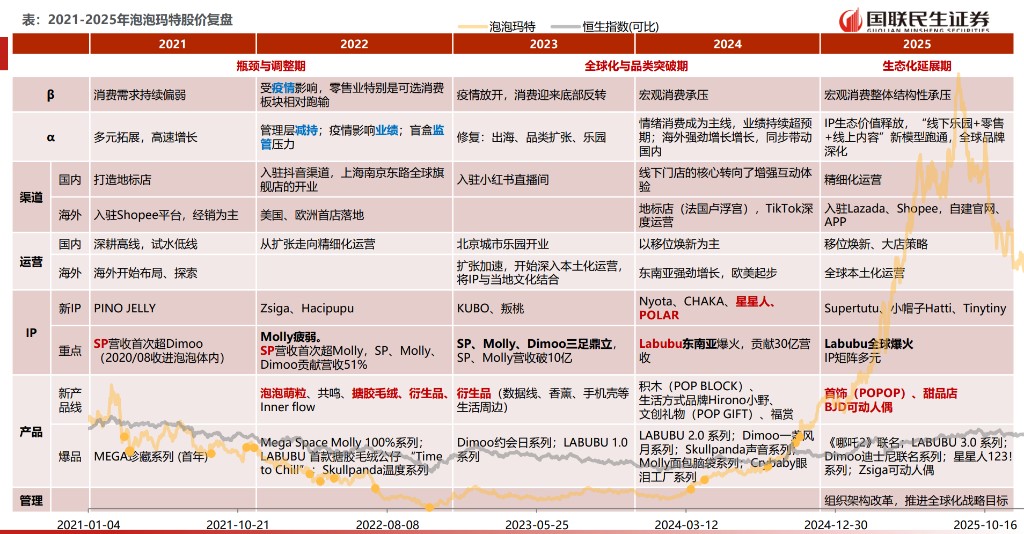
Guolian Securities pointed out that POP MART has surpassed the "blind box bubble" stage and is establishing a sustainable IP ecosystem through the Labubu family and new IP matrices like Star People. Its core strategy is global expansion (especially clustering stores in North America) and extending the industrial chain (entering high-frequency consumption scenarios such as baking and jewelry), driving the company to transform from a "super IP" to a Disney-style global evergreen IP group. By 2026, revenue is expected to exceed 51 billion yuan, marking a complete switch in its valuation logic
Standing at the time node of 2026, investors must abandon their past stereotypes of Pop Mart as merely a "blind box bubble."
On February 10, Guolian Minsheng Securities' research report pointed out that the market's perception of the company is undergoing a qualitative leap: evolving from a simple "blind box company" to a "global IP full industry chain group." For investors, the most core impact lies in the complete switch of the valuation system—the company is no longer just a retail channel provider but has the potential to benchmark against international IP giants like Disney and Sanrio.
The report predicts that by 2026, the company's total revenue will exceed 51 billion yuan, with adjusted net profit reaching 18 billion yuan. The logic behind this performance explosion is not short-term speculation but is based on proactive supply chain management, deep penetration into the North American market, and substantial expansion of IP monetization boundaries. Based on the growth elasticity and global scarcity of IP, the report assigns a 23 times PE for 2026, corresponding to a target market value of up to 414 billion yuan.

The Truth Behind Labubu's Declining Popularity: Healthy Cleansing and Familial Moat
The market's concerns about the recent decline in core IP Labubu's popularity on Google Trends and North American social media have been defined by the research report as a "healthy cleansing" rather than a signal of collapse. This is fundamentally different from the previous "Dou Dou Wa" bubble. The decline in Labubu's popularity is the result of the company's proactive management, aimed at squeezing out the inflated bubble in the secondary market through refined tiered supply. Data shows that in the second half of 2025, the company's plush production capacity increased tenfold year-on-year, with August capacity exceeding 30 million units. This supply-side optimization successfully guided prices back to rationality, laying the foundation for long-term healthy growth.
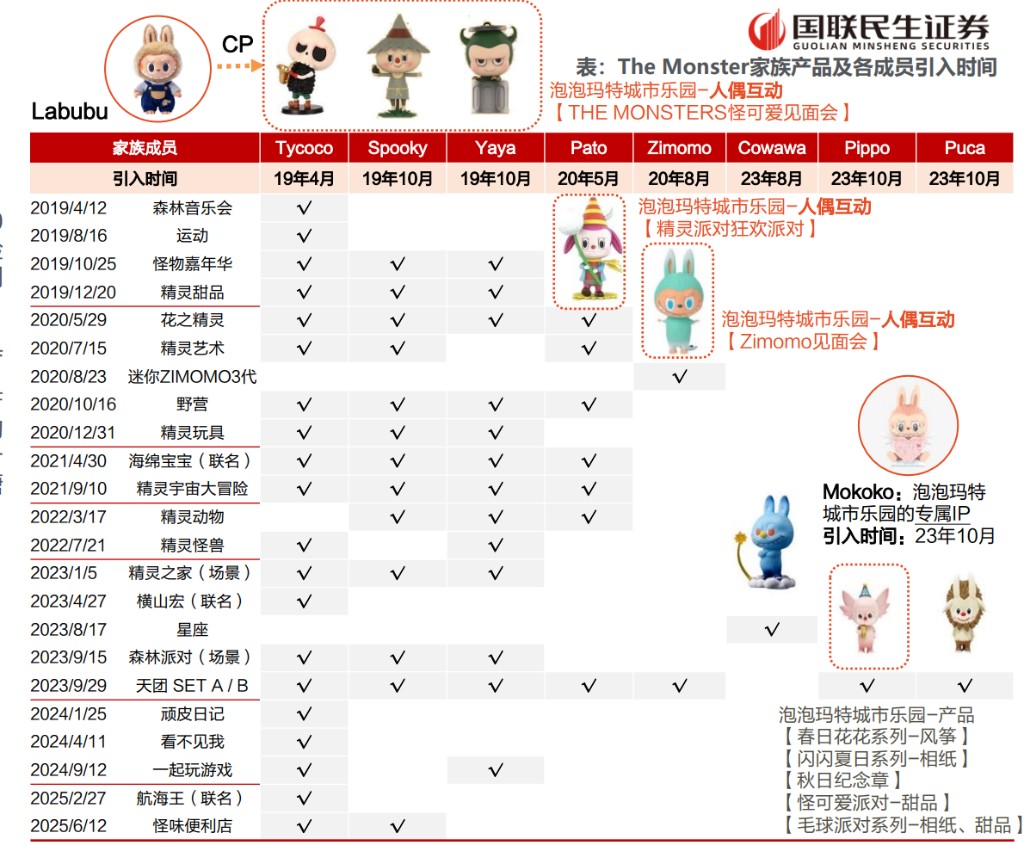
More critically, Labubu's lifecycle is being extended through a "familial strategy." Benchmarking against the Duffy family at Tokyo Disneyland, Pop Mart is constructing an IP universe by introducing characters like ZIMOMO and MOKOKO. In January 2026, the company launched THE MONSTERS' tenth-anniversary products covering ten IP family members, proving its ability to enhance customer value through multi-character penetration. Currently, even after the popularity adjustment, Labubu's search index is still five times that of KAWS and on par with Doraemon, marking its smooth transition from a "phenomenal hot product" to a "global evergreen IP."

Verification of Industrialized Star-Making Ability: Star People Taking Over and IP Tier Iteration
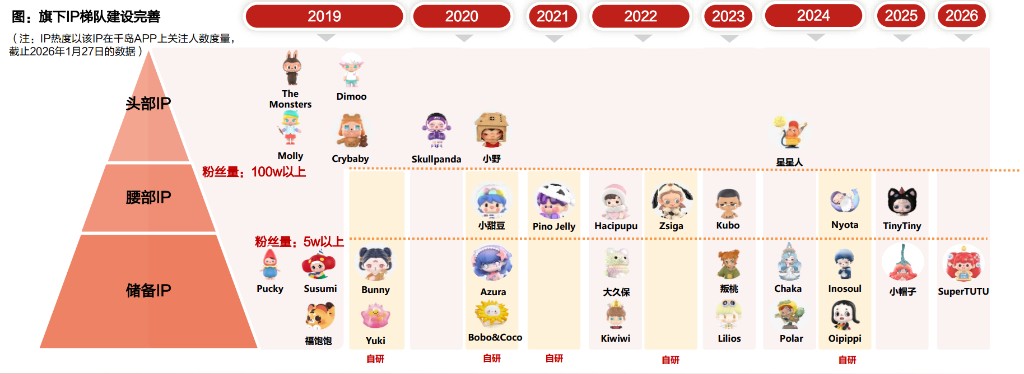
The investors' concerns about the "one-man show" issue have been addressed, as the company has established a replicable industrialized IP incubation system.
In addition to the leading IPs, the new IP tier is performing strongly, especially with the addition of "Star People," which has only been around for a year. Unlike Labubu, which relies on social driving, Star People has rapidly risen through "healing" emotional resonance and strong channel push (such as prominent store displays) Data shows that in just the first half of 2025, the revenue from the Xingxingren IP reached 390 million RMB. This proves that POP MART has the capability to mass-produce medium-sized IPs, forming a complementary matrix with Labubu, ensuring the continuous iteration of product tiers and performance relay.

Breakthrough in the North American Market: From Single Store Trials to Cluster Operations
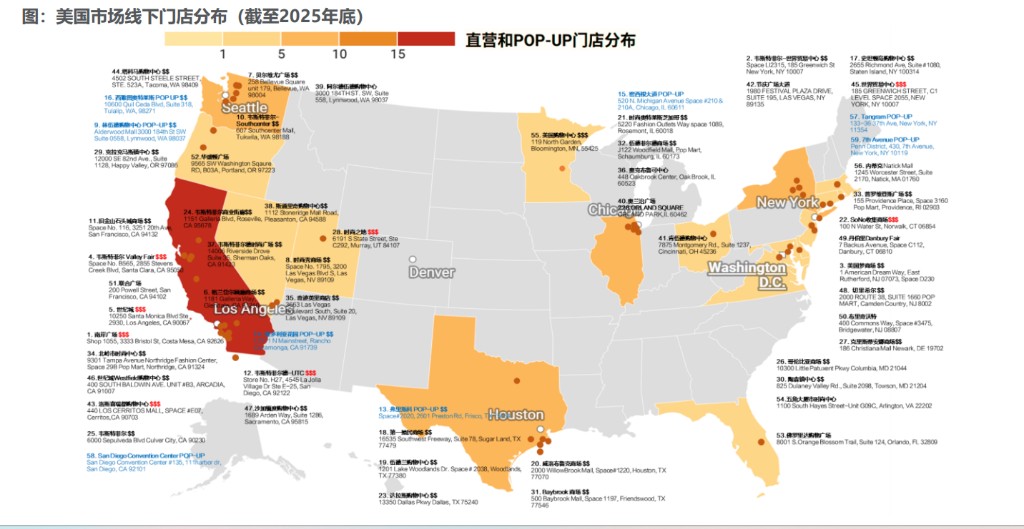
The North American market is becoming a new growth engine for the company, with its expansion strategy shifting from initial single-point trials to a mature "cluster layout." Research reports indicate that POP MART has adopted a site selection logic similar to that of Apple and Pandora in North America, estimating long-term store space to be between 270 and 550 locations. The current layout shows significant strategic intent, such as intensive store openings in Houston and Florida, forming regional penetration.

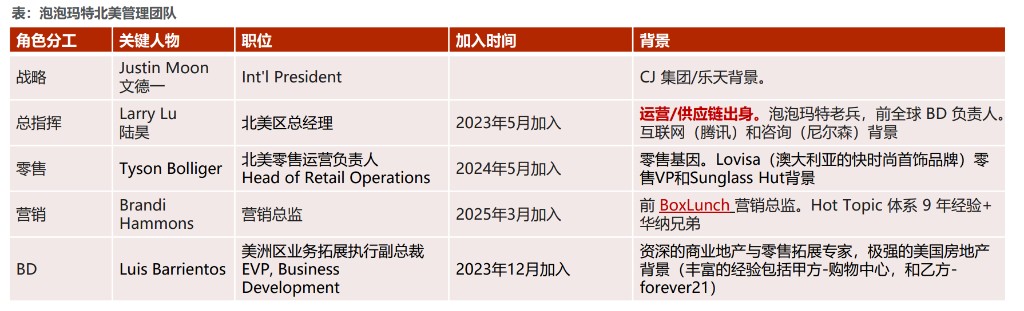
The localization of the management team is the core guarantee for the implementation of this strategy. The company has brought in Justin Moon, who has a background with CJ Group and Lotte, as well as local executives with retail experience from Lovisa and Sunglass Hut, building an organization with strong retail genes. Through a three-dimensional network of "flagship stores + core stores + channel stores," combined with a plan to double the number of stores by 2026, the North American market is expected to contribute 13.5 billion RMB in revenue by 2026, becoming a key engine driving global growth.

Europe and New Business: Cultural Output and High-Frequency Consumption Scenario Construction
The expansion in the European market focuses more on establishing brand tone and cultural output. In the first half of 2025, revenue from Europe and other regions grew by as much as 729% year-on-year, reaching 478 million RMB. The company has adopted a strategy of binding with artistic landmarks such as the Louvre and Pompidou, and by establishing its European headquarters in London, it radiates to core markets like France and Italy. Future plans include adding seven stores in the UK, including a flagship store on Oxford Street, and expanding 20 stores across Europe to further enhance market coverage density.

At the same time, the company is extending IP monetization into higher frequency and higher unit price areas through two new business lines: POP BAKERY (desserts) and POPOP (jewelry). POP BAKERY enters daily social scenarios with pricing ranging from 39 to 199 yuan, while POPOP enhances brand value with affordable luxury jewelry priced between 249 and 2699 yuan. These new businesses not only enrich the consumption experience of the IP but also further explore the lifecycle value of 50 million members through synergy with the main business.
In summary, the research report holds a highly optimistic view on POP MART's performance growth in 2026. It is expected that the company's total revenue will reach 51 billion yuan in 2026, with an adjusted net profit of 18 billion yuan, a year-on-year increase of 22%. This growth comes not only from the improved sales per unit area brought by the renovation of stores in China but also from explosive growth in overseas markets—overseas revenue is expected to reach 25 billion yuan in 2026, almost accounting for half of the total. With the deepening of global layout and the maturation of new businesses, POP MART is completing a magnificent transformation from a trendy toy company to a global IP business empire.