


Evaluation surpasses Google and NVIDIA! Alibaba releases RynnBrain robot large model: enabling robots to have a "thinking brain"
On February 10th, Alibaba launched the robotic AI foundation model RynnBrain, aimed at empowering robots with perception, decision-making, and execution capabilities. This model surpassed mainstream models from Google and NVIDIA in multiple evaluations, possessing spatiotemporal memory and reasoning abilities, and maintaining work continuity across multiple tasks. RynnBrain's open-source strategy will promote the standardization and industrial implementation of robotic technology, showcasing Alibaba's ongoing investment in the AI field
On February 10, Alibaba officially launched the robotic AI foundation model RynnBrain. This open-source model aims to endow robots with perception, decision-making, and execution capabilities, promoting their autonomous task completion in real-world scenarios.
RynnBrain is independently developed by Alibaba's Damo Academy and possesses core capabilities such as environmental interaction, spatiotemporal understanding, and task decomposition planning. This model can assist robots in object recognition and localization, motion trajectory prediction, and achieve precise navigation and autonomous operation in dynamic and complex environments like kitchens and factory assembly lines.
According to the testing data released by Alibaba, RynnBrain has performed outstandingly in several authoritative evaluations, surpassing mainstream industry models such as Google Gemini Robotics-ER 1.5 and NVIDIA Cosmos-Reason2. This model has set new records (SOTA) in 16 embodied open-source evaluation rankings.
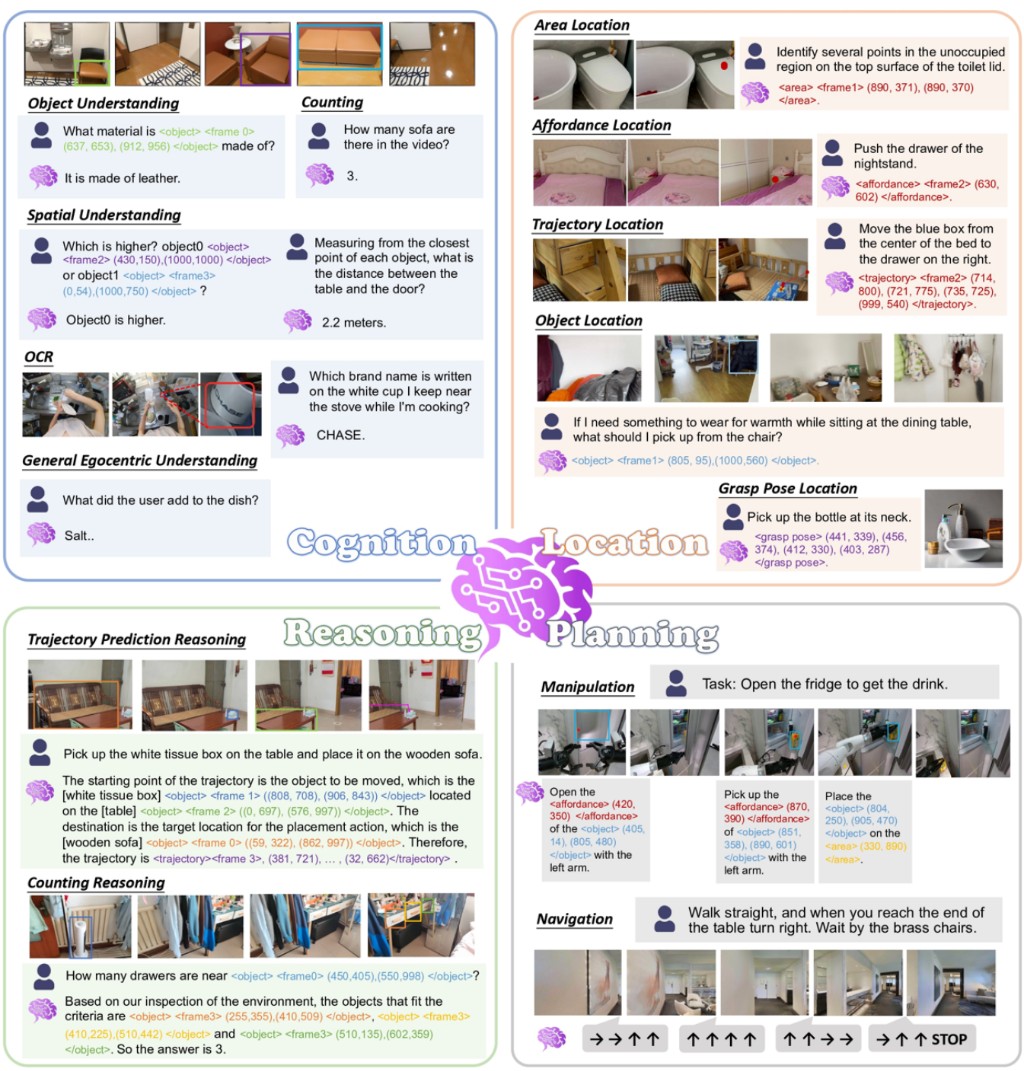
Currently, robotic technology is becoming a key track in global technological competition and industrial transformation, with cutting-edge directions such as humanoid robots being viewed as important drivers for reshaping the manufacturing and service industry ecosystem. Alibaba's release of a foundational model with "thinking brain" attributes not only reflects its continuous investment in core AI technology but also demonstrates a clear path for promoting technological standardization and industrial implementation.
Breakthroughs in Spatiotemporal Memory and Reasoning Capabilities
The core technological breakthrough of RynnBrain lies in its integration of spatiotemporal memory and spatial reasoning capabilities into robotic systems for the first time. By embedding these two key abilities into the model architecture, robots can maintain continuity and consistency in their working state while executing multiple tasks.
In practical applications, if a robot equipped with this model is interrupted while performing Task A and redirected to Task B, it can accurately remember the spatiotemporal nodes and execution progress of Task A, autonomously resuming the previously interrupted workflow after completing Task B.
This model integrates multidimensional capabilities such as environmental cognition, precise positioning, logical reasoning, and task planning, and demonstrates strong scalability. Based on the RynnBrain foundational framework, developers only need to use hundreds of data points for fine-tuning to efficiently train specialized models suitable for navigation, planning, and motion control in different scenarios.
Full Series Open Source Strategy
Damo Academy has open-sourced all seven models in the RynnBrain series, covering various specifications from a 2 billion parameter version to a 30B mixture of experts (MoE) architecture. This series is trained based on the Qwen3-VL visual language model and is available on platforms such as Hugging Face and GitHub.
Among them, the industry's first 30B embodied model using MoE architecture aims to enhance the fluidity and responsiveness of robotic movements. To standardize evaluation criteria, Damo Academy has simultaneously released a new evaluation benchmark RynnBrain-Bench, focusing on spatiotemporal fine-grained task assessments, filling the current industry's evaluation gap in this field. **
Zhao Deli, head of the Embodied Intelligence Laboratory at Damo Academy, stated:
"RynnBrain has achieved a deep understanding and reliable planning of the physical world for the first time, marking a key step towards general embodied intelligence under the hierarchical architecture of the brain and cerebellum. We look forward to it accelerating the process of AI transitioning from the digital world to real physical scenarios."
Accelerating the Industrialization of Embodied Intelligence Layout
Chinese technology companies continue to increase their open-source investments in the field of artificial intelligence, forming a technology development path characterized by open collaboration. In cutting-edge areas such as embodied intelligence, open-source strategies help gather global developer resources, accelerating technological iteration and ecosystem building.
Robotics technology is seen as a key area for driving industrial upgrades. At the policy level, intelligent robots, including humanoid robots, have been clearly identified as a key development direction, aiming to reshape the operational models of manufacturing and service industries through technological innovation.
Damo Academy continues to promote technological openness in this field, having successively open-sourced several embodied intelligence models, including WorldVLA, which integrates world models and visual language models, and RynnEC, an environmental understanding model. It has also released the industry's first robot context protocol, RynnRCP, dedicated to building deployable, scalable, and continuously evolving embodied intelligence systems.
Risk Warning and Disclaimer
The market has risks, and investment should be cautious. This article does not constitute personal investment advice and does not take into account the specific investment goals, financial conditions, or needs of individual users. Users should consider whether any opinions, views, or conclusions in this article align with their specific circumstances. Investment based on this is at one's own risk
