Robinhood's fourth-quarter profit fell by 34%, with sluggish cryptocurrency dragging down revenue, dropping over 6% in after-hours trading | Earnings Report Insights

Wallstreetcn
2026.02.11 00:22
portai
I'm PortAI, I can summarize articles.

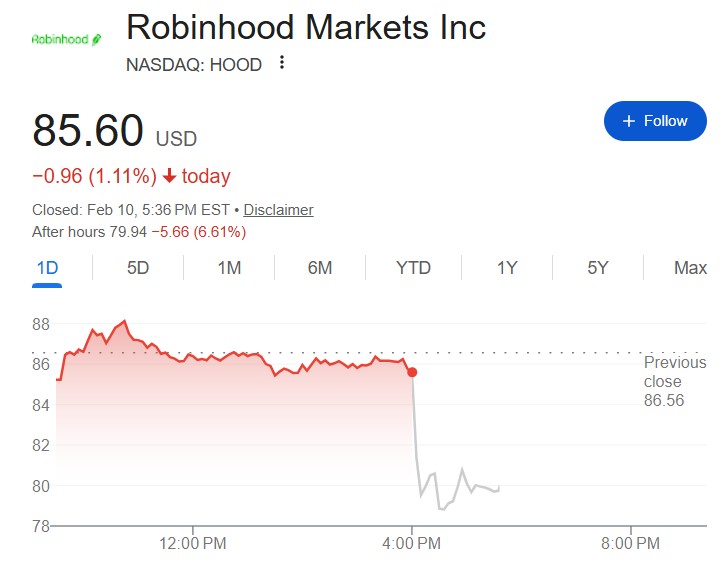
Robinhood's net profit in the fourth quarter fell 34% to $605 million, with total revenue of $1.28 billion missing Wall Street expectations. Revenue from cryptocurrency trading plummeted 38% to $221 million, becoming the biggest drag. The company's stock price has already dropped 24% this year and continued to decline by 6.6% in after-hours trading

Robinhood's net profit in the fourth quarter plummeted significantly, although it slightly exceeded analysts' expectations, but total revenue falling short of expectations raised concerns among investors.

On Tuesday, February 10, after the U.S. stock market closed, Robinhood announced that its net profit for the fourth quarter decreased by 34% year-on-year to $605 million, or $0.66 per share, slightly above the average analyst expectation of $0.64 according to a Bloomberg survey. However, total revenue of $1.28 billion did not meet Wall Street's expectation of $1.34 billion.

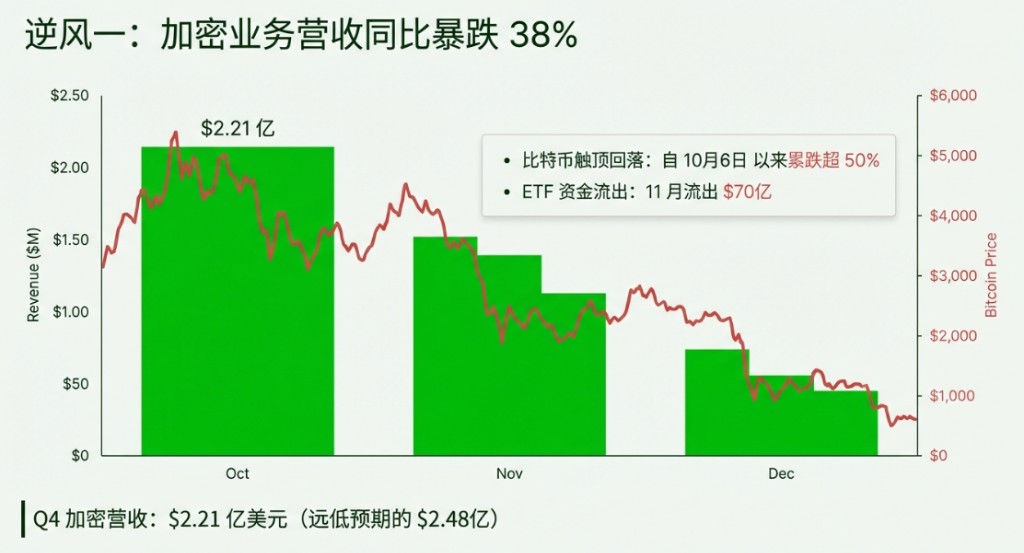
Revenue from cryptocurrency trading plummeted by 38% year-on-year to $221 million, far below analysts' expectations of $248 million. Bitcoin has already fallen over 50% since peaking on October 6 last year. As a result, Robinhood's stock price has dropped 24% this year, continuing to decline by 6.6% in after-hours trading.

The performance announcement comes at a time when U.S. brokerage firms are generally under pressure. Although individual investors remain an important force supporting the stock market, the continued volatility of digital assets is testing these platforms' diversification capabilities. For Robinhood, whose stock price tripled last year, whether it can maintain growth momentum by 2026 has become a focal point for the market.

Significant Shrinkage in Crypto Business

The weakness in digital asset trading has become the biggest drag on this quarter's performance.

Revenue from cryptocurrency trading plummeted from $357 million in the same period last year to $221 million, a decline of 38%. This performance not only fell short of market expectations but also reflects the difficulties facing the entire cryptocurrency market.

Bitcoin began its sharp decline in early last year's fourth quarter, dropping nearly 30% from its peak on October 6, and further declining about 20% after the end of the year. Analysts at Deutsche Bank noted in a report to clients that the U.S. spot Bitcoin ETF recorded a net outflow of about $2 billion in December last year, with outflows reaching $7 billion in November.

Chief Financial Officer Shiv Verma explained in a media interview that active traders enjoy the lowest pricing tier due to high trading volumes, resulting in the company's rebate rate being lower than expected. Verma just took over as CFO last week.

Prediction Market Becomes Growth Highlight

Despite the shrinkage in the crypto business, the prediction market performed strongly in the fourth quarter.

After launching its prediction market business at the end of 2024, Robinhood traded over 12 billion event contracts on its platform last year, with a record 8.5 billion contracts traded in the fourth quarter.

This emerging business provides additional growth momentum for the company. The prediction market allows consumers to bet on outcomes based on events, including various categories such as sports events.

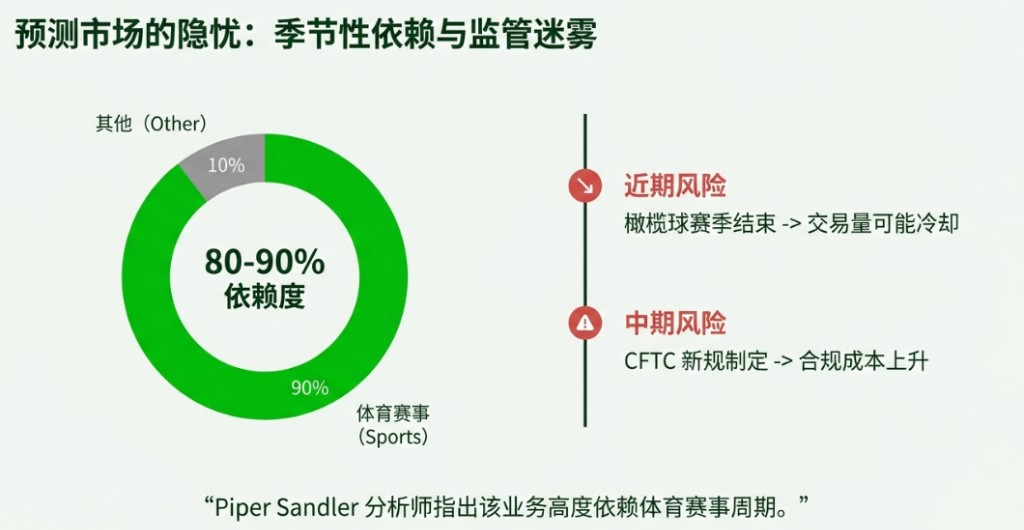
However, analysts at Piper Sandler estimate that sports events account for 80% to 90% of Robinhood's prediction market trading volume, which means the end of the football season may temporarily cool this business.

In the fourth quarter, Robinhood announced a partnership with Susquehanna International Group to acquire a majority stake in the derivatives exchange LedgerX The announcement of this transaction came before the U.S. Commodity Futures Trading Commission announced plans to establish new rules for this multi-billion dollar prediction market industry.

Traditional Trading Business Shows Resilience

The traditional trading business demonstrated resilience in the fourth quarter.

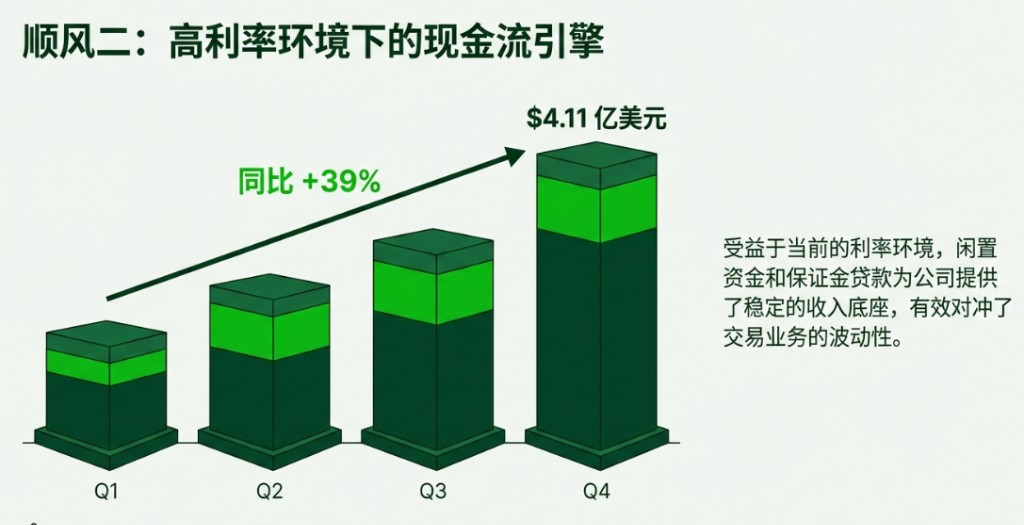
Trading revenue grew 15% to $776 million, with stock trading revenue surging 54% and options trading increasing by 41%. Net interest income rose 39% year-over-year to $411 million, benefiting from the interest rate environment.

Retail investors continue to be a significant force supporting the stock market, actively buying amid concerns over the AI bubble and market sell-offs triggered by geopolitical turmoil. This has provided support for Robinhood's core brokerage business.

The company's Gold subscription user base grew 58% year-over-year to 4.2 million, allowing these users to utilize AI-driven investment assistants for trading advice and order placement. This growth indicates that the company's efforts to expand into wealth management and banking services are making progress.

Diversification Strategy to Address Challenges

In the face of uncertainty in 2026, CEO Vlad Tenev previously stated that the company's goal is to create a "financial super app" that meets all customer needs on a single platform.

Verma emphasized in a media interview that the company's business structure is robust enough to handle market fluctuations. He stated:

The most important thing is to maintain diversification; if you focus on input, the output will naturally be resolved.

However, the company still faces multiple challenges. The Federal Reserve's rate-cutting cycle may erode interest income, the timing of a recovery in the cryptocurrency market remains unclear, and there is uncertainty regarding the regulatory outlook for prediction market businesses.

After tripling in stock price last year, Robinhood's stock has fallen about 24% this year, as the market reassesses its growth prospects