"The AI War" cannot afford to lose! What does it mean for the market if the US stock market's Mag 7 burns its cash flow into negative this year?

Wallstreetcn
2026.02.11 01:29
portai
I'm PortAI, I can summarize articles.

The $740 billion AI capital expenditure in 2026 is expected to grow by about 70% year-on-year, consuming the operating cash flow of major U.S. tech giants. Except for Microsoft, other companies may see their free cash flow turn negative. AI-related debt accounts for about 14% of the U.S. IG bond market, with funds shifting from equity market premiums to the bond market. As cash flow and financing pressures intensify, the market's tolerance for error decreases. Once the pace of returns slows down, risks will spread to a broader range of assets

As the AI capital expenditures of Silicon Valley giants swell to nearly the scale of their annual cash flow, the market's concern has shifted from "Is it worth it?" to "Can it sustain it?"

According to the latest publicly available data, the combined capital expenditure guidance for the four major cloud providers—Google, Amazon, Microsoft, and Meta—for 2026 is approximately $650 billion.

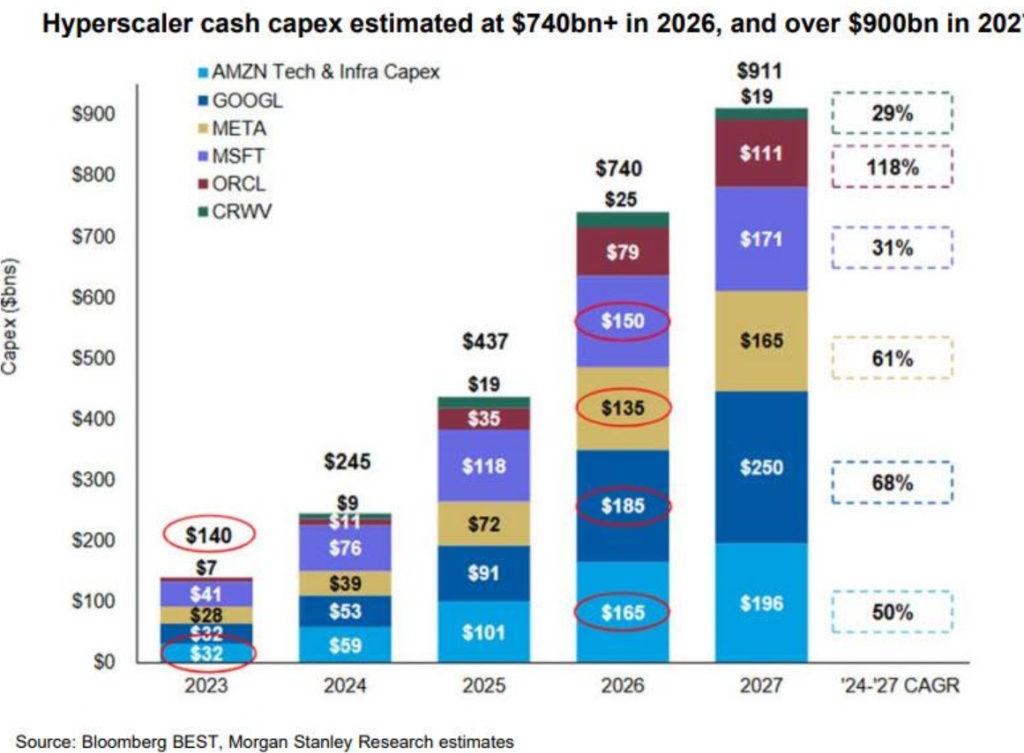
When including Oracle and CoreWeave, the total scale rises to $740 billion.

These figures not only exceed market expectations but also represent a multiple deviation. What does $740 billion mean?

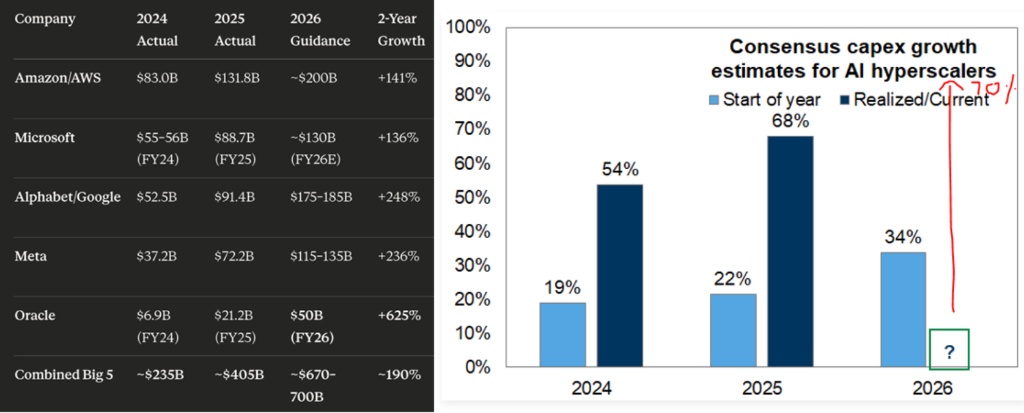
  • $740 billion represents a year-on-year growth of approximately 70% compared to 2025;

  • It is twice the market consensus expectation at the end of 2025 (approximately 35% capital expenditure growth);

  • $740 billion is close to the total annual operating cash flow of the entire hyperscale cloud provider system.

  • More concerning is that: Goldman Sachs analyst Shreeti Kapa pointed out that if this level is reached, the intensity of such spending will approach the 1.4% of GDP level seen at the peak of the internet bubble in the 1990s. Although still lower than the intensity during the Industrial Revolution, it is rare in modern technological history.

The well-known financial blog ZeroHedge analyzed:

"These numbers are so large that we immediately joked at the time that after using all free cash flow to pay for capital expenditures, the Mag 7 would simply be unable to afford any stock buybacks in 2026 (or even longer)."

What truly shakes the market is not that a single company "spent more money," but rather that the capital expenditures of the entire hyperscale cloud provider system are simultaneously out of control. This is not a normal capital expenditure adjustment, but a structural leap.

Cash Flow is Being "Devoured" by AI

Not having enough money for stock buybacks—this no longer seems like a joke, but a reality that is happening.

Goldman Sachs estimates that if capital expenditures reach the $700 billion level in 2026, this figure will almost equal the total operating cash flow of the hyperscale cloud providers.

Bank of America, in a more detailed model, concluded:

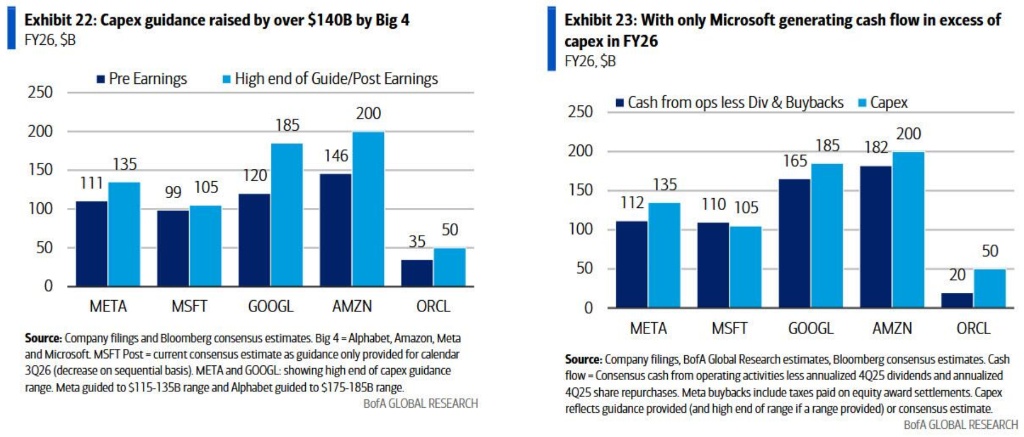
  • Microsoft's Loneliness: In 2026, only Microsoft is expected to have operating cash flow that can still cover capital expenditures.

  • Meta's Turning Point: Meta has already hinted that it may transition from "net debt neutral" to "net positive debt" at some point

  • Other Companies: Even if buybacks are completely halted, free cash flow will be exhausted.

Bank of America wrote in its report:

"Except for Microsoft, even if stock buybacks are not conducted or are slowed down in the fourth quarter, the cash flow surplus of other companies will significantly shrink."

This means that if capital expenditures continue to rise, cash balances will decline rapidly, debt financing will be inevitable. And this will become a major issue.

AI Evolving into a Debt Bubble: Related Debt Accounts for About 14% of the U.S. IG Bond Market

As internal cash flow is insufficient to cover expenditures, tech giants are forced to enter the bond market on a large scale.

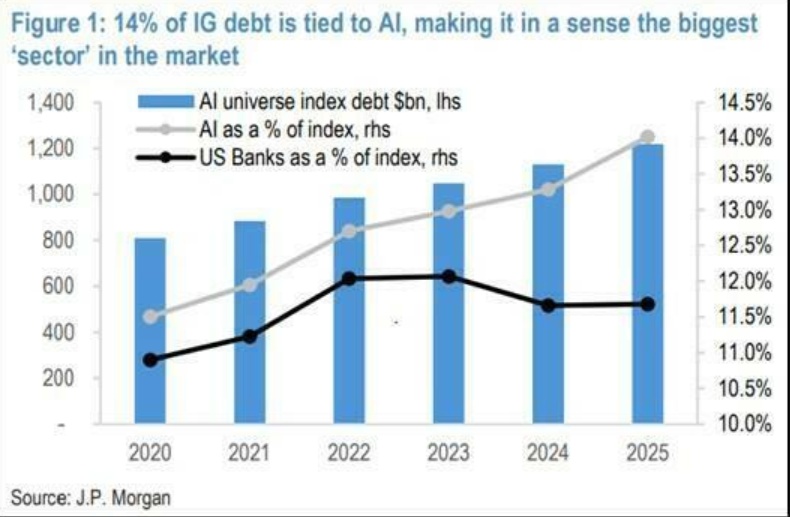
Months ago, ZeroHedge warned: "AI is now also a debt bubble, quietly surpassing all banks to become the largest sector in the market."

Bloomberg wrote in the latest issue of "Credit Weekly":

"Large tech companies are preparing for spending on artificial intelligence that far exceeds previous investor expectations, and regardless of the outcome, fund managers are increasingly concerned that the credit market will be impacted."

In the week leading up to February 11, 2026, the market witnessed a crazy scene:

  • Oracle: Issued a record $25 billion in bonds. Even though its stock price plummeted due to negative cash flow and soaring default risks, this bond issuance still attracted $129 billion in subscription orders.
  • Google: A week after Oracle's issuance, Google followed suit, completing a $20 billion dollar bond issuance (originally planned for $15 billion). This is the largest bond issuance in its history, with subscription orders exceeding $100 billion. Google is even planning to issue a rare 100-year bond—the first such attempt by a tech company since the internet bubble of the 1990s.

Why issue so much debt? Because relying solely on revenue from advertising and cloud services is simply not enough.

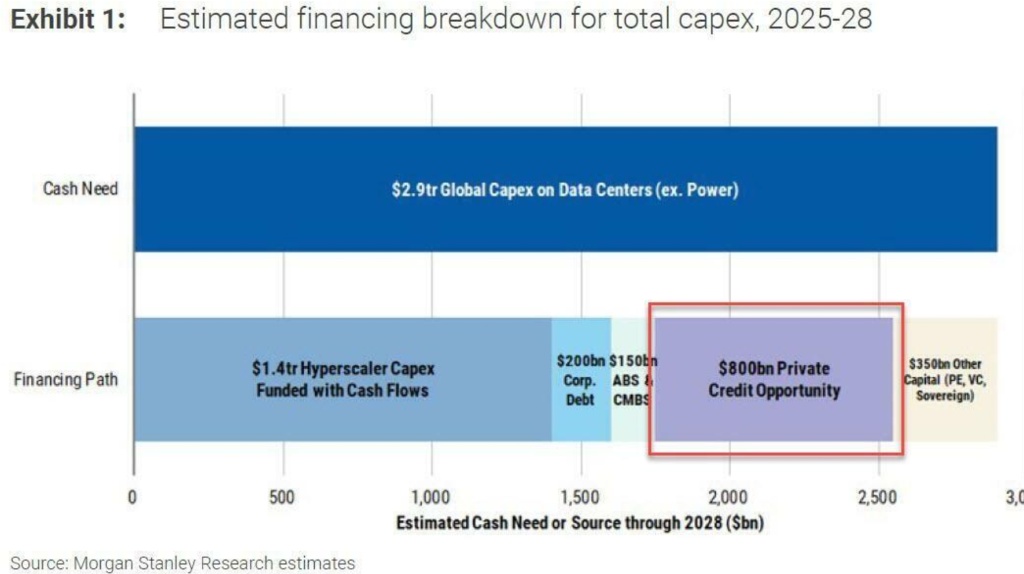
According to estimates, the capital expenditure required for global data centers before 2028 is about $2.9 trillion (this figure is still increasing). However, the company's own operating cash flow can only cover half of this through capital expenditures.

How to fill the remaining $1.5 trillion gap? The answer is only one: debt.

This includes corporate bonds, asset-backed securities (ABS/CMBS), private credit, and even sovereign debt.

By the end of 2025, AI-related investment-grade debt will account for 14% of the U.S. IG market, becoming the largest single thematic sector in the market, surpassing the banking industry. Morgan Stanley expects that the issuance of investment-grade bonds in the technology, media, and telecommunications sectors could reach $2.25 trillion by 2026, setting a new historical high.

The Bond Market is Showing Cracks

Despite current demand remaining strong, cracks have begun to appear.

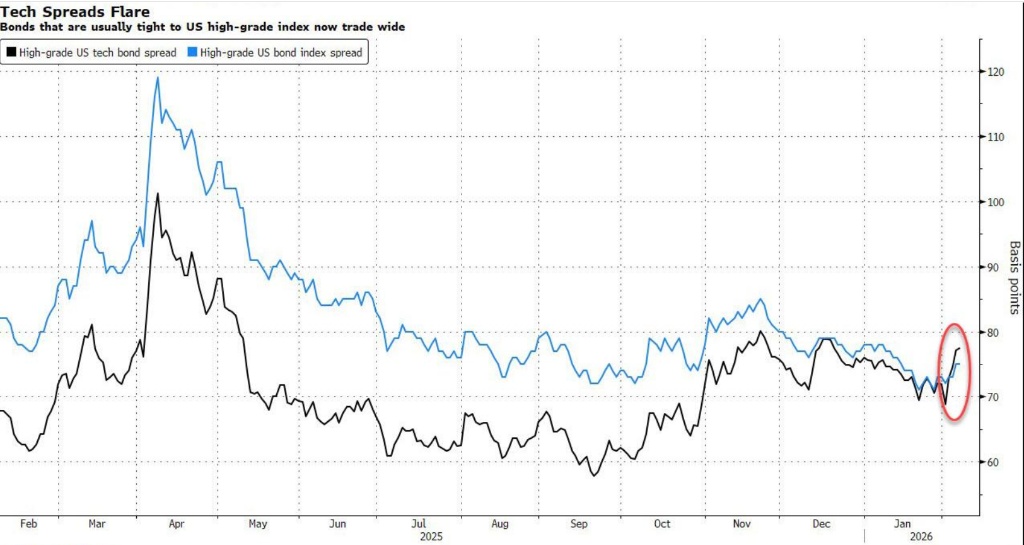
Bloomberg data shows that last week, the spread of U.S. investment-grade corporate bonds widened by about 2 basis points. Oracle's newly issued $25 billion bonds significantly underperformed U.S. Treasuries in the secondary market. Moreover, after Oracle announced it would sell stock to raise funds, market anxiety surged, leading to a sharp drop in its stock price.

Alexander Morris, CEO of F/m Investments, stated:

“The investment frenzy in the field of artificial intelligence has indeed attracted many buyers, but the upside is limited, and the margin for error is minimal. No asset class is immune to depreciation.

The current equilibrium is extremely fragile. The market is in an "autopilot" state; as long as the AI narrative can continue, the doors to the bond market remain open. However, once a shock similar to the "DeepSeek moment" in January 2025 occurs, or if technological iterations damage the competitive moats of giants, the bond market could close instantly.

The Ripple Effect in the Software Industry and Private Credit

AI is not only draining the cash flow of giants but also destroying the valuation logic of the traditional software industry, which poses the biggest risk to the credit market.

Bloomberg points out that as AI tools continue to penetrate the professional services sector, investors are beginning to reprice the growth prospects of the entire software industry.

  • AI Efficiency = Decreased Software Demand: With companies like Anthropic launching AI tools for professional services, investors are starting to worry that AI will render many SaaS (Software as a Service) products obsolete. If AI can write code and generate reports, why would companies still want to purchase expensive software licenses?

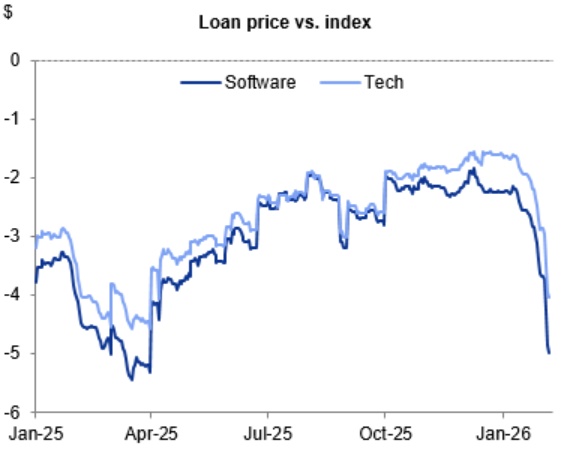
  • Software Company Bonds Being Sold Off: This year, the prices of leveraged loans for software companies have dropped by about 4%.

  • Private Credit is Affected: This is the most dangerous link.

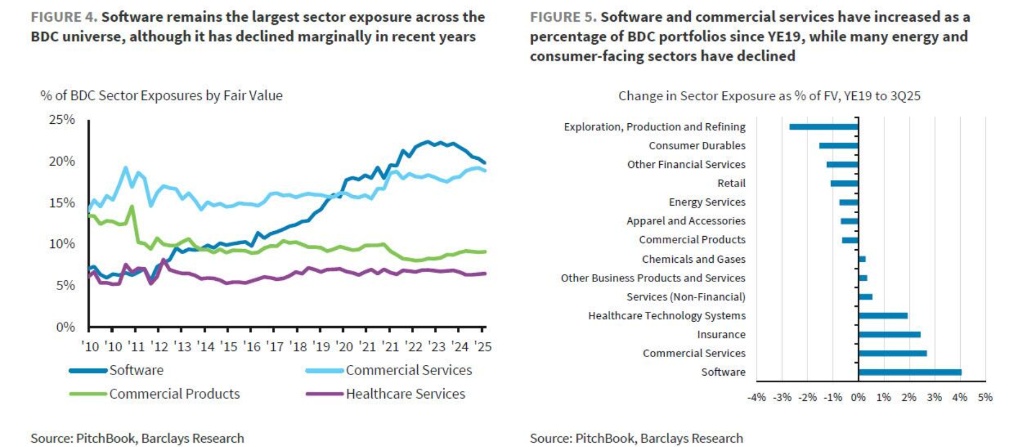
According to Barclays' analysis, the software industry represents the largest risk exposure for Business Development Companies (BDCs, i.e., publicly traded private credit funds), accounting for about 20% of their investment portfolios. The bank noted in its report:

"Software is the largest industry exposure in the BDC investment portfolio, accounting for about 20%, which makes the industry particularly sensitive to the recent decline in software equity and credit valuations."

As AI giants frantically burn cash to build infrastructure, they are effectively creating a technology that could potentially kill their downstream customers (software companies). If software companies default because their products are replaced by AI, the private credit market holding their substantial debts will be the first to collapse, triggering a chain reaction.

Prisoner's Dilemma: Knowing it's a bubble, why still invest?

Faced with Goldman Sachs' question of "too much investment, too little return," why do the CEOs of Google, Microsoft, and Amazon still choose to "go full speed ahead"?

The answer lies in the "Nash Equilibrium" in game theory.

For the giants, this is a classic binary strategic choice:

  • If you don't invest: Permanent loss of market share. AI infrastructure has a "winner-takes-all" dynamic. If you fall behind now, you'll never catch up. Just like IBM missed out on cloud computing, facing strategic obsolescence.

  • If you invest but overdo it: Poor financial statements, compressed profit margins, and prolonged return cycles due to overcapacity. But at least, you're still alive and at the table.

  • Prisoner's Dilemma: If a competitor invests and you don't, you will lose customers; if you invest and your competitor doesn't, you will gain the market. Therefore, the rational strategy is always to invest.

As Goldman Sachs analyzed, this dynamic creates a Nash Equilibrium, where even if recent returns are compressed, continued capital expenditure is rational at the individual level.

This is why, even when facing the risk of shifting from "net cash" to "net debt," and needing to bear hundreds of billions of dollars in debt, the giants will never stop. Because for them, the shrinkage of market value (due to deteriorating financial conditions) is bearable, but the disappearance of existence (due to technological lag) is unacceptable.

Outcome Projection: Trillion-dollar profits or irretrievable doom?

The ultimate outcome of all this depends on one core question: Return on Investment (ROI).

Goldman Sachs analyst Shreeti Kapa calculated the numbers:

Over the past decade, the profits generated by large tech giants have typically been 2-3 times their capital expenditures. Given an average annual capital expenditure of $500-600 billion from 2025 to 2027, to maintain the return rates that investors are accustomed to, these companies need to achieve an annual profit run rate of over $1 trillion.

Currently, the market consensus estimate for profits in 2026 is only $450 billion.

This is a huge gap. Even the most optimistic strategists find it difficult to explain how a $30 monthly subscription fee and occasional enterprise contracts can double the giants' profits in the short term Goldman Sachs has provided two possible outcomes:

  1. Bull Market Scenario (Cloud 2.0): AI adoption follows the trajectory of cloud computing. Amazon AWS achieves breakeven within three years and reaches a 30% operating profit margin within ten years. If AI can replicate this path, the current massive investments will yield astonishing returns. The current $1.5 trillion cloud backlog supports this narrative.

  2. Bear Market Scenario (Global Crossing Revisited): History shows that pioneers of significant technological innovations often perish on the beach (like Global Crossing during the fiber optic era). While today's giants have stronger financial resources, the current scale of spending and intensifying competition indicate that not all giants will generate sufficient long-term profits to reward today's investors.

Before this high-stakes gamble determines the winners and losers, the "vigilantes" of the bond market may awaken first. If they decide not to foot the bill for this feast any longer, this debt-driven AI boom could come to a very abrupt end