Will optical fiber be the next storage?

Wallstreetcn
2026.02.11 07:13
portai
I'm PortAI, I can summarize articles.

The optical fiber industry is experiencing a turning point due to the surge in AI demand, with clear signals of shortages and price increases. The report from Guotai Junan indicates that G.652D fiber is difficult to obtain at high prices, with a projected year-on-year demand increase of 75.9% by 2025. Corning has signed a $6 billion supply agreement with Meta, driving growth in optical fiber demand. Shenwan Hongyuan Research believes that the optical fiber industry is in a recovery phase, with earnings coming from fundamental and structural upgrades rather than mere valuation recovery

As the market focuses on the high prosperity of the AI computing power industry chain, some seemingly "traditional" industries are quietly reaching a turning point due to supply being squeezed by AI. Optical fiber and cable is one of the most typical cases.

The latest change is that the shortage and price increase signals in the optical fiber industry are becoming increasingly clear. Guotai Junan stated in a report on February 5 that there is a structural contradiction of "high-priced cash hard to procure" for mainstream G.652D scattered fibers in China, with longer delivery times. Prices are expected to rise further after recovering in the second half of 2025, with the upcoming procurement by operators and pre-holiday stocking before the Spring Festival possibly driving the continuation of price increases.

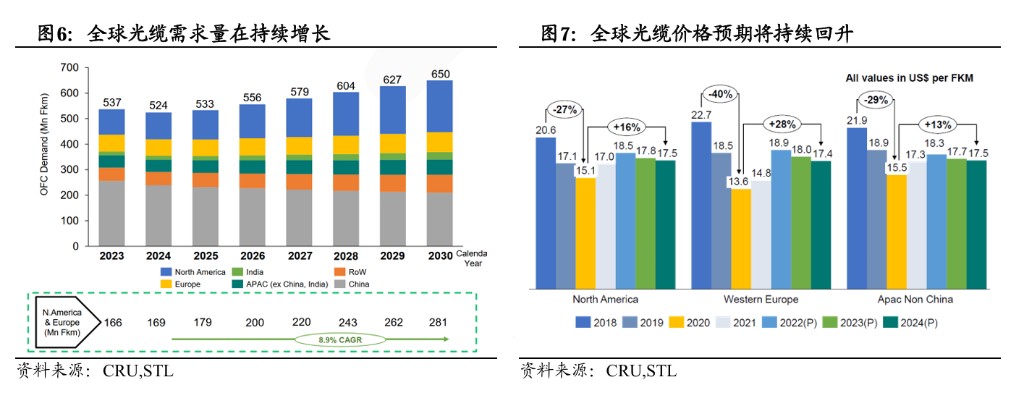
The core incremental demand comes from internal interconnection within AI data centers and DCI (Data Center Interconnect). Guotai Junan cited CRU, stating that global demand for optical fiber and cable in data centers is expected to increase by 75.9% year-on-year in 2025, and the proportion of optical fiber demand driven by AI scenarios is expected to rise from less than 5% in 2024 to 35% in 2027. The overseas "lock-in" is also intensifying the tension, with Corning signing a long-term supply agreement worth up to $6 billion with Meta and expanding production to support its AI data center construction.

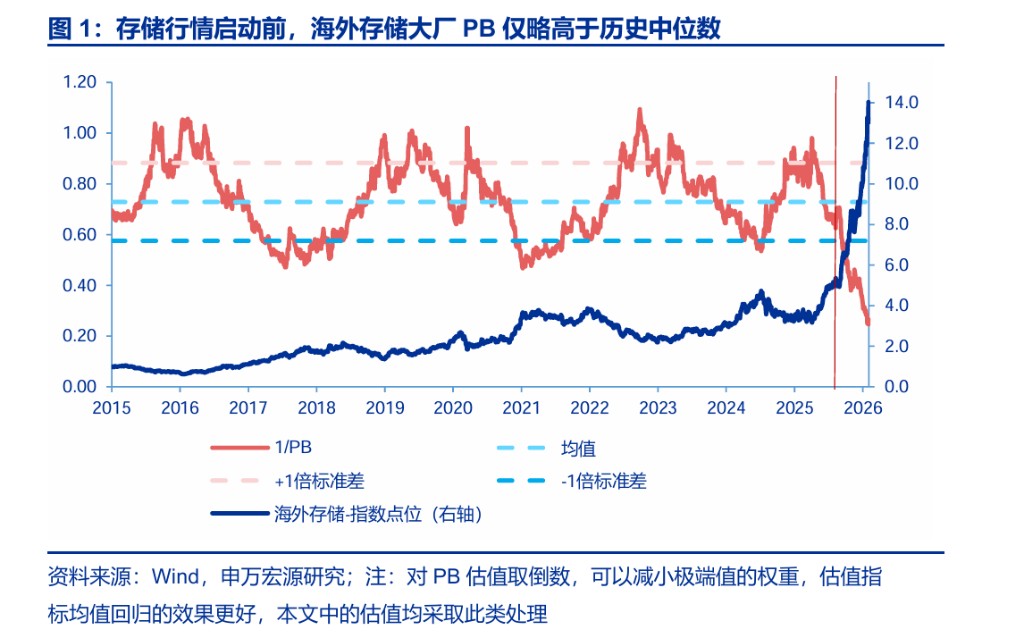
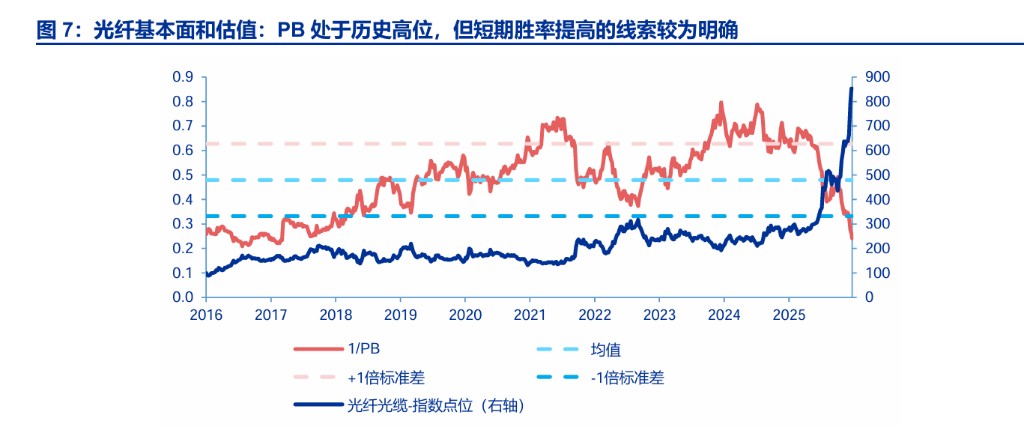
For investors, optical fiber is more like "storage without perfect replication, but with 'small storage'." Shenwan Hongyuan Research on February 11 positioned optical fiber as "traditional part repair + short-term AI business progress expectation as an upward option," believing that the supply in the industry has continued to decline since 2023, confirming the bottom of the cycle, but the sector's PB is at a historical high, with revenue sources leaning more towards fundamental realization and structural upgrades rather than simple valuation repair.

The Template Provided by Storage: How High Prosperity "Squeezes Supply" and Overflows into Traditional Categories

Shenwan Hongyuan Research reviewed that the core of the storage market in 2025 lies in the structural changes in AI training demand driving capacity to be prioritized for high-margin products like HBM, while traditional DRAM and NAND capacities are squeezed out. AI inference has also raised broad demand for storage, leading to dramatic changes in supply and demand that bring a double hit to prices and valuations.

This mechanism is summarized into four rules of "high prosperity overflow":

First, performance money comes from the early turning point after supply is squeezed out, while valuation money comes from the repair expectations after the previous valuation is at historical median or low levels;

Second, the overflow market also has a bottom line, requiring confirmation of a clear cycle bottom, controllable demand downside risks, and sufficient supply clearance;

Third, the win rate is not inherently high and requires Alpha add-ons such as "bargaining power, production expansion bottlenecks, and the possibility of entering high prosperity industries";

Fourth, the valuation of the spillover structure is difficult to break through the historical mean in the long term, and after the cost-performance ratio declines, it is more likely to shift to high-level fluctuations.

Supply Side: Long Expansion Cycle for Optical Rods, Capacity Structure Adjustment Compresses Traditional Supply

The "rigidity of supply" in the optical fiber market is the foundation of the current price increase narrative. Guotai Junan Securities states that the core bottleneck in the optical fiber industry chain lies in the preparation of optical fiber preform rods (optical rods), with an expansion cycle lasting 2 to 3 years. Since the last industry downturn, the long-tail capacity of optical rods has basically been cleared, and the expansion decisions of existing manufacturers are generally cautious, resulting in slow global growth in optical rod capacity and a rigid overall supply.

At the same time, capacity is structurally tilted towards high-demand, high-margin products. Shenwan Hongyuan Research points out that conventional capacity is shifting towards high-profit products corresponding to AI data centers and drone demand, while traditional optical fiber capacity is being squeezed, and the upstream expansion cycle for optical rods has bottlenecks.

Guotai Junan also mentions that leading manufacturers, while ensuring system performance, continue to shift conventional G.652D capacity towards high-margin products such as G.654.E ultra-low loss, G.657A2, multi-core, and hollow-core, creating a structural imbalance of "insufficient high-end capacity and squeezed traditional capacity."

Price Increases Are Happening: G.652D Shortage Raises Spot Prices and Delivery Times

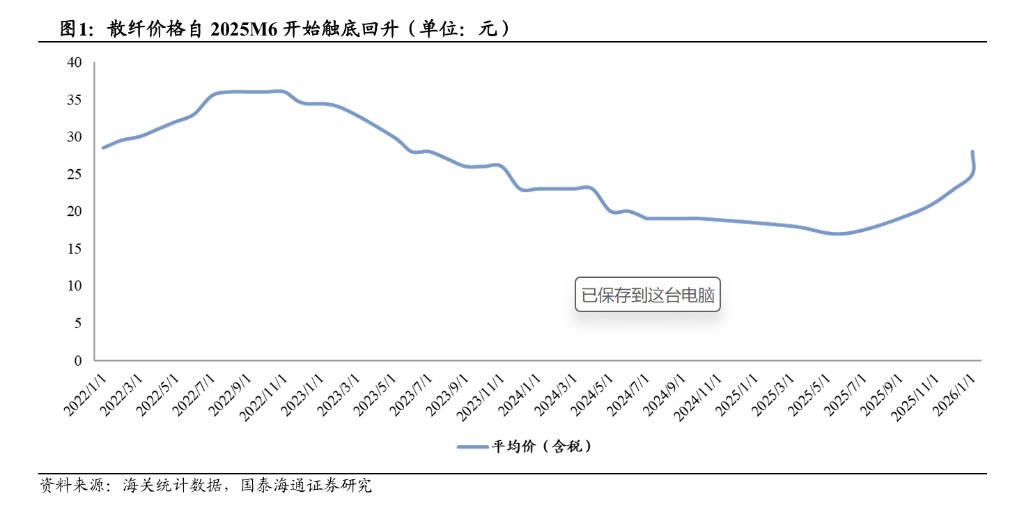
The direct carriers of price increases are the prices of scattered fibers and delivery cycles. Guotai Junan states that the scattered fiber market is dominated by G.652D, with demand being weak in the first half of 2025 leading to price pressure. After hitting bottom in June 2025, prices are expected to rebound in the second half of the year as demand for overseas G.657A2 significantly increases, driving capacity switching. The supply of G.652D will decrease, and delivery times will lengthen, leading to significant price increases and supply tightness for mainstream G.652D ordinary optical fibers in the fourth quarter of 2025, with some large manufacturers unable to meet orders and turning to external procurement.

In terms of pricing, Guotai Junan states that by the end of 2025, the quoted price for G.652D scattered fibers has risen to 24.0 to 25.0 yuan per core kilometer, with an annual cumulative price increase of over 50%. The latest scattered fiber prices in January 2026 have exceeded 30 yuan per core kilometer, approaching 40 yuan per core kilometer, which is "more than double" the optical fiber conversion price during the operators' centralized procurement in 2025. They believe that with the upcoming centralized procurement by telecom and mobile operators, as well as increased industry stocking demand before the Spring Festival, prices may continue to rise, and major domestic clients are also expected to accept price increases, a logic confirmed amid sector fluctuations.

Demand Side: Computing Power Competition Pulls Optical Fiber from "Telecom Cycle" to "Data Center Cycle"

The cyclical attributes tied to traditional telecom investments have not disappeared, but AI is reconstructing marginal demand. Guotai Junan states that the rigid demand for ultra-high bandwidth and low-latency transmission in intelligent computing centers makes them the core engine for the growth of optical fiber demand. A typical 10,000-card GPU cluster requires tens of thousands of core kilometers of optical fiber just for internal server interconnection, and the optical fiber demand of a single intelligent computing center can reach several times or even ten times that of a traditional data center. **

Data is also reinforcing this direction. Cathay Securities cites CRU stating that global demand for fiber optic cables in data centers will increase by 75.9% year-on-year by 2025, noting that the North American market is experiencing the fastest growth driven by data centers. Guolian Minsheng mentioned in its weekly report on February 2 that there is a shortage of high-quality fiber optic products from leading companies, with some order production cycles extending to several months. Factors such as AI data center construction are resonating, leading to a concentrated increase in demand for various types of fiber optics, while the expansion cycle for fiber optic preforms is about two years, exacerbating the supply-demand mismatch.

Where is the "upside option": Going overseas, major players locking in volume, and the industrialization progress of hollow-core fiber optics

Fiber optics are not only increasing in price but are also transitioning from "quantity" to "quality." Cathay Securities states that the demand for specialty and multimode fiber optics continues to grow, with hollow-core fiber optics being viewed as an important direction for internal data centers due to advantages such as low latency and high capacity. They disclosed progress from several manufacturers: Yangtze Optical Fibre and Cable Company has achieved a minimum loss of 0.05dB/km for hollow-core fiber optics and has won the bid for Guangdong Unicom's hollow-core fiber procurement project with Hengtong Optic-Electric, totaling 82 core kilometers, with a procurement unit price not exceeding 33,000 yuan per core kilometer; Zhongtian Technology is participating in a hollow-core fiber pilot project with UAE operator e&, with test results showing a transmission delay reduction of about 30% compared to traditional fiber optics.

On the overseas side, Cathay Securities states that both Microsoft and AWS are laying out hollow-core fiber optics. AWS's Vice President of Core Networking, Matt Rehder, indicated that hollow-core fiber optics may replace traditional fiber optics as the standard choice for long-distance trunk networks in the future, but currently faces supply shortages. The certainty of demand is also reflected through orders and capital expenditures: both Cathay Securities and Guolian Minsheng mentioned that Corning signed a supply agreement with Meta worth up to $6 billion, and Guolian Minsheng cited Tencent Technology stating that Meta disclosed a capital expenditure of $135 billion for 2026.

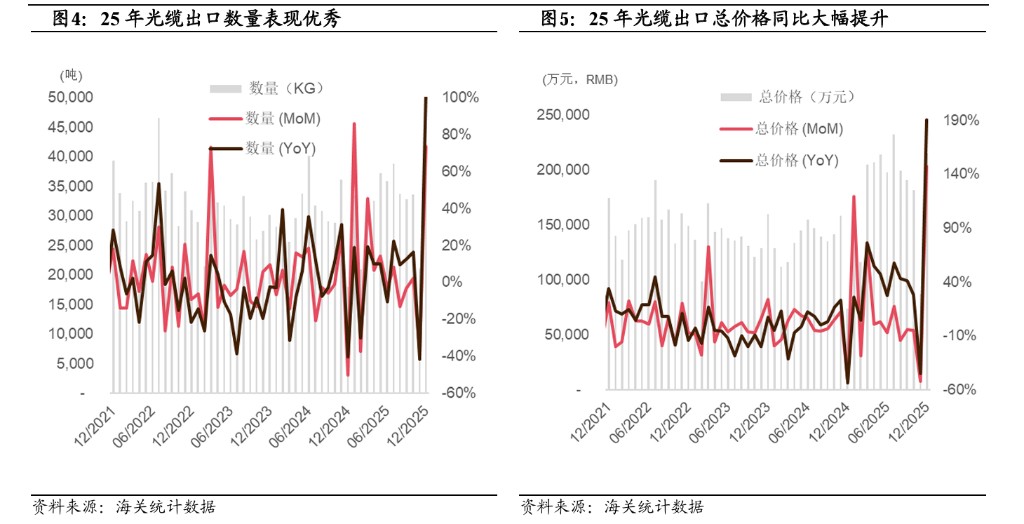
Going overseas provides another clue to the prosperity of domestic manufacturers. Cathay Securities states that by December 2025, the total export of cables, fiber optics, and fiber rods will reach 41,000 tons, a year-on-year increase of 6.5%, with an export value of $450 million, a year-on-year increase of 41.8%; the total annual export for 2025 will reach 454,000 tons, a year-on-year increase of 11.1%, with a total export value of $4.475 billion, a year-on-year increase of 44.1%, and believes that going overseas has become an important profit growth point for industry enterprises.

Can it become the "next storage": Short-term win rate increases, but it tests valuation and sustainability more

From the "mechanism" perspective, fiber optics possess elements that align with storage: AI demand is experiencing a concentrated explosion, there are bottlenecks in the supply side for fiber rods, structural adjustments in production capacity are squeezing the supply of traditional models, price increases are already reflected in both price and delivery time, and high-end products and overseas markets provide additional upside options. Shenwan Hongyuan Research also judges that fiber optics have a "high short-term win rate" and views the expectation of high-end products entering North America as one of the upside options

However, unlike storage, the valuation starting point for the optical fiber sector is not low. Shenwan Hongyuan Research clearly indicates that the PB of the optical fiber sector is at a historical high, mainly due to the market's previous pricing of certain companies' optical connection businesses. This means that the market is more reliant on the realization of price increases and the continuous strengthening of fundamental visibility. Once price increases spread or demand visibility fluctuates, it is more likely to shift from an upward trend to high-level fluctuations.

On the risk side, Shenwan Hongyuan Research highlights risks including AI technological advancements falling short of expectations, industry supply expansion exceeding expectations, and demand decline exceeding expectations; Guotai Junan also points out risks such as technological updates and intensified competition, fluctuations in raw material prices, and market demand fluctuations.

For investors, the key variable determining whether the optical fiber sector can break out of a "storage-style" market will be whether price increases can surpass centralized procurement pricing, whether supply bottlenecks continue to be effective, and whether high-end products and overseas expansion can extend the prosperity from "shortage" to "structural upgrade."

Risk warning and disclaimer

The market has risks, and investment requires caution. This article does not constitute personal investment advice and does not take into account individual users' specific investment goals, financial conditions, or needs. Users should consider whether any opinions, views, or conclusions in this article align with their specific circumstances. Investment based on this is at one's own risk