Cisco's revenue last quarter hit a record high, with AI demand supporting an upward revision of the full-year guidance, but the gross margin for this quarter is expected to be weak, falling over 7% in after-hours trading | Earnings Report Insights
Cisco's revenue in the second fiscal quarter exceeded expectations with a year-on-year increase of 10%. Orders for AI infrastructure from large-scale cloud vendors have "significantly accelerated" to $2.1 billion. The revenue guidance for this fiscal year has been raised by at least over 1%, and the revenue guidance for the third fiscal quarter is above expectations. However, the gross margin guidance for the third fiscal quarter is expected to decline, dropping more than 3 percentage points year-on-year to 65.5%, with a larger decline compared to the second fiscal quarter
Cisco, the world's largest network equipment manufacturer, reported double-digit growth in both revenue and profit for the last fiscal quarter, setting a record for quarterly revenue and raising its guidance for the current fiscal year. However, the weak gross margin guidance for the current quarter has raised concerns among investors, as demand for artificial intelligence (AI) may boost revenue, but related expenditures could erode profitability.
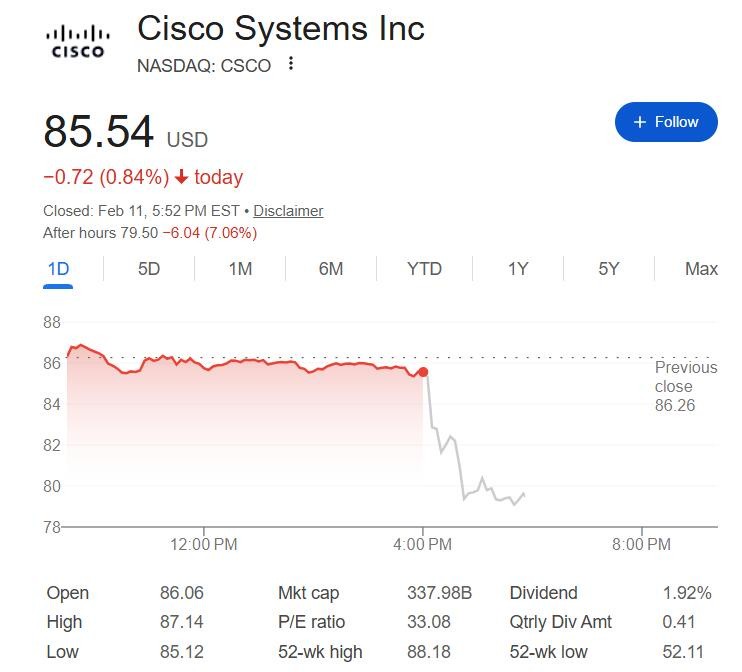
After Cisco's announcement on Wednesday, Eastern Time on the 11th, the stock price fell over 0.8% on the day and further declined by more than 7% in after-hours trading. As one of the winners of the AI boom, Cisco's stock price has risen approximately 30% cumulatively by 2025.
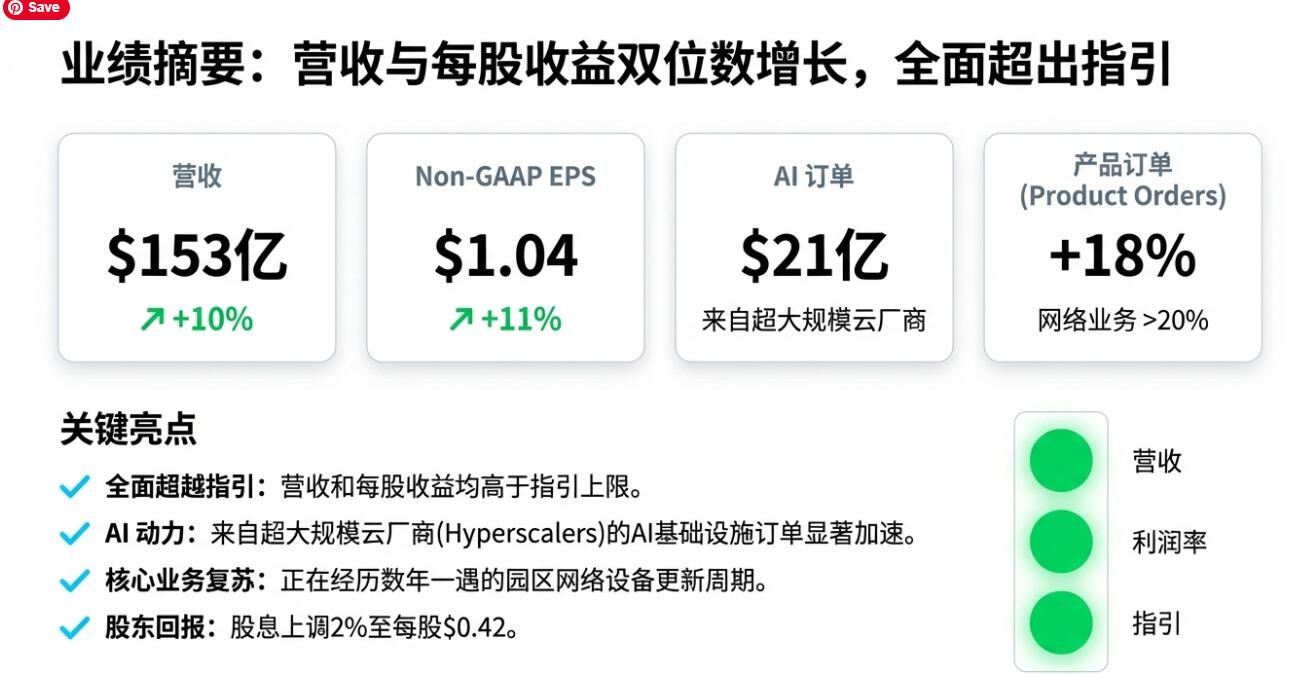
From an operational quality perspective, Cisco's gross margin remained stable in the last fiscal quarter, and its operating profit margin exceeded expectations, both above the upper end of the range previously provided by the company. At the same time, the company announced a quarterly dividend increase of 2% to $0.42 per share.
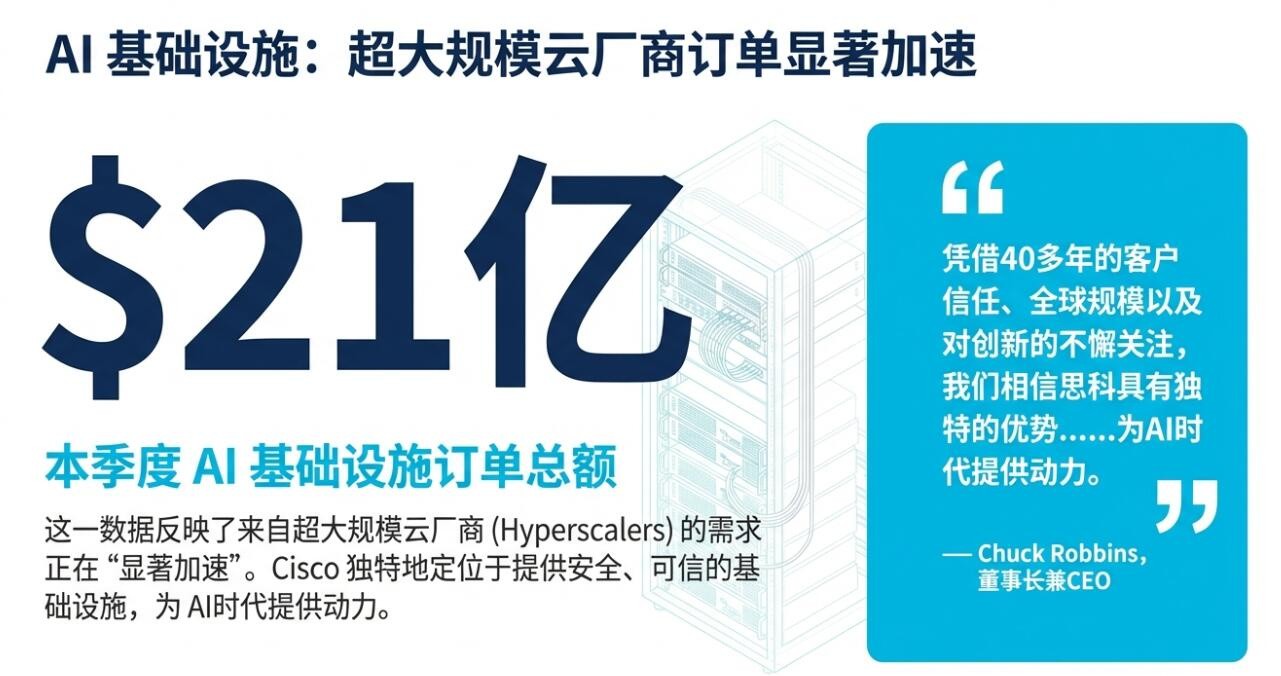
Demand-side signals are more positive. Cisco disclosed that product orders increased by 18% year-on-year, with accelerated growth in all regions; among them, orders for networking-related products accelerated to over 20% year-on-year. In terms of AI, Cisco stated that AI infrastructure orders from hyperscalers reached $2.1 billion, with "significant acceleration" in growth.
However, from the stock price performance, the earnings report did not reverse the market's cautious sentiment. The decline in service revenue, pressure on certain business lines, and the guidance indicating lower profit margins along with tariff uncertainties may all be suppressing the stock price rebound.
AI Demand Drives Performance Exceeding Expectations, Orders Accelerate
The earnings report showed that in the company's second fiscal quarter ending January 24, 2026, total revenue increased by approximately 10% year-on-year to a record $15.3 billion, exceeding analysts' expectations of $15.12 billion; adjusted earnings per share (EPS) on a non-GAAP basis grew by 10.6% year-on-year to $1.04, also higher than the expected $1.02.
In the second fiscal quarter, Cisco's product revenue was $11.64 billion, a year-on-year increase of 14%, surpassing analysts' expectations of $11.29 billion. Service revenue was $3.71 billion, a year-on-year decrease of 1%, slightly below the expected $3.84 billion. Profit for the second fiscal quarter reached $3.18 billion, higher than $2.43 billion in the same period last year.
Cisco CEO Chuck Robbins stated in a statement: "Cisco is uniquely positioned to provide the trusted infrastructure needed to securely drive the AI era." The company began offering its own Silicon One G300 AI chip on Tuesday and completed the acquisition of AI software companies NeuralFabric and EzDubs in the second fiscal quarter Compared to revenue recognition, orders often better reflect the marginal changes in corporate IT spending. Cisco disclosed:
- Product orders increased by 18% year-on-year, with accelerated growth in all regions.
- Orders for network-related products grew by over 20%.
- AI infrastructure orders from hyperscale cloud service providers reached $2.1 billion, indicating a significant acceleration in AI-related demand under the company's metrics.
The orders from hyperscale cloud vendors reflect a surge in demand for Cisco's core networking products driven by the investment boom in AI infrastructure. The increase in data center investments is propelled by technology companies' demand for AI computing infrastructure, creating strong demand for Cisco's products such as switches and routers.
On one hand, the order data indicates that under the dual tracks of AI data center and campus network upgrades, hardware and infrastructure budgets have not significantly contracted. On the other hand, it raises external expectations for the continuity of product revenue in subsequent quarters.
However, it is important to note that strong orders do not automatically equate to profit elasticity. AI-related infrastructure and the delivery of large projects often come with more intense bidding and more complex delivery rhythms, leading the market to further question whether changes in order structure will compress gross margins and whether the accompanying revenue from services/subscriptions can keep pace.
Full-year revenue guidance raised by at least 1%, this quarter's guidance exceeds expectations
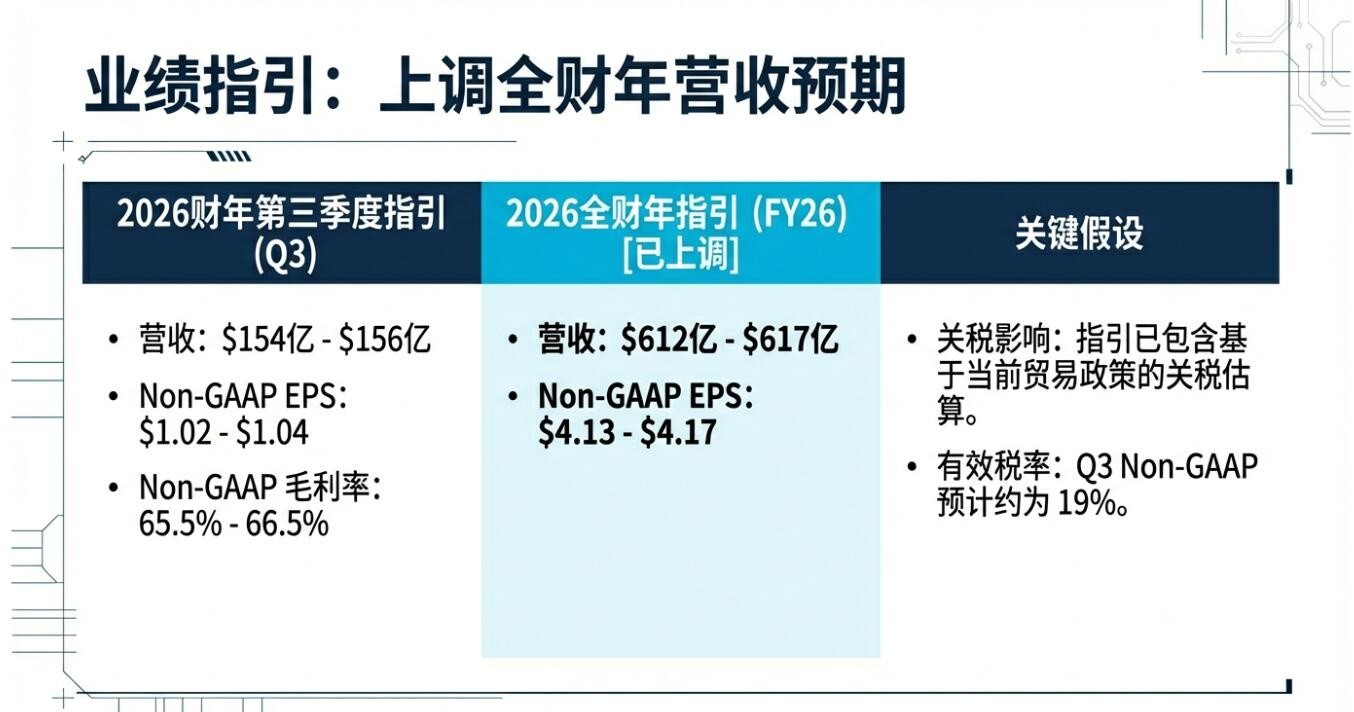
In other performance guidance, Cisco expects full-year revenue for fiscal year 2026 to be between $61.2 billion and $61.7 billion, raising the low end by nearly 1.7% and the high end by over 1.1% from the previous guidance of $60.2 billion to $61 billion.
Cisco expects adjusted EPS for the full year to be between $4.13 and $4.17, raising the low end by over 1.2% and the high end by over 0.7% from the previous guidance range of $4.08 to $4.14.
The above guidance is generally higher than Wall Street expectations. Analysts previously estimated Cisco's full-year revenue at $60.8 billion and EPS at $4.13.
For the third fiscal quarter, Cisco expects revenue of $15.4 billion to $15.6 billion, comfortably exceeding Wall Street's expectation of $15.18 billion. Adjusted EPS is expected to be around $1.03, which is basically in line with analysts' expectation of $1.02.
The above revenue guidance reflects Cisco's growth potential in the AI wave. Reports suggest that enterprise customers are expected to ensure their campus networks are "AI-ready," as infrastructure readiness is crucial for the workloads of the AI era and the modernization needs of switching, wireless, and IoT systems.
Third fiscal quarter profit margin guidance declines instead of rising
Although the revenue outlook is optimistic, Cisco's forecast for gross margin this fiscal quarter has disappointed the market.
Cisco expects the adjusted gross margin for the third fiscal quarter to be between 65.5% and 66.5%, representing a year-on-year decline of 2.1 to 3.1 percentage points, with a widening decline compared to the previous fiscal quarter. In the second fiscal quarter, Cisco's non-GAAP gross margin was 67.5%, down 1.2 percentage points from 68.7% in the same period last year.
Analysts expect Cisco's average gross margin for the third fiscal quarter to be 68.2%, which means it has slightly increased from 68.6% a year ago Analysis indicates that because Cisco's profit margins and earnings in the second fiscal quarter are in a relatively "good-looking position," the market is more likely to shift its focus to the next fiscal quarter to see if profit margins can maintain this level.
Cisco specifically noted that the EPS and profit margin guidance has incorporated estimates of tariff impacts based on current trade policies. Given the strong performance and orders in the second fiscal quarter, the lower gross margin range in the guidance, along with the explicit inclusion of tariff impacts, may lead the market to adopt a more cautious pricing framework in the short-term trading perspective. This could also be one of the important backgrounds for Cisco's expanded decline after hours.
Commentary suggests that Cisco is increasing spending to create new AI products, while the tech industry is also facing the threat of memory chip shortages, which is driving up costs.
AI has become a lucrative market for Cisco, but competition is also intensifying. Traditional networking companies like Broadcom and HPE, which acquired Juniper Networks, are also trying to get a share of the spending boom in AI model development and operational hardware.