


"The next AI victim" has emerged, real estate service stocks have been sold off, marking the largest single-day decline since the pandemic
Following software companies, private credit firms, wealth management institutions, and insurance brokers, real estate service stocks have also fallen into the so-called "AI panic trading" sector within a week. Investors are concerned that AI tools will disrupt their high-fee, labor-intensive business models, impacting the job market and commercial real estate demand. CBRE and Jones Lang LaSalle fell by 12%, while Cushman & Wakefield dropped by 14%, marking the largest decline since the pandemic
The stock prices of real estate service companies have plummeted significantly as investors reassess the vulnerabilities these firms face in light of artificial intelligence applications and tools.
On Wednesday, the stock prices of CBRE Group and Jones Lang LaSalle fell by 12%, while Cushman & Wakefield dropped by 14%, with CBRE and Cushman & Wakefield recording their largest single-day declines since the market sell-off during the pandemic in 2020.
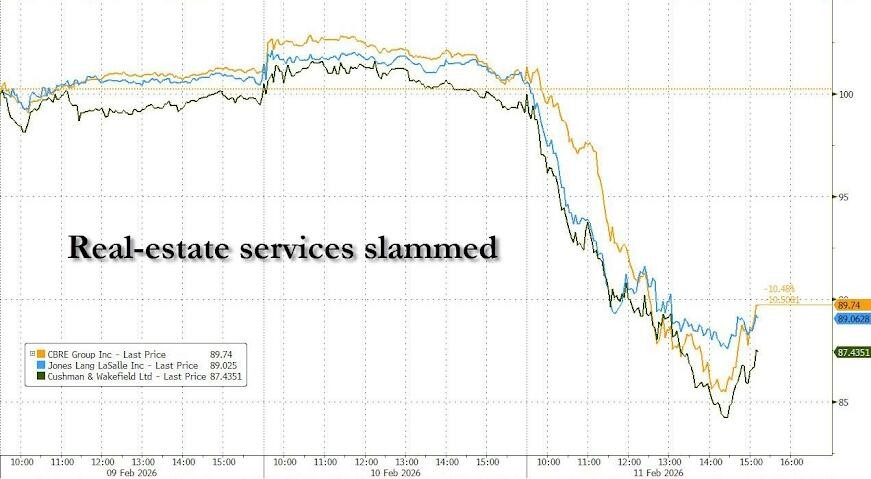
Wall Street Journal previously mentioned that software companies, private credit firms, wealth management institutions, and insurance brokers have all faced declines due to AI concerns, marking another industry sector caught in the so-called "AI panic trading" within just over a week.
Keefe, Bruyette & Woods analyst Jade Rahmani stated that investors are withdrawing from high-fee, labor-intensive business models, as these models are seen as potentially vulnerable to AI-driven disruption.
Analysts also pointed out that this sell-off may have exaggerated the immediate risks of AI to complex transaction businesses, with some selling pressure stemming from concerns that AI will disrupt the job market and demand for commercial real estate.
Commercial Real Estate Industry Faces Additional Challenges
This sell-off has brought new shocks to the commercial real estate industry.
The sector has been struggling to recover since the pandemic, with dramatic changes in office demand and a high-interest-rate environment severely suppressing transaction volumes.
Although the AI boom has provided growth momentum for certain sub-sectors, particularly data centers and high-end office leasing, investors are weighing whether advancements in AI will ultimately pressure some businesses through task automation and streamlined transaction processes.
Companies like CBRE and Jones Lang LaSalle have been trying to buffer the impact of the market downturn by expanding their services to include property management, valuation, and investment sales, covering various industries from hotels and warehouses to apartments and life sciences laboratories.
Market Reaction May Be Overdone
Barclays analyst Brendan Lynch stated that given the limited news flow on that day, the stock price declines appear "excessive."
The analyst noted that some selling pressure stems from concerns that AI will disrupt the job market and demand for commercial real estate. Lynch said:
These are potential risks, but there has been no change compared to yesterday.
This wave of panic intensified after AI startup Anthropic released tools aimed at automating tasks across various fields, from legal services to financial research, last week.
Meanwhile, analysts and investors warned that some of the severe sell-offs reflect a knee-jerk reaction that may have overestimated the actual risks. Jefferies analyst Joe Dickstein stated:
The threat of AI to the leasing and capital markets business is limited. CBRE and its peers benefit from significant scale advantages, including data and industry relationships. Their position as intermediaries in large leases and large transactions is unlikely to change.
Although analysts believe that the market's concerns about the immediate risks of AI may be overstated, Rahmani also acknowledges that the long-term impact of AI remains in a "wait-and-see" state.
