Both the financial report and guidance exceeded expectations, yet the "AI application hot stock" AppLovin's stock price still plummeted

Wallstreetcn
2026.02.12 01:15
portai
I'm PortAI, I can summarize articles.

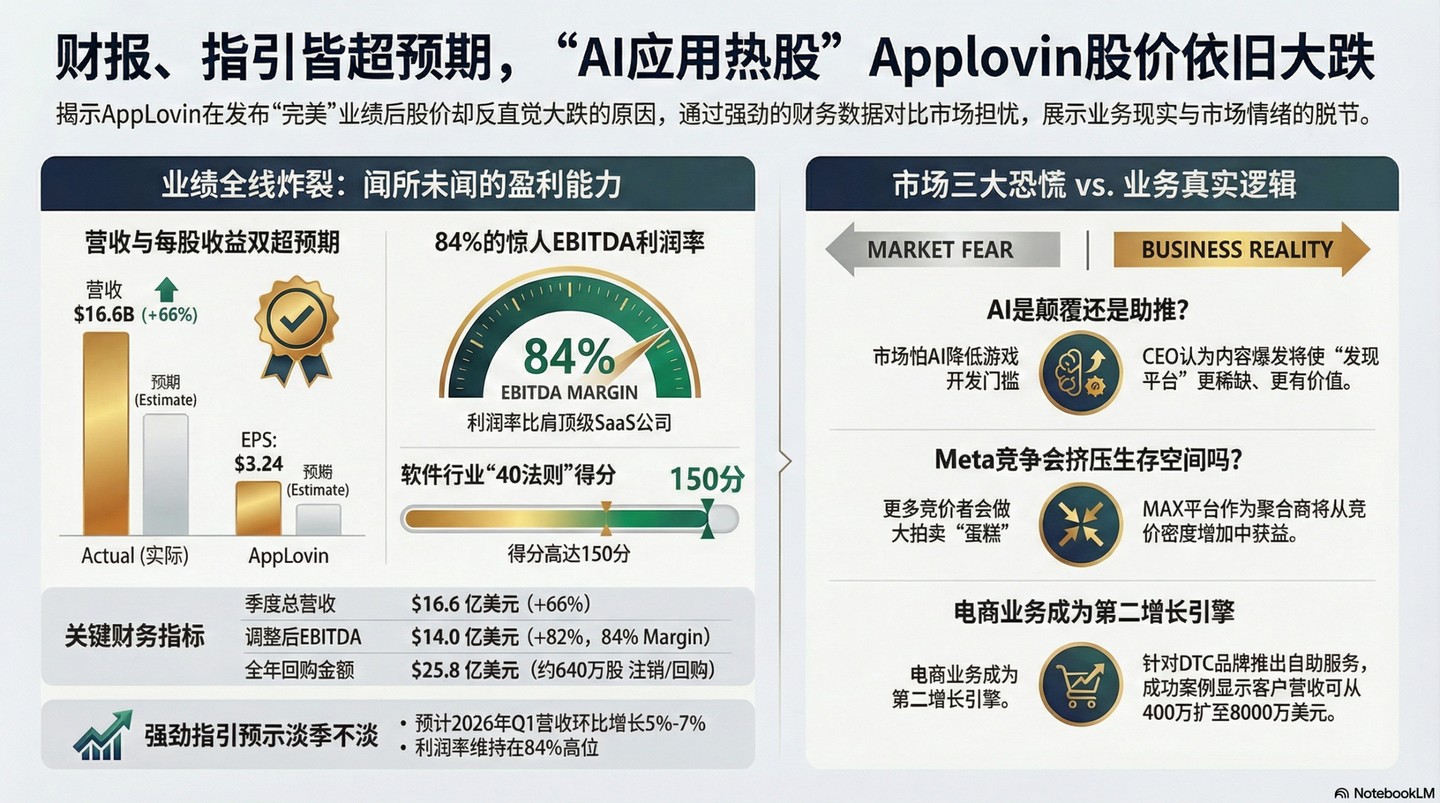
The financial report shows that AppLovin's Q4 revenue was $1.66 billion (+66%) and the EBITDA profit margin (84%) exceeded expectations. However, due to market concerns about AI disruption and competition from Meta, the stock price plummeted after hours. The company's CEO firmly responded that market sentiment is disconnected from reality, emphasizing that the content explosion brought by AI will make the company's traffic distribution capabilities even more scarce, and pointed out that the increase in bidding density has instead enhanced platform revenue

In the face of a "perfect" report card, Wall Street chose to sell off, forcing AppLovin CEO of the "AI application hot stock" to candidly state during a conference call: "There is a serious disconnect between market sentiment and our business reality."

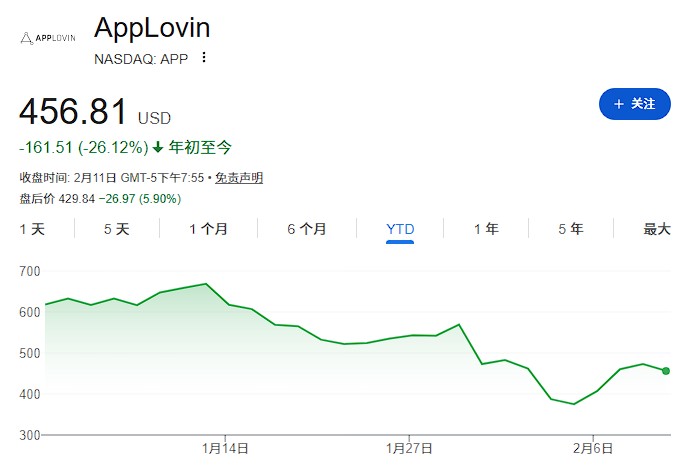
On February 11, the "AI application hot stock," mobile marketing technology company AppLovin, released its financial report for the fourth quarter and the full year of 2025. Despite core financial metrics overwhelmingly surpassing Wall Street expectations and a strong guidance for the first quarter of 2026, the company's stock price plummeted in after-hours trading due to market concerns about AI disrupting game development and competition from tech giants.

Performance Explosion: Profit Margins on Par with Top SaaS, Guidance Indicates Continued High Growth

The financial report shows that AppLovin's revenue for the fourth quarter reached $1.66 billion, a year-on-year increase of 66%, exceeding analysts' expectations of $1.6 billion; earnings per share (EPS) were $3.24, also beating Wall Street consensus expectations of $2.95.

Even more impressive is its profitability, with adjusted EBITDA (earnings before interest, taxes, depreciation, and amortization) reaching $1.4 billion, a year-on-year increase of 82%, and an astonishing EBITDA profit margin of 84%.

The company's Chief Financial Officer (CFO) Matt Stumpf emphasized this extremely rare financial model during the conference call:

"According to the commonly used 'Rule of 40' in the software industry, our 66% revenue growth combined with an 84% EBITDA profit margin scores 150 points. At this scale, this level of profitability is almost unheard of."

For the upcoming first quarter of 2026, the company expects revenue to be between $1.745 billion and $1.775 billion, indicating a 5% to 7% quarter-on-quarter growth even in what is typically a slow season, with the EBITDA profit margin expected to remain high at 84%.

Facing the Market's Biggest Fear: Is AI Friend or Foe?

Despite the impressive performance, the market is clearly more concerned about recent rumors regarding Google's "Project Genie" and other generative AI tools potentially disrupting the gaming industry, as well as major moves by giants like Meta in the advertising space. During the conference call, analysts' questions almost entirely revolved around these "macro headwinds."

In response, AppLovin co-founder and CEO Adam Foroughi made a strong rebuttal in his opening remarks, extensively citing internal data to counter the market's bearish logic. Foroughi stated:

"In recent weeks, discussions about how AI and competition will challenge our business have been rampant. But when I look at our internal dashboard, we are delivering the strongest operational performance in history The driving force behind this growth is our own AI model. There is a real disconnect between market sentiment and the reality of our business.

In response to the bearish view that "AI lowering the barriers to game development will devalue the AppLovin ecosystem," Foroughi proposed a completely opposite logic. He believes that AI will lead to a significant reduction in content production costs, triggering a "content explosion." Foroughi explained:

“As content becomes abundant, discovery becomes a scarce resource. In a world where anyone can create an app or game, millions of experiences will compete for attention. The winners will be those platforms that can effectively match the right users to the right content at the right time. That is exactly what our model is designed to do.”

On Competition with Meta: Increased Bid Density is Actually a Good Thing

Another core concern in the market is whether Meta (the parent company of Facebook) will use its vast social graph to squeeze AppLovin's survival space in the mobile advertising field.

Foroughi remained very calm about this, pointing out that MAX (AppLovin's aggregation platform) is a bid-based system, and more competitors will actually enlarge the cake.

Foroughi explained his unique business logic to analysts:

“In a typical zero-sum game market, if one side progresses, the other side fails. But in our case, as bid density increases, the cake expands. When a competitor wins a display, it is likely the one where our model is valued lower. This leads to publishers earning more, and in many cases, we do as well, because we no longer win low-value displays but charge a 5% fee to the winning bidder.”

He further emphasized that startups attempting to challenge their business must answer one question:

“If you hear about a startup coming to take our business, you should ask how their value proposition can be stronger than ours. If our value proposition were not strong, we would have lost these partnerships long ago.”

E-commerce Business and Buybacks: New Growth Engines and Confidence

In addition to its core gaming business, the market is also highly focused on AppLovin's expansion into the e-commerce sector. The company revealed that while it has not disclosed specific figures for its e-commerce advertising business, it launched a self-service platform in the fourth quarter, and existing customers' spending has seen "substantial growth."

Foroughi shared a case: an Israeli cookware company expanded its revenue from $4 million to $16 million on the AppLovin platform and expects to reach $80 million this year. “What we are doing is serving small businesses and helping them become large enterprises,” he said.

In terms of capital allocation, AppLovin continues to execute an aggressive buyback strategy. For the full year of 2025, the company repurchased approximately $2.58 billion of stock using free cash flow. By the end of the year, the company still had $2.5 billion in cash on its balance sheet. In the face of the sharp fluctuations in stock prices, Foroughi left investors with a thought-provoking statement at the end of the conference call:

"If the market chooses to price our stock based on fear, while we continue to compound growth in revenue, cash flow, and product capabilities, we will focus on execution and let the results speak for themselves over time. We embrace the feeling of being undervalued."

Full translation of AppLovin's Q4 2025 earnings call:

AppLovin Q4 2025 Earnings Call

Company Participants

Adam Foroughi - CEO and Co-Founder

David Hsiao - Head of Investor Relations

Matt Stumpf - CFO

Other Participants (Analysts)

Alec Brondolo - Wells Fargo

Benjamin Black - Deutsche Bank

Bernie McTernan - Needham & Company

Clark Lampen - BTIG

Cory Carpenter - JP Morgan

James Heaney - Jefferies

Jason Bazinet - Citi

Martin Yang - Oppenheimer & Co.

Matthew Cost - Morgan Stanley

Omar Dessouky - BofA Securities, Inc.

Ralph Schackart - William Blair

Robert Coolbrith - Evercore

Stephen Ju - UBS

Tim Noland - SSR

Vasili Karasev - Cannonball

Jim Callahan - Piper Sandler

Presentation Segment

David Hsiao: Welcome to AppLovin's Q4 and full-year earnings call for the period ending December 31, 2025. I am David Hsiao, the Head of Investor Relations. Joining me today to discuss our performance are our Co-Founder, CEO, and Chairman Adam Foroughi, and our CFO Matt Stumpf.

Please note that our SEC filings submitted to date, as well as the financial updates and press releases discussing our Q4 and annual performance, can be found at investors.applovin.com.

During today's call, we will make forward-looking statements, including but not limited to the future development and reach of our platform, our expected growth opportunities, the company's anticipated future financial performance, and other future events These statements are based on our current assumptions and beliefs, and we do not undertake any obligation to update these statements except as required by law. Our actual results may differ significantly from those projected. We encourage you to review the risk factors listed in our most recent 10-Q filing for the quarter ended September 30, 2025.

More information can also be found in our upcoming 10-K annual report for the fiscal year ending December 31, 2025, which we will submit later this month. We will also discuss non-GAAP financial metrics. These non-GAAP metrics are not intended to be superior to or a substitute for our GAAP performance. Please be sure to review our GAAP performance and the reconciliation of GAAP and non-GAAP financial metrics provided in our earnings releases and financial updates on our investor relations website.

This conference call is being recorded, and a replay will be available on our investor relations website for a period of time. Now, I will turn the meeting over to Adam and Matt for opening remarks, followed by the host guiding us into the Q&A session.

Adam Foroughi: Thank you all for joining us today. I want to start by addressing a question that everyone is clearly concerned about. While I tend to ignore short-term fluctuations in stock prices and focus on long-term value maximization, the recent volatility is worth responding to.

In the past few weeks, there has been a lot of discussion about how AI and competition will challenge our business. But when we look at our internal dashboards, we are delivering the strongest operational performance in our history. What is driving this growth is our own AI models. As internal and external AI research continues to advance, our business will grow accordingly.

There is a real disconnect between market sentiment and the actual state of our business. Before discussing future opportunities, let me first explain how we view competition in the AI space. First, regarding competition, we have been competing with many companies from day one. We have never feared competition because it forces us to innovate, which in turn allows us to better serve our gaming ecosystem. We operate a foundational part of the ecosystem—MAX Auctions.

MAX Auctions improve with more competition, which is crucial for the ecosystem, and in turn helps publishers earn more money, leading to more user acquisition. In a typical zero-sum auction market, if one party improves, the other party suffers. However, in our case, as bidding density increases, the pie gets bigger. While our share in the auction may shrink, our economic benefits are actually growing.

Some impressions are very well understood and highly valued by our models. Others have fewer signals and are valued lower. When a competitor wins an impression, it is likely the one we valued lower. This leads to publishers earning more, and in many cases, we also earn more because we do not have to win low-value impressions but instead charge the winning bidder a 5% fee When you hear that a startup is coming to take our business, you should ask how their value proposition could possibly be stronger than ours. If our value proposition with partners wasn't strong, we would have lost those relationships long ago. We have performed exceptionally well in the competition with giant companies in the mediation field. The network effects in this industry are very real.

We have expanded our network by providing publishers with the best monetization capabilities and, more importantly, the best advertising tools. This combination is unmatched by our peers. Next, let's talk about AI and game creation. The bearish view assumes that if AI makes it easier to build games, the value of our ecosystem will decline.

However, we believe the opposite is true. AI will significantly reduce creation costs, which means content will grow exponentially, and as content becomes abundant, discovery will become a scarce resource. Even in the past, when mobile games were built by human teams, content was abundant and, in many cases, commoditized. This is precisely what enables us to provide such a strong value proposition through our advertising solutions.

In a world where anyone can create an app or game, millions of experiences will compete for attention. The winners will be those platforms that can effectively match the right users with the right content at the right time. This is exactly what our model is designed to do. We are not limited to any specific type or format, whether casual, mid-core, or others.

Our system tracks engagement, and AI will only enhance the potential of this capability. Furthermore, we have not seen any signs of a decrease in mobile gamers. The human needs met by casual games differ from those of console, PC games, AAA games, or any other form of deeply immersive gaming experience. People will always seek entertainment that can naturally fit into their daily lives.

What is changing is how this attention is monetized. Even today, we are only converting a small portion of the impressions we serve. We do not see this as a limitation but rather as a huge long-term opportunity as our model continues to improve. This brings me to the aspects we can control: performance and culture.

In terms of performance, our business is executing very well. Despite the large base, we continue to grow very rapidly. We achieved strong growth in the fourth quarter, and although typical seasonal factors usually lead to a weaker first quarter compared to the fourth quarter, we guided significant quarter-over-quarter growth. This reflects the continued strength of the gaming business and the scaling of our e-commerce and self-service customers.

Culturally, we are happy to be underestimated. A skeptical market sharpens our focus and drives our team to execute. Our revenue per employee remains among the highest in the world because we have built the best and most scalable products in their class. If the market chooses to price our stock based on fear while we continue to compound growth in revenue, cash flow, and product capability, we will focus on execution and let time prove our results

From our perspective, we are still in the early stages of this platform's potential. With that said, I will hand the meeting over to Matt to introduce the financial situation.

Matt Stumpf: Thank you, Adam. The fourth quarter not only marks a strong quarter but also our most outstanding year ever in terms of deliveries, and one of the strongest performances in the public market.

Given our scale, the combination of growth, profitability, free cash flow, and capital returns we delivered is quite rare. Fourth quarter revenue was $1.66 billion, a year-over-year increase of 66%, driven by continued technological advancements in our core mobile gaming business, seasonal advantages, and the growing impact of our e-commerce initiatives. Adjusted EBITDA was $1.4 billion, up 82% year-over-year, with a margin of 84%. The margin expanded by over 700 basis points compared to the same period last year, and the quarter-over-quarter conversion rate to adjusted EBITDA was approximately 95%, further demonstrating our relentless commitment to execution and the efficiency with which incremental revenue translates into business profits.

Investors often mention the "Rule of 40" in the software industry. Based on this, our 66% revenue growth and 84% adjusted EBITDA margin translate to a score of 150 points. Achieving such a level of profitability at this growth rate is almost unheard of, reflecting the fundamental operational leverage of our model. This quarter, free cash flow was $1.31 billion, an 88% year-over-year increase, bringing our cash balance to $2.5 billion and strengthening the strength of our balance sheet.

This has indeed been an extraordinary year for AppLovin. Revenue reached $5.48 billion, a 70% year-over-year increase. Adjusted EBITDA was $4.51 billion, up 87%, with an adjusted EBITDA margin of 82%, a level of profitability that few companies can achieve, let alone maintain at this scale. Total free cash flow was $3.95 billion, a 91% year-over-year increase, which not only emphasizes growth but also highlights the exceptional quality and durability of our earnings.

In short, few publicly traded companies can match our current levels of expansion, profitability, and cash generation. This strength directly translates into shareholder returns. In this quarter, we repurchased and withheld approximately 800,000 shares at a cost of $482 million. For the full year, we repurchased and withheld approximately 6.4 million shares, totaling $2.58 billion, all funded by free cash flow.

As of the end of the year, we have approximately $3.28 billion remaining in our stock repurchase authorization. Over the past four quarters, we have reduced our weighted average diluted shares outstanding from 346 million shares to approximately 340 million shares while investing in organic growth and maintaining significant liquidity. Our stock repurchase program reflects our belief in the value and durability of the business. Turning to our outlook for the first quarter of 2026, we expect revenue to be between $1.745 billion and $1.775 billion, representing a quarter-over-quarter growth of 5% to 7%

The adjusted EBITDA is expected to be between $1.465 billion and $1.495 billion, with an adjusted EBITDA margin of approximately 84%, maintaining top-tier profitability while we continue to scale. Finally, AppLovin represents an extremely rare combination: sustained high growth, excellent margins, significant free cash flow generation, and disciplined capital returns. We believe this sets us apart and enables us to continue delivering excess value to shareholders over the long term. Now, let's move into the Q&A session.

Q&A Session

Operator: We will now begin the Q&A session. (Operator instructions). Your first question comes from Benjamin Black of Deutsche Bank. You may unmute and ask your question.

Benjamin Black: Great. Thank you for taking my question. My first question is about the e-commerce opportunity. Could you please review the launch of self-service, share some key learnings, what worked, what didn't, and whether there is room for improvement? If possible, it would be great to share or quantify the contribution of e-commerce to revenue and advertising spend for this quarter and guidance. Thank you.

Adam Foroughi: Yes, the e-commerce business has obviously been running with us for a year and a half. It has performed very well. In the fourth quarter, we opened the self-service platform, which is currently referral-only. So we haven't reached the full GA release stage yet. We will get there, and we said it would be in the first half of this year, and it is still on track.

There are a few things that excite us. One is the existing customers that extend from Q4 2024 to Q4 2025, whose spending has seen substantial increases as our model continues to improve. Keep in mind that this business and the model driving advertiser value are actually still in their infancy. We need some time to iterate continuously to improve the model.

In fact, just a few weeks ago, we had a significant uplift. So those customers from the same period last year saw tremendous growth. Then you have new customers coming in through the referral program. I mentioned in the last earnings call that we saw significant growth there.

We won't see anything for a while that will impact our overall numbers, but we are seeing good trends. I will talk about advertising later in the call, guiding advertisers onto our platform, but the numbers we are seeing are exciting. Regarding splitting e-commerce data, we won't do that because we view our platform as a unified platform. For example, if the engineering team improves the game model by 50% tomorrow.

So the e-commerce (proportion) may decrease, but the business will grow rapidly. This does not mean there is anything wrong with our platform. Fundamentally, we are a single auction, but gaining more diversity will give the model more ways to serve the end consumer and should boost our overall conversion rates But we believe that if you start talking about vertical industries in a market like ours, you will begin to receive very misleading information that can confuse investors.

Benjamin Black: Okay, I think my second question relates to the set of features you are launching. I believe you mentioned in the past that if partners can not only optimize the best-performing creators but also truly scale and automate the creation of these video assets, they could see an increase in conversion rates. So in this context, where are we on the automation curve, and where might we be in the next 12 to 18 months?

Adam Foroughi: Yes, good question. We are still in very early stages.

I pulled some data earlier just to compare the number of ads e-commerce companies upload versus those gaming companies that have been optimizing for our platform for over a decade. Top gaming companies run tens of thousands of ads at any given time. Whereas top e-commerce companies run hundreds. So there is a huge disparity here.

If you feed more ads into our system, the model performs much better. That’s a fact. It has the opportunity to diversify the content that the end user sees and try to find the content that ultimately converts that user. Now, how do we bridge that gap? It’s twofold.

First, customers need to become more accustomed to our platform and understand what types of creative assets work so they can build production around effective content and scale it up. More importantly, generative AI tools for creating creative assets at very low costs are on the way. We already have generative AI-based tools for part of the ad units in pilot programs with over 100 customers. Our ads are videos, plus an interactive page, followed by a store preview dynamic product page follow-up.

However, the interactive page in the middle is not something these advertisers are used to building, as they don’t need these on social media or search. We are now automatically generating these pages for over 100 customers. If they perform well, we will roll them out to a broader customer base soon.

Soon, our video model will also be launched. We will run the same pilot process. We will ensure that the video output looks good. But if we can reach a point where the video model can help these customers create new video ads in bulk at a dollar-level cost instead of thousands of dollars, we expect these new customers to significantly increase the number of ads on our platform, making them more competitive against our gaming customers.

Benjamin Black: Great. Thank you very much. Very helpful.

Adam Foroughi: Yes.

Operator: Your next question comes from Jason Bazinet of Citigroup

Jason Bazinet: Thank you very much. How are you?

Adam Foroughi: Very good.

Matt Stumpf: Hey, Jason.

Jason Bazinet: One thing that investors have been somewhat troubled by is the "black box" nature of the model.

It's like they can't confidently create a P times Q (price times quantity) model and infer the model's development from it. I know you won't separate e-commerce from mobile business as you mentioned. But when investors are looking at those e-commerce accounts that have your Pixel installed, what advice would you give to buyers to leverage those numbers and try to do some calculations to understand how well you are doing? Thank you.

Adam Foroughi: Yes.

I mean, it's really, really difficult because we are just getting started. Facebook may have installed Pixel on over 10 million websites. You have been reporting that our Pixel numbers are in the thousands. So it really relates to the number of advertisers we have on the platform, but we are just getting started.

We can't build a P times Q model in a time frame where we expect to have hyper-scale growth. Once you open the platform, start marketing the platform, and begin to make more sales, you will eventually have a flood of advertisers coming in. We can't predict that. It won't stabilize until we get deeper into the future stages.

But what excites us is, as I mentioned in my previous answer, we are already testing and advertising to attract customers to the platform. So what you are seeing now is just based on recommended advertiser accounts. But if we start to really market our platform and convert customers through the funnel, it will help us truly catalyze faster growth without a sales team. A data point I pulled earlier was really cool; we are doing a small amount of advertising testing on social and search, and then we are doing a referral program.

But currently, we see that around day 30, LTV (lifetime value) is equal to CAC (customer acquisition cost). If you consider the lead generation model, and if you understand the lifetime value we create for advertisers (which is value over years), being able to recoup media purchase costs in 30 days is outstanding. We have what can be said to be one of the best business models the world has seen, and we are seeing the ability to market our platform at this level of small-scale testing. This excites us.

Now, we are not ready for a full GA (general availability) yet, and you might ask why. The reason is that we need to optimize our conversion funnel. We are no different from any social network trying to acquire users. We want to get users onto this advertising platform

Currently, we see that among qualified potential customers, 57% of advertisers have gone live. This means there is a 43% churn. We believe we can bring this number closer to 100% before the opening. Nevertheless, we have seen this 30-day LTV and CAC breakeven. So we are very excited about the current situation.

We believe that as we open up and truly start to onboard a large number of advertisers, we will experience this high-growth phase. Once we reach a stable position where we can start forecasting the number of advertisers in future quarters, we will provide you with the P times Q model.

Jason Bazinet: Thank you.

Adam Foroughi: Yes.

Operator: Your next question comes from Omar Dessouky of Bank of America.

Omar Dessouky: Hey guys, thanks for taking my question. I want to ask a more general question, as the market seems to be in an AI moment. So, looking ahead three to five years, it could be a world where consumers interact with the internet through natural language-based agents. How will the potential changes in the way consumers interact with the internet, which are different from performance advertising neural networks, affect your business? That’s the first part.

The second part is, how do you anticipate, also in the long term, three to five years, how do you expect mobile game developers, casual mobile game developers, to adapt to a world where they need to compete for time with these complex chatbots?

Adam Foroughi: Yes, good question. The way I see LLMs is that it will enable anyone to come up with game ideas and create a game. This doesn’t mean you will get users to play your game, but it does mean you can create content at a very low cost without having to be an engineer. This will accelerate content production for mature, complex studios.

It will also create a lot more personalized content from those who have no engineering background but can become game developers. This is a good thing for us. I mentioned in the conversation that as content becomes more abundant and commoditized, discovery platforms—of which there are very few—become where the real value lies, as these customers will have to come to MAX to monetize, and they will have to come to our discovery platform to run ads to get users into their space. Now, if humans just want to chat with chatbots and do nothing else, of course, if they don’t do anything else, we will lose the time spent on games.

But that seems a bit far-fetched. The games people play in our space are not very immersive games. They are quick, relaxing games where people play solitaire, play mahjong, and the like. This audience tends to be older and skewed towards women

This audience is unlikely to stop playing crossword puzzles in ten years just because they chat with a chatbot. So, not only do we believe that the core audience will continue to play games, but you also need an outlet to relax. If LLMs improve productivity, people may have more time for outlets like games. If LLMs enhance the quality and production capabilities of games, you will have more content, which aligns perfectly with business models like ours.

Omar Dessouky: Okay, thank you.

Operator: Your next question comes from Bernie McTernan at Needham.

Bernie McTernan: Great. Thanks for the question.

I want to follow up on the e-commerce question. Given the rollout of self-service, have you seen any changes in the type, scale, and category of customers entering due to self-service compared to the previous managed services? Additionally, as a follow-up, we've seen some non-e-commerce applications with your Pixel in our own tracking. Is this an exception, or is this a new growth factor you are pursuing through NLS?

Adam Foroughi: Yes, I mean, obviously with the opening of self-service, we no longer set a minimum GMV (Gross Merchandise Volume) threshold. So in the previous year, we had quite a high minimum standard for businesses.

Now you will see companies with hundreds of thousands of dollars in GMV and millions of dollars in GMV purchasing on our platform every year. The benefit of this is that not only can we track performance very clearly on a small brand, but if they start spending money, that money will convert into revenue. And it’s very clear in their numbers that their previous revenue was only in the hundreds of thousands. Let me give you an example.

A year ago, we had an Israeli cookware company go live with $4 million in revenue. Stories like this make us very proud. Last year, they scaled up on our platform. 65% of their user acquisition spending was on our platform.

They scaled up to $16 million in revenue and were profitable in the process. We can see the results directly translating from the growth driven by spending on our platform. This year, they are growing so fast again, putting most of their UA (User Acquisition) spending on our platform. It looks like they expect revenue to reach $80 million.

So you start to see this type of rapid growth from specific customers, and we know the product is effective and works very well. This makes us proud. We believe what our company really enjoys doing is serving smaller businesses, helping those small businesses become big businesses. That’s how we entered the gaming space.

We first helped independent developers (Indies). Now every significant game company in the mobile space is likely collaborating with our platform in a major way. But in e-commerce and other categories, we feel the same way. Helping small businesses, helping them scale their operations, and then we will capture all the brands in the coming years

In terms of new categories, we emphasize again that we do not set any thresholds. So if you are in the auto insurance industry and register on our platform today, you can go live. We are still in the early stages in these other categories because we have to make certain adjustments to the model for each case. Our current focus is on any transaction-based business, rather than lead-based business.

So think about it if you are a transaction-based business, you are not e-commerce, but something like fintech. This could work out of the box very well. That is another growth category. But there is also a large chunk that is lead generation business.

You want to collect user information and sell it to them at a call center. This will come to us in the coming months, and we will really focus on categories like that. Our job is to serve every transaction category that is purchased based on performance and do it well, so that the billions of daily active users we see on our platform can enjoy diverse content.

Bernie McTernan: Thank you.

Adam Foroughi: Yes.

Operator: Your next question comes from Matthew Cost of Morgan Stanley.

Matthew Cost: Hello everyone. Thank you for taking my questions.

I would like to first confirm some comments from your prepared remarks, as the data points from the channels are a bit unusual and sparse. Have you seen Meta conducting more advertising tests in the in-game advertising environment? Regardless of whether you have seen this, how should the market view the potential impact of a player as large as Meta becoming more aggressive in this market? Then for the second question about MAX,

you have been in the business of persuading people to switch mediation platforms for a long time. Given this experience, how would you describe the moat of MAX?

Adam Foroughi: Yes, two good questions. Regarding Meta, Meta is a launch partner of MAX.

They are a good partner. They have been on the MAX platform for a long time. They are currently bidders for any traffic with an ID, rather than bidders for traffic without an ID.

So think about the situation with IDFA being turned off. That accounts for about two-thirds of the full-screen ad units they are currently bidding on. As you see on LinkedIn, they are starting to bid more in that area. They have not started bidding on traffic without an ID, but they are likely to bid on traffic without an ID in the coming quarters. As you know from our business over the past few years, there have been many times we have increased competition in the MAX auction.

Unity has grown with Vector. Liftoff launched Cortex and is growing very quickly. Moloco has been growing, and we turned them into a bidder last year You have Google turning to bidding.

Every time this happens, there is this confusion that in a dynamic auction-based system, competition should weaken AppLovin's advantage. You've never seen this happen. This is what I was trying to cover in the conversation.

The reason is, first, we are really big and very good at what we do. Second, the value of each impression is not the same. Our model is very good at valuing impressions based on our data and customer insights.

Sometimes it values them highly, and we make a lot of money. Other times it values them low, and we make less or might even lose a lot of money. What happens when these bidders get better is that they take away some of the impressions we valued lower, on which we might not make money or make substantial money. And now we can charge a 5% fee to the bidders in the ecosystem.

So the growth of the ecosystem allows for improved economic benefits in the MAX market. Since we became so good, we've never seen the growth of the ecosystem harm AppLovin's bidding environment. Now, this is after AXON2, and we have become the market leader. So I do think this is an important point that people easily overlook. So I want to see if you have any other questions about this before you ask about aggregation.

Matthew Cost: No, that’s very clear.

Adam Foroughi: Thank you. Okay. Regarding aggregation, you see, when we acquired MAX and built that technology, we entered the market.

We didn’t buy technology. We just bought a way into the market. That was in 2018. Before we acquired MoPub, the MAX platform had already grown to be the number one in the field.

When we acquired MoPub, we merged the two. As everyone knows, we are very dominant in this field. We adopted MoPub's technology in less than 90 days, discarded it, migrated everyone we could to our platform, rebuilt the best features of MoPub, and put them on top of the best features of MAX, ultimately achieving a very dominant position. At this point, some players in the aggregation space have already counted themselves out.

Then there’s Google Level Play and us. And obviously, there’s the startup that everyone has been discussing. So in a world where CloudX becomes the startup entering this field, you have to discuss what they are stepping into? How is today’s world different from the past? The moat around our aggregation is not just because of the aggregation itself. We are very good.

We have the highest bidding density in any aggregation A/B test. If you talk to publishers, you will hear that MAX performs better, but we are not leaving them in the dust. We are several percentage points better than others. If someone wants to pay a premium to cover this, they might pay a premium to cover it

The truly expensive part for publishers, and where we really lock in, is that we have the best advertising solutions in the market. In fact, for many of these publishers, we account for over 50% of their entire user acquisition spend. They can't get this anywhere else. If they leave MAX, it will decline.

So they are in a world where they have the best purchasing tools. They have the best monetization tools. This has turned into a very powerful 360-degree solution, and their growth depends on it. Moreover, the growth of the MAX ecosystem is not slow.

As we discussed in previous conference calls, this is a double-digit, very strong growth category, and these publishers see their businesses improve due to our technological advancements. When you have this foundation and an extremely strong moat with technology that others cannot replicate or possess, you ultimately get a very sticky solution, and we are very confident that our solution is just that.

Matthew Cost: Great, thank you very much.

Operator: Your next question comes from James Heaney of Jefferies.

James Heaney: Yes, great. Thank you. How are you thinking about Axon's marketing investment for 2026? I know you talked about a goal of spending $1 million a day at the end of last year. Is that still the right way to think about it? Is the ultimate general availability (GA) the biggest barrier to you doubling down on that investment? Thank you.

Adam Foroughi: Yes, I mean, look, right now we are in testing, so the numbers are not large. You don't see anything reflected in our EBITDA margins. In fact, you see them rising to 84%. We believe the growth of the business is so high, and our LTV to CAC looks so attractive, that you won't see an increase in marketing leading to a significant decline in EBITDA margins.

If you do see that, it's a good thing. It just means we are making great strides in marketing, and we see a lot of customers that can be brought in to accelerate growth. But more likely, we will control this because we do want to take the time to build the tools. When we start buying and enter general availability (GA) and bring in customers, if we don't have good content creation tools for them—creating videos with generative AI tools, creating interactive pages with generative AI tools, and doing it in a very powerful way—their success rate on our platform won't be as high.

That said, we are not in a hurry. We are seeing about a 30-day LTV to CAC parity. If we see that scaling is the same, we will scale up, but we are not in a hurry because we want the tools to catch up with the opportunity.

James Heaney: Great, thank you

Adam Foroughi: Yes.

Operator: Your next question comes from Alec Brondolo of Wells Fargo.

Alec Brondolo: Yes, hey, thank you very much for the question. I appreciate it.

I want to double-click on the Meta situation because I think it’s absolutely the most important thing amidst all the noise in the market. Right now, probabilistic targeting is the basis for competition among all mobile games and app networks. I have no doubt that you can effectively compete with Meta on a probabilistic basis. When I talk to investors, I think the market's concern is that Meta might find a way to bid deterministically and exclude ATC (App Tracking Transparency) traffic through their audience graph, which would give them an advantage over vertical ad networks.

Do you think that’s technically possible? If so, are you still confident that market expansion can offset the loss of market share?

Adam Foroughi: Yes, I mean, look, I think it’s technically possible. I think it’s a blatant violation of Apple’s terms. I don’t think the space is big enough for Meta to say they want to violate the terms of the platform they rely on.

So I would be skeptical about the scenario you described happening. It doesn’t logically make sense. In a world where they bid deterministically or probabilistically on no IDFA traffic, they are still competing with the Axon2 model. Five years ago, when Meta was very large in this space, I think that’s what confused people.

People recall the time when Meta occupied half the space. They think it will occupy half the space again. Since the no IDFA changes, Meta has been on traffic based on IDFA and Google Advertising ID.

Nothing has changed for them. The changes happening in the market are that other ad platforms built for this category, like Unity, Liftoff, Moloco, etc., have become better. Now we have become the best.

AXON2 is the biggest breakthrough in this category model, period. We are able to ultimately become number one, and by a large margin. AXON2 didn’t exist five years ago. So in the face of such competition, it’s impossible for Meta to ultimately become that dominant player in the world.

In fact, I can’t see anyone else being able to do that because they have to face that kind of dominance. As these models build more data, it’s a closed-loop model that continuously self-reinforces and becomes smarter. Our model has become very sophisticated in this niche market. This niche market is not small

And we have such a strong position that it is highly unlikely anyone will come in and cause any substantial damage. So to make a long story short, let me emphasize again, no, we do not see the kind of fear that people have. We believe that psychologically, people are just referencing the numbers from five years ago, thinking, oh, Meta will return to that level. But just ask the clients you are talking to.

What is our wallet share in traffic based on IDFA compared to them and everyone else? That will give you an indication of how good we are.

James Heaney: Perfect. This is very helpful. Perhaps there is one additional question.

Regarding the marketing funds you are spending on AXON today, where you achieve a 30-day LTV and CAC breakeven, what are the most effective channels? For example, I see ads on Google search. I see ads on Facebook and Instagram. Where have you found the greatest success? What platforms have you found to be the most successful in acquiring customers?

Adam Foroughi: That's a good question. I mean, we are still too early in testing to really assess or provide any directional insights because we don’t want to mislead.

But I will say that some of the coolest returns and partnerships we have seen are with these measurement companies. If you talk to TripleWhale, they have our sponsorship. TVPN, that podcast, has named their gong after our brand. That has brought in a lot of business.

Things like that. We are in a very early stage. Part of the direct response channel here is actually just building the brand. So when we get to that position, people start hearing about this AXON advertising platform.

Then they go to Google, and we don’t have any SEO (search engine optimization) yet. Once we have history and publish more content on our blog (we are committed to doing that) and gain more backlinks, we will also have SEO. But today, it’s great even without Google search terms. We are starting to gain brand awareness. People knowing our platform is crucial.

They go to search Google, and we are now the first ad word (AdWord). We are not the first organic link because we don’t have that kind of history. So all of these things will improve over time. We believe our job is to combine brand advertising with this direct response to really unlock growth in that area.

James Heaney: Okay, thank you.

Operator: Your next question comes from Clark Lampen of BTIG.

Clark Lampen: Thank you. Risking it, I think, I might be overemphasizing this Meta point a bit. I want to see if you can, Matt is laughing, so I think I might be overdoing it a bit now, but just remind us of the scale you are bidding at now

I believe the figure of $11 billion or more that you provided in the blog post is a recent example. Is this something that really needs to be replicated in this niche market so that probabilistic bidding can truly drive signals or capture signals, allowing someone to replicate the same level of effectiveness? I think this would help people understand, and perhaps even if someone wants to move in this direction, what are the capital constraints of doing such things?

Adam Foroughi: Yes, I mean, look, first of all, there are different approaches to modeling these businesses. Meta has a great model, super complex, but it's built for social. Most of their training data is social-based.

We have a cutting-edge model that is very complex and built for our ecosystem. Our training data is based on that ecosystem. Our clients are perfectly tuned to that ecosystem. We start with gaming.

We are the largest in gaming UA (User Acquisition) funding. So this funding won't just shift because others enter the space. The funds are already locked in with us, and our model is very smart. When there is a high-value user, sometimes our model bids thousands of dollars on a CPM (Cost Per Mille) basis.

The model knows what works for these clients. So in a market where a budget has already been given to us, we are at the forefront of technology, it's simply unimaginable to let others in. Now, if we stop innovating, we technically regress, we stop serving our clients, leading them to start hesitating. Yes, those things might change, but it won't happen overnight.

And in our 14 years as an engineering product-driven organization, one thing we can confidently say is that you have seen us act extremely quickly. We are innovators. In this field, the engineering team is top-notch, second to none. We are very focused on continuing to push our model forward, and we are doing this from a very strong leadership position.

Clark Lampen: Okay. If I could add a very quick follow-up question. Prospecting campaigns. This is a product that was recently launched.

There has been a lot of very strong feedback across the channel this quarter regarding some clients seeing a complete transformation in the effectiveness of repeat buyers versus new customers. Can you talk about that product's approach? I know you don't want to give specific details about non-gaming versus gaming business, but is it possible to contextualize the impact for us, or what advertiser behavior you see as we enter 2026?

Adam Foroughi: Yes, I mean, you may have already talked to some advertisers, so you've heard positive comments about it, but for advertisers, understanding the incremental value of retargeting is really difficult. Understanding the incremental value of a new customer is really simple

So when we entered the market for a year or a year and a half, we realized this, but just a generic campaign mixed with new customers and retargeting is not the ultimate answer. We need more targeting to map these customers to their goals. So we launched this product in the fourth quarter. We let them upload their historical purchase records.

Using this data, our model can start shifting from past buyers to users they have never seen before. The results are fantastic. In the advertising market, every new product takes time to gain adoption, but we have seen very fast adoption of this product because when they flip the switch, they immediately start seeing more new customers.

Clark Lampen: Thank you.

Operator: Your next question comes from Robert Coolbrith of Evercore.

Robert Coolbrith: Okay, thank you for the question, I appreciate it. Adam, you have mentioned the connection between advertising ROAS (Return on Advertising Spend) and MAX several times. I wonder if we can be a bit more explicit. If a publisher gives another platform priority access to inventory (Firstlook) or similar opportunities, would that significantly reduce the connectivity between advertising ROAS and MAX from the publisher's UI perspective? Then I will follow up.

Adam Foroughi: Yes, I mean, our terms state that they cannot do that. So that is not part of the equation.

Robert Coolbrith: Got it, perfect. Then I think there is also a notion out there that demand partners might bid differently in different environments, or a similar idea.

What are your thoughts on that? Just—

Adam Foroughi: Yes, I mean, look, MAX is completely fair and transparent. We accept audits from bidding partners. It represents the vast majority of the market. Isn't it a foolish business decision to bid differently on a very small platform compared to one that has most of the space? It makes no sense.

So if someone wants to be a competitive bidder, they almost certainly want to be a competitive bidder in the market-leading market.

Robert Coolbrith: Got it, and just a quick follow-up on the churn rate you mentioned regarding qualified leads going live or being released. I wonder if you could talk about some of the headwinds today and how you plan to address some of those issues. Thank you.

Adam Foroughi: Yes, the biggest issue is that they are not producing video ads that meet our required format for our platform at all. So those generative AI tools should be able to significantly increase the proportion of live customers

Robert Coolbrith: Okay, great, thank you very much.

Adam Foroughi: Yes.

Operator: Your next question comes from Jim Callahan of PepperSandler. (Audio - Video Presentation) Hello everyone, thank you for the question. Just following up on market growth, you mentioned this double-digit framework for the second half of 2025. Can we expect this growth to continue through 2026? Is this a step change that we believe can be sustained?

Adam Foroughi: Look, MAX is growing very quickly.

It is largely driven by the strength of our platform. So when we see over 70% year-over-year growth, a significant amount of dollars spent on our platform comes from publishers buying customers. So this has propelled the growth of the ecosystem. As long as we do well and other marketing platforms in the gaming space do well, the MAX market is likely to grow very quickly.

Now, this is no longer a situation where you don't have other data points. You need very fast growth vectors, like companies such as Moloco, which, although private, is talking about going public and is growing rapidly. Liftoff has been doing roadshows, so those numbers are out there. They are growing very quickly.

When you have all these market participants growing rapidly, I think the way the MAX market is growing is something people haven't understood or anticipated, and we haven't seen any slowdown there.

Robert Coolbrith: Got it. That's very helpful. Thank you.

Then, you talked about this reinforcement learning framework for gaming. Now, we've been in e-commerce for about a year and a half, how does e-commerce reinforcement learning compare? Is it faster or slower? Does it take longer?

Adam Foroughi: I mean, we've talked about how gaming models can improve based on their own results. So it creates its own memory. It gets smarter.

The e-commerce model is the same, but I just want to remind people that we are much earlier in e-commerce. We have very little data in the market. So if you consider the transaction volume we have in gaming, we have most of the market within our system. So from a data perspective, the model is quite complete.

And we have also had, I think, about three years to continuously improve that model. As you've seen, we've made multiple improvements over the past 12 to 14 quarters. E-commerce is relatively new. It started from an earlier place.

Our data penetration is much lower. So we can't track, for example, well, how much has the model improved in a stable world? Because the improvements in the model will come more from our team improving the model through changes, and then from customer onboarding. Every new customer that installs Pixel on their site will pass data to us, including engagement data and transaction data. So as we increase our customers, our data penetration in the market will shift from very little to much larger

With this situation occurring, it will become a huge catalyst for improvement in this category.

Robert Coolbrith: Great. Thank you.

Adam Foroughi: Yes.

Operator: Your next question comes from Stephen Ju of UBS.

Stephen Ju: Okay. Thank you. Hi, Adam. Hi, Matt.

I think you mentioned earlier that Applovin is demand-constrained rather than supply-constrained, but could you help clarify that? Yes, both you and the private company you just mentioned, as well as Unity, are getting better. I think investors are used to thinking of all this as a zero-sum game. So, could you help us think about how much supply can still increase with the addition of new publishers, and what existing publishers who have already accepted this can consider doing?

Adam Foroughi: Yes, I think we have a long way to go before we need new publishers. I mean, we've talked about it, and I think at this point people should believe this is not a zero-sum market.

This is not a ride-sharing service where one person gets a ride and another loses out. If that were the case, given our growth and such a dominant market position, these smaller game ad networks could not grow in the way they are now. So if we set aside the zero-sum concept, then you have to ask, how much more can we drive transactions to this billion-plus users? A billion users playing mobile games every day, casual games. Shopping users, because they are adults, skewing female, and this dollar amount is not finished yet.

I mean, if you just convert it to Meta's users, that's over three times the users, spending a little more time. But the revenue they bring to advertisers, compared to what we and the entire field bring to advertisers, could be eight times. So there is still a lot of room to monetize this audience. We have also historically told you that our conversion rate on 1,000 impressions is about 1%.

Now it's obviously higher. We talked about this a year or two ago. The conversion rate is higher, but we think it could be as high as 5%. That's what we see when we run a model that is confident users will take action on the ads.

Now, why isn't our overall business converting at 5%? Why aren't we doing $50 billion in revenue on the system? Well, we don't have enough advertisers yet to know what users will be interested in at that moment. So if we keep showing them game ads, some users are interested in new games. They convert at 5%, fifty per thousand. Other users are not interested, with a very low conversion rate.

It might only be two per thousand, which dilutes you down to one percent. E-commerce has given us a pathway to diversity, but we only have a handful of clients. Once we deeply penetrate this area and have truly diverse content to show to clients, we believe the conversion rate will continue to rise and will rise very quickly

Stephen Ju: Understood.

Secondly, I think you have expressed a desire to pursue advertisers of a certain scale. So before targeting advertisers with potentially larger budgets but perhaps many at the top of the funnel, is that part of the market currently untouchable, or is it part of the future roadmap?

Adam Foroughi: I think we will pursue any non-brand funding. By brand, I mean those companies that do not optimize to the transaction point, whether they optimize to the transaction point or something performance-based like potential customers, we will pursue them.

Right now, we are not building a sales team to pursue those, even in the performance space, it requires you to go through their agencies, and it takes a lot of time to acquire a potential customer and get an advertiser's ads live. When I talk about this Israeli cookware company, that is a business that might spend thousands of dollars a day, rapidly scaling to tens of thousands or even hundreds of thousands of dollars a day on our platform. They are growing very quickly. They have expanded their business from nearly zero to $16 million and now hope to reach $80 million this year.

This is an example of taking a client with not much business, plugging them into our toolkit, letting our technology work for them, creating huge business for them, and building a good relationship for us. These kinds of things will indeed cascade into more value creation over time because it happens very quickly. They become dependent on our platform. We love these stories because we are helping them build their business.

If we help Coca-Cola spend more on advertising, we are not changing anything in the economy. Coca-Cola is somewhat blindly throwing money out there, but if we can help clients spend money and see a direct correlation with their revenue, hire employees, and grow their business, that is a wonderful story for us because it shows we are growing the world economy. We are creating jobs, and we are really building this dependency on our platform.

So really, that is the focus for us. In gaming, that is independent game developers; in branding, that will be these performance-based DTC (direct-to-consumer) companies, more Shopify merchants, rather than the big brands that people talk about buying through Madison Avenue agencies.

Martin Yang: Thank you.

Operator: Your next question comes from Cory Carpenter of JP Morgan.

Cory Carpenter: Hey, Matt and Adam, great to see you again. Matt, I have to ask you a question before the call ends. So I asked about the guidance for the first quarter, 5% to 7% sequential growth, which is higher than your usual guidance for the first quarter. Of course, this year, if you want to say, you have additional headwinds from the seasonality of the e-commerce business. Can you talk about some of the assumptions you made in the outlook and the trends you have seen so far this year in e-commerce and gaming?

Adam Foroughi: Yes, so consistent with our usual practice, Cory, we set the guidance at a level where we have a high degree of confidence.

For the first quarter, clearly coming from the fourth quarter, we had a very strong exit rate. So considering the factors Adam mentioned earlier, the performance of the mobile gaming business, the launch of e-commerce, and the potential customer development model, we had a lot of growth in the fourth quarter, so the exit rate was quite good. Then this was offset by seasonal factors that carried over from the fourth quarter into the first quarter, which is typically a weaker seasonal period. Also, we had a few fewer days in the first quarter compared to the fourth quarter, so that partially offset it as well.

That's why we ultimately landed on a quarter-over-quarter growth of 5% to 7%.

Cory Carpenter: Then Adam, you hinted at, I think, a few weeks ago you saw an unlock in the e-commerce business. Any details you can provide on what that is would be helpful. Thank you.

Adam Foroughi: Yes, look, the team is continuously improving the model. We do a lot of testing. We have seen substantial improvements in the model. We rolled it out.

Advertisers have seen a significant improvement in return on ad spend. They are starting to rapidly allocate more budget to our system. So these types of things have really catalyzed our growth. When we talk to advertisers and say, test products in our system, it’s testing now, but be patient because understanding today’s performance doesn’t represent performance six months from now.

Our system is continuously improving because our team is enhancing these models. They are doing internal research. They are using external research published in the AI field. These techniques can be applied to what we do.

When applied well, these advertisers will see returns. In gaming, since we launched Axon2, they have consistently seen returns. In e-commerce, again, we started from a lower point because you need to gather more data, you need more time for the model to become more sophisticated to use that data and create better value for customers. We are doing our work now. We are improving the model. They are seeing the results. They are putting more money into our platform.

Cory Carpenter: Okay.

Thank you.

Operator: Your next question comes from Ralph Schackart of William Blair.

Ralph Schackart: Hey, Adam. Hey, Matt.

Adam, maybe just stay on that model unlock for a moment, and maybe frame it a bit. Is it consistent with other unlocks you’ve seen previously? Is it different, perhaps in magnitude? And then, I’m not sure if this is a question for you or Matt, but can you frame or Matt, can you give us a sense of how significant the impact will be on the business once self-service is launched and fully rolled out (GA)? Will this be a slow building process? Could this be something with potential gains for growth in the second half of the year? It would be great if you could frame it for me, thank you.

Adam Foroughi: Yes, I mean, regarding the second question, look, our growth rate is very fast right now, and our business is very large. So taking a self-service platform and opening it up, I don't think it will really change the overall numbers on day one or in the first month or second month.

It will build over time. Now, of course, if you bring in funding that was previously nonexistent, it will add something. So I think it depends on what our overall growth rate is, but given the scale of our business, the growth rate we have is rapidly reaching very, very large numbers. So I expect that to build over time.

I don't expect it to have an immediate impact. As a major growth catalyst, it will show up in our numbers. When it comes to improving the model, we no longer specifically point it out. We are continuously improving the game model. Every quarter, there are situations where we discover something. Then the e-commerce aspect starts from a poorer place. As we've discussed, it's just an earlier stage with less data. So the improvements brought by the team refining the model may be more substantial.

However, the e-commerce business, even if you look at the disclosures from last year's first quarter, last year's first quarter, it was about 10% of our business. So if you improve 40% of 10% of your business, you only get a 4% overall improvement, right? So its potential today is much smaller. Now, what we know about scaling the business is that we have to compound these gains so that our performance in the market is undoubtedly the best for these customers. If they see that, they will invest more and more funds with us.

Most of these customers have scaled businesses. Most of these customers have already purchased on social and search. We are a new entrant. Most of the new entrants in this field over the past few years have not performed well in proving effectiveness.

So we know our performance must be top-notch. We are working towards that, and these kinds of improvements can compound growth and give us that answer.

Analyst: Okay, thank you.

Adam Foroughi: Yes.

Operator: Next, we will turn to Martin Yang from Oppenheimer.

Martin Yang: Hi, thank you for taking my question. In the past, you mentioned expanding supply sources. Where do you rank this among the growth drivers for overall performance?

Adam Foroughi: I mean, look, our supply is growing very fast because MAX is growing very fast, right? So I do get people to focus on the market we have. It's a very large market

If we go after a major publisher tomorrow, it won't change the business's direction because that publisher doesn't contribute significantly to our overall market percentage growth. What I mean is, you're talking about a market where, given the scale of our business and the advertising revenue we provide you, and we are not the entire market, the MAX market exceeds $10 billion annually. There aren't many publishers that can have a significant impact on those overall numbers. We will eventually go after new publishers.

We constantly receive calls, and every publisher wants a monetization platform like ours to help them monetize their business, unless they are Facebook, Google, or Amazon. So we have many opportunities there to expand supply. But right now, we are focused on the demand side because the conversion rates can improve significantly from today. By simply improving demand generation and enhancing our core model, we face tremendous growth.

Martin Yang: Understood. Following up on the creative aspect. Do you think the e-commerce version of Axon, its creative format, and the overall process with end cards and interactive elements is a differentiated area?

Adam Foroughi: Yes. I mean, look, our ads force attention.

So it's very different from the ads people are used to. You could say the closest thing to our ads is television because you have a 30-second clip. But it's well known that most people today have attention deficits and don't really watch ads on TV. Our ads have over 30 seconds of engagement.

Users can't do anything else. They are already on their phones. It's a full-screen lock. It gives advertisers about 30 to 60 seconds or more to engage consumers with their content.

They can't get that kind of experience anywhere else. So I would say our starting point in terms of ad quality is the best that advertisers can get anywhere in the world.

Operator: Thank you. We will take the next question from Vasili Karasev from Cannonball.

Analyst: Thank you for taking my question. Just following up on what you mentioned earlier, Adam, about the e-commerce model being at a stage that can't be learned as quickly right now. I think you mentioned in a recent blog post that the e-commerce positioning is different because there are more parameters, and they are different, right? There are different LTV calculations. No advertising components.

So I want you to compare the e-commerce model at this stage of its existence with AXON2's position, which is unfair, right? Because there isn't enough data. But what gives you confidence that once you have enough data, it will be equally effective or comparable?

Adam Foroughi: I mean, look, if you talk to the customer base, many customers see our performance on any other funnel top discovery channels as being on par, including the largest social platforms today. So it's not that we're behind trying to catch up. We are starting from a competitive position, trying to become the best in the world

Now, we start with a very low data penetration rate. This is an important point. If you consider the gaming model, I mentioned this earlier, all transactions in the space, like all IAPs (in-app purchases) in the space, all ad impressions in the space, our model sees the vast majority of everything in today's mobile gaming world. This allows our engineers to capture that data and turn it into excellent predictions on the other end.

In e-commerce, we start from, I mean, reports show thousands of websites, right? So we start from thousands of websites in a world where we can pixel over 10 million websites. To reach the same data position as gaming, we still have a long way to go in e-commerce. Now, the good news is that these models are very smart, and the team that builds them is also very smart. So we don't need 100% market penetration or anything close to gaming to make a real impact.

We have already proven it effective with very little market data penetration. Once that number starts to grow rapidly, you will begin to see this model self-improve simply because it is getting more data. Based on that incremental data, the same model will make better predictions, whether in gaming or non-gaming, and when we bring in advertisers, this will really help catalyze the growth of our business. We believe that every new advertiser is both funding and, equally importantly, data entering the model.

Unknown Speaker: So I guess a fairer way to say it is that the e-commerce model you have now is already competitive. It's not that you're behind and need more.

Adam Foroughi: Of course. We are not an e-commerce brand, but if you talk to them, if you talk to 10 people, at least 5 will tell you that we perform really well on our platform.

Analyst: Okay. Thank you. This is very helpful.

Adam Foroughi: Yes.

Operator: We will take the last question from Tim Noland at SSR.

Analyst: Thank you. Hi, guys. We're at the tail end of the discussion. So actually just a few clarifying questions.

First, asking Adam, we've been talking about e-commerce, all the conversations, but besides e-commerce, you are also serving other areas. Can you clarify that? I guess e-commerce is the largest in the non-gaming space, but what other areas are you serving, and how important are they?

Adam Foroughi: Yes. Look, other areas are still in the early stages. We are starting to call it e-commerce.

I now refer to it as web advertising. Any website with a transactional business model should be able to work on our platform. However, for businesses outside of e-commerce, we are still in an earlier stage in terms of model evolution.

Analyst: Yes.

Then there are actually a few points to ask Matt. You have done a great job in reducing costs, cutting a lot. I think a large part of that is SBC (stock-based compensation). I noticed that your R&D expenses have slightly increased in the cost line for the fourth quarter.

I guess the question is, with such a high adjusted EBITDA margin, you seem very confident in maintaining it. We need to know what other cost items might rise? In the coming periods, not just the first quarter, how much might they increase? The last question is about cash. You currently have $2.8 billion in cash and $3.5 billion in debt on your balance sheet. Just wondering what your thoughts are on the capital structure and what your priorities for cash usage are from here.

Adam Foroughi: Yes. Regarding margins, I mean, we are very confident in the level of margins today. The X factor that could change this in the short term might be the performance marketing we talked about earlier. To some extent, if we see some of the activities running perform very well, and we significantly scale those activities.

We might see margins impacted in the short term. Obviously, we will do this in the disciplined way we usually spend, which is very disciplined. And then obviously, we will look at the returns. So we will run return-based activities.

So we will recoup the spending in a relatively short time. Adam mentioned those activities have a 30-day return. So overall, that’s why we can be so confident in the overall margin level, it shouldn’t see substantial changes from here. As for cash usage, obviously our top priority is for organic growth plans.

So this is to ensure we continue to retain talent, provide generous compensation, and hire to continue supporting our growth plans, such as e-commerce and our engineering team, etc. But that obviously hasn’t really changed the pointer for cash and cash balance growth. So after that, it’s really what do we do with cash? We have been very active in the buyback program and we plan to continue to do so.

Analyst: Okay, thank you.

I just used 60 minutes. So the timing is perfect. Thank you.

Adam Foroughi: Perfect, thank you.

Operator: The Q&A session for this quarter has concluded. We would like to thank everyone for joining us today. Have a great afternoon.

Adam Foroughi: Thank you, everyone.

Matt Stumpf: Thank you, everyone.

Call ends