


Energy, essential consumer goods, and U.S. Treasuries lead the way in 2026! Wall Street's "AI trading" has been "disrupted" by AI
"AI disruption" impacts industries such as software, finance, and logistics, while extreme positions and leverage further amplify market volatility. Investors are beginning to adjust strategies to increase hedging, with the skew of put options at historically high levels. However, Goldman Sachs' Chris Hussey stated that the theory of AI disruption conflicts with economic resilience data, and the ultimate direction of the market still requires time for validation
AI was supposed to be the most certain trading theme this year. However, it has turned into a threat, not to the tech giants building AI, but to those light-asset companies that may be replaced by AI.
This week, the S&P 500 index was heading towards its worst performance since November, until Friday's mild inflation data provided a rebound, while the panic over AI disruption is spreading across various markets.
White-collar industries such as software companies, wealth management institutions, brokers, and tax advisors have seen the profit margin expansion accumulated over the past decade re-priced within weeks, with the shockwaves even transmitting to the private credit market that provides loans to these companies.
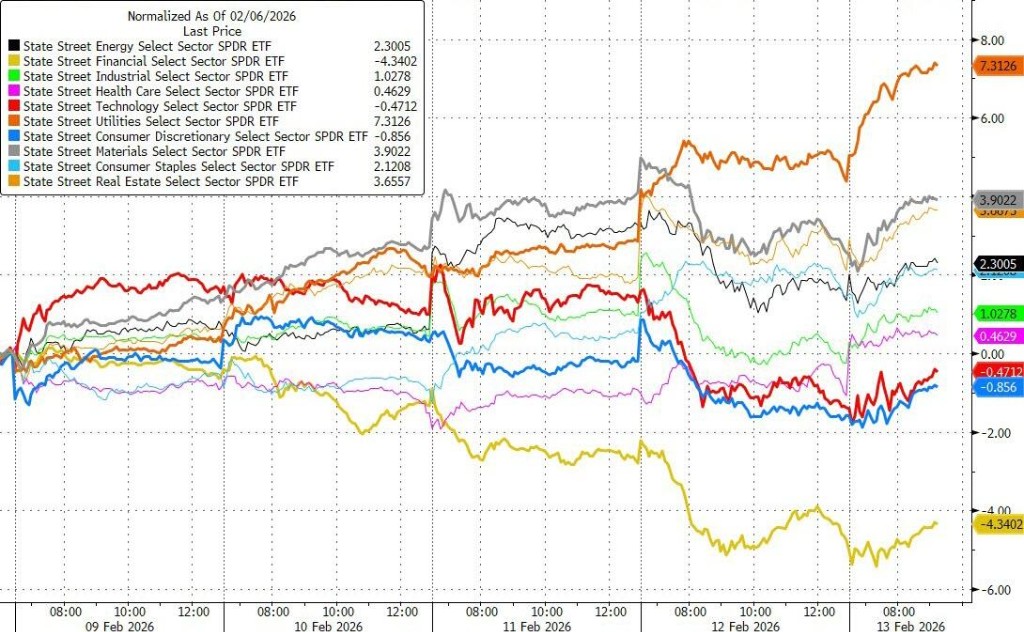 (This week, the U.S. utility sector performed significantly better as a safe haven against AI impacts, while the financial sector became the worst-performing sector of the week.)
The bets that Wall Street was highly confident in have completely failed within six weeks. Fund managers who had historically low cash allocations and minimal hedging at the beginning of the year are now witnessing the collapse of consensus trades, with the most favored assets losing to the least favored ones.
Energy, essential consumer goods, and U.S. Treasury bonds are leading the market in 2026, while the consensus bets on AI made at the beginning of the year have all failed. The iShares 20+ Year Treasury Bond ETF (TLT) recorded its largest gain since April this week, while the S&P 500 tracking ETF (SPY) has lagged TLT by 2 percentage points since December, marking the worst year-to-date performance in a decade.
AI Transitions from "Sure Win" Trade to "Disruption" Threat
The AI investment theme, initially seen as a certain opportunity, is now becoming the largest source of uncertainty in the market.
Investors are beginning to question the timeline for returns on the massive capital expenditures of tech giants and whether remaining cash can continue to support stock buybacks. Adam Crisafulli, co-founder of Vital Knowledge, stated:
In the past few months, more stocks have been harmed by AI than helped.
Morgan Stanley's Chief Investment Officer Jim Caron previously stated on a media program:
We are experiencing a re-pricing in a certain sector of the market, namely the software industry. The market is concerned that this could trigger a contagion affecting other areas.
He is focusing on two questions: whether the losses caused by AI will lead to contagion and how to hedge this risk through diversification.
Extreme Positions Amplify Market Volatility
Two forces are exacerbating volatility in the U.S. stock market.
First is position allocation. A Bank of America investor survey in January showed cash allocation dropped to a historical low of 3.2%, with nearly half of fund managers holding no downside protection, the lowest level since 2018.
Second, the leverage network connects seemingly unrelated portfolios, where a liquidation in one corner triggers a sell-off in another area. James Athey, a portfolio manager at Marlborough Asset Management, stated:
The biggest risk here is additional volatility shock events. Everything seems highly correlated, so a sell-off in one asset could force other assets to experience sell-offs.
According to Wall Street Insight, the broad decline in U.S. stocks this Thursday triggered algorithmic selling in metals, forcing some investors to exit commodity positions, including metals, to gain liquidity. Gold fell more than 3% that day, dropping below $5,000, while silver plunged 11%.
A model designed by Jordi Visser of 22V Research shows that even with the VIX remaining low and the S&P 500 index staying above the 50-day moving average, market connectivity is soaring. This combination is interpreted as pressure hiding beneath a calm surface.
In the past two years or so, such pressure signals have appeared about once a month. However, in less than two months this year, there have already been more than a dozen.
This week, the VIX briefly broke through the widely watched 20 level. Although the readings did not show signs of panic, the skew of put options remains at historically high levels, indicating that the market is methodically buying protection against downside risks.
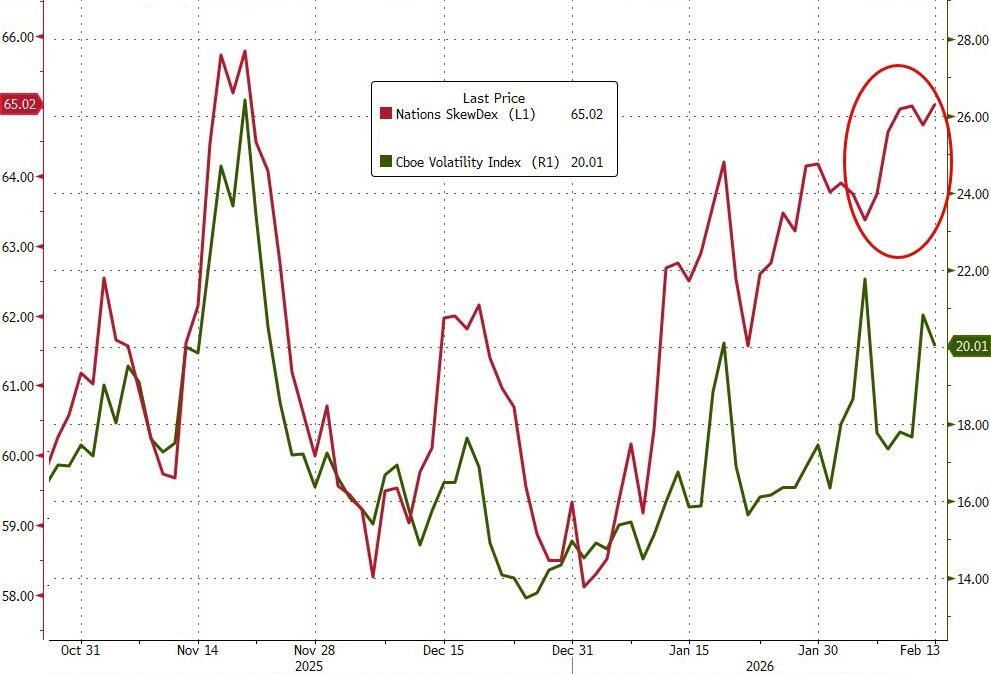 (The skew of put options has surged this year)
The ETF tracking investment-grade bonds (LQD) recorded its best weekly performance since October relative to the high-yield bond ETF (HYG), expanding its lead for the year. Meanwhile, the yield on the U.S. 10-year Treasury bond closed at a two-month low this week.
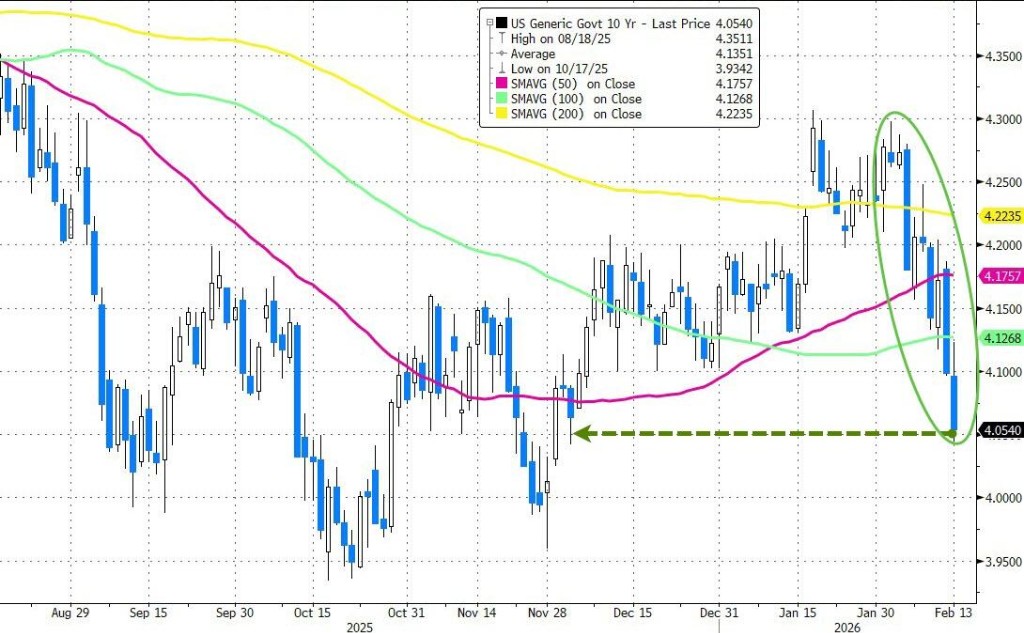 (The yield on the 10-year Treasury bond closed at a two-month low)
Investors Begin to Adjust Strategies
Currently, the extreme volatility has not evolved into a sustained market collapse.
The S&P 500 index is still hovering near historical highs, and credit spreads remain near ten-year lows. However, looking at the trading volume of put and call options on individual stocks, hedging activity is increasing.
The put/call ratio indicator from the Chicago Board Options Exchange has surged since January, rebounding from near four-year lows.
ETFs tracking companies with higher shareholder returns attracted $3.6 billion in new funds this month, making it the largest among the so-called smart beta funds tracked by Bloomberg.
Analysts believe that if negative news about AI disruption pauses and volatility decreases, U.S. stocks may support upward movement as traders shift their hedging to more supportive positions. But as Goldman Sachs' Chris Hussey stated:
AI will disrupt the market consensus across a wide range of economic sectors, creating a conflict with macro data and corporate performance that show no abnormalities. Whether the collective consensus will prevail or the ongoing theme of economic resilience post-pandemic will continue, with U.S. growth and corporate earnings remaining robust, may take a considerable amount of time to determine.
