


"We are witnessing a wave of AI creative destruction sweeping across various industries globally"! Goldman Sachs partner: Essentially, this is a "moat check."
Goldman Sachs partner Rich Privorotsky believes that the market is caught in a "sell first, ask questions later" panic, which is essentially a comprehensive examination of companies' moats. He suggests focusing on companies with real moats, physical assets, and industrial stocks, and is optimistic about the aerospace sector, but warns of risks in bank stocks. Goldman Sachs expects CTAs to sell off $1.5 to $2 billion in U.S. stocks, and if the S&P breaks below the mid-term threshold of 6,723 points, it will accelerate the selling pressure
Goldman Sachs partner Rich Privorotsky warned that a "creative destruction" driven by artificial intelligence is sweeping across industries in real-time, essentially a comprehensive test of corporate moats.
From the shock faced by the software industry last week to the initial impact on insurance and wealth management stocks at the beginning of this week, followed by real estate services and logistics sectors later in the week. AI was initially seen as a positive factor for the stock market, but it is now aggressively testing which companies truly have defensible competitive advantages.
The sentiment of "sell first, ask questions later" is spreading in the market, with the pace of selling accelerating, but there are no clear catalysts other than concerns about AI. Rich Privorotsky believes this is a moat check:
Can a company's business withstand technological shocks? If there were an army of robots, could they disrupt existing companies? Must companies compete to invest or acquire, or they will be replaced?
Privorotsky further emphasized the need to be wary of CTA (Commodity Trading Advisor) trigger signals in major U.S. stock indices. Goldman Sachs currently estimates that CTAs will sell off $1.5 billion to $2 billion worth of U.S. stocks in the coming week.
Software Sector Valuation Under Pressure
Rich Privorotsky believes that AI has not allowed everyone to win effortlessly; instead, it is making it impossible for those who want to "lie flat and earn interest" in the economy to hide.
In many areas previously thought to have moats, technological advancements are rapidly dismantling those fortresses built on experience and knowledge work, with new entrants quickly challenging existing companies.
Once AI concerns disturb market sentiment, the terminal value of software and technology sectors comes into question, which is the core issue facing the current market.
Privorotsky pointed out that, based on his trading experience, valuation multiples are the hardest metrics to anchor; once they start to be questioned, it is often difficult to stop.
Currently, the valuations of publicly traded companies have fallen from over 30 times price-to-earnings ratio (blended forecast for the next 24 months) to just over 20 times, but the valuations of private equity portfolios often remain at much higher levels.
Thus, this turmoil has spread along the chain from the public market to the private equity sector, further affecting private credit, especially the leveraged loan market.
Market Signals Growth Shock
In the past week, U.S. Treasury yields have declined, while cyclical stocks have been sold off relative to defensive stocks.
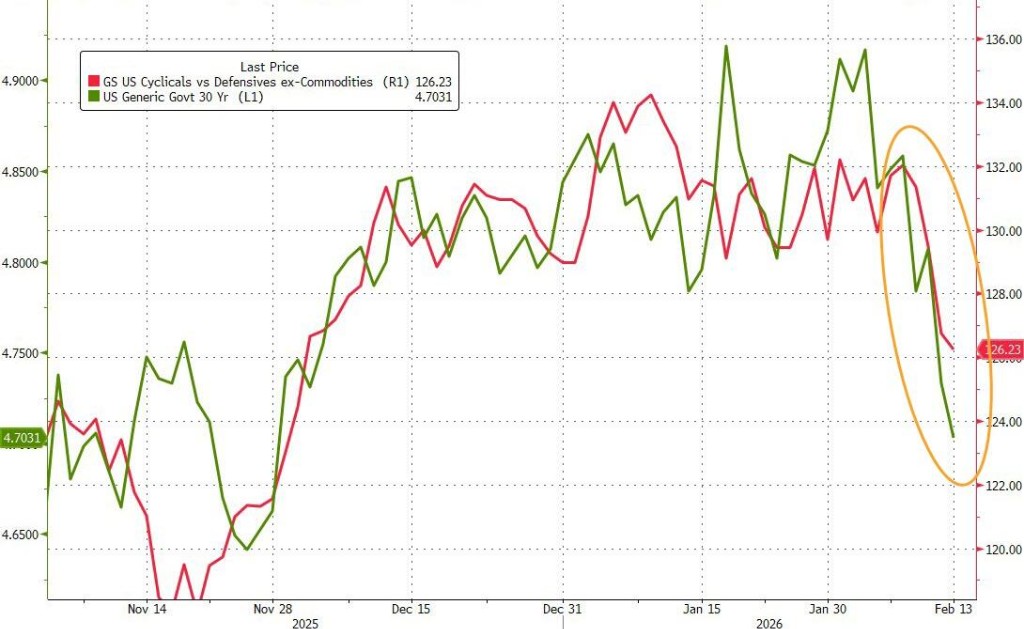
Goldman Sachs noted that the current market feels like a short-term growth shock. The yield curve is flattening, and bonds continue to rise.
According to Wall Street News, the U.S. January CPI year-on-year at 2.4% is below expectations, and the core CPI has dropped to its lowest level in four years. Market concerns about inflation have eased, consistent with the narrative that AI will disrupt multiple industries faster than expected Goldman Sachs believes that the final outcome may lead to a complete deflation in certain areas, as "rent-seekers" are losing pricing power.
Investors Should Look for Real Moats
In this environment, Rich Privorotsky suggests focusing on companies with real moats and tangible assets.
The aerospace sector feels timely, and exposure to companies like Airbus is worth paying attention to. Industrial stocks should perform well, but it is essential to select companies that benefit from the investment cycle rather than just short-cycle cyclical stocks.
Tangible assets are a bullish direction, although the surge in commodities is not worth chasing at this point. He is optimistic about European real estate investment trusts and bullish on German residential real estate but will avoid office building REITs.
Bank stocks appear weak, facing fourfold risks: in Europe, they are crowded long positions; risks from AI disruption or net interest margin compression are almost unaccounted for; a weaker dollar under deflationary mechanisms is unfavorable for the interest rate curve; in the U.S., predictive markets show a probability of over 30% for a Democratic sweep, significantly increasing regulatory risks.
CTA Sell-off Trigger Point Approaches
Rich Privorotsky emphasizes the need to be vigilant about the CTA trigger points for U.S. indices.
In North America, the most severe sell-off is expected not to be in the S&P 500 but in the Nasdaq 100. The S&P 500 has fallen below the 50-day moving average (6,895 points) and the CTA short-term threshold (6,911 points).
The good news is that the scale of the sell-off remains moderate. Goldman Sachs currently estimates that CTAs will sell off between $1.5 billion to $2 billion of U.S. stocks in the coming week. Additionally, the S&P 500 is still about 110 points above the mid-term threshold of 6,723 points, and falling below this level would accelerate the sell-off.
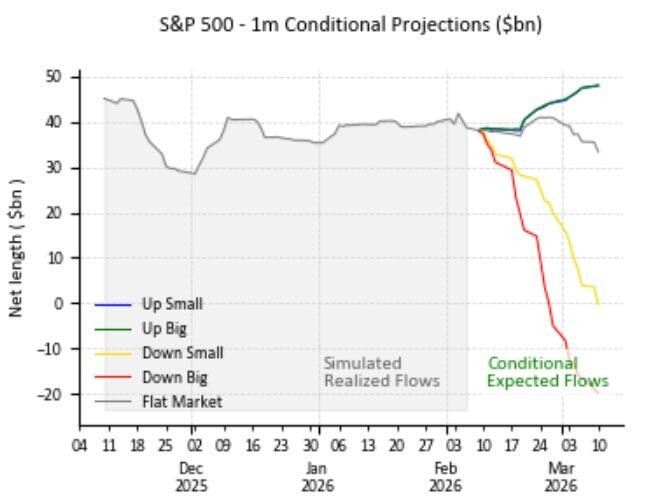 (Predicted fund flows for the S&P 500 index over the next month under different scenario trends)
Rich Privorotsky states that as AI lowers entry barriers every day, this is a market of winners and losers. He cannot predict what the shipping industry will look like tomorrow, but he can be certain that terminal valuation multiples are being questioned, which is structurally problematic.
The current environment favors companies with real moats and tangible value. Emerging markets remain a relatively clearer safe haven, and trading in other regions of the world will continue to drive relatively superior performance.
