


Mercedes-Benz China changes leadership, bidding farewell to the "Duan Jianjun era"
The first local executive has stepped down
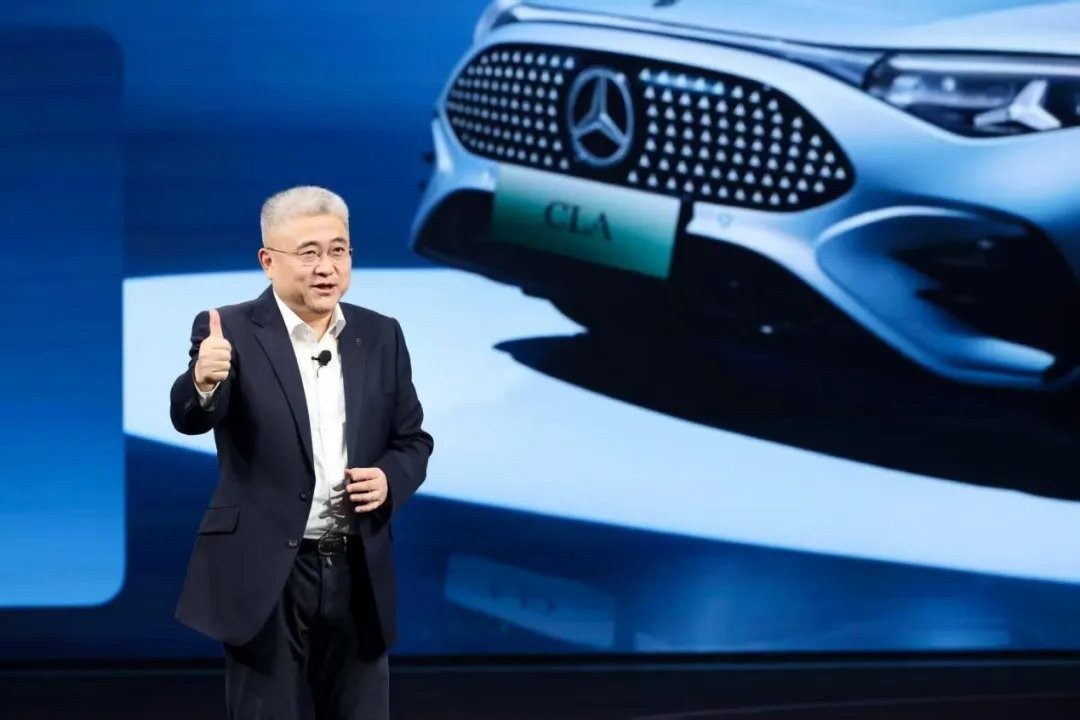
Author | Chai Xuchen
Editor | Zhou Zhiyu
The first local executive of Mercedes-Benz in China is about to leave.
On February 14, Mercedes-Benz (China) officially announced that Duan Jianjun has resigned from his position as President and CEO for personal reasons. Starting March 1, the baton will be passed to the current Executive Vice President of Sales, Daniel Lescow.
As the first local CEO in Mercedes-Benz's history in China, Duan Jianjun's departure seems to symbolize the end of an "era." A question inevitably arises in public discourse: does replacing a Chinese executive with a German executive mean that Mercedes-Benz's proud "localization" strategy is retreating? The answer is no.
Duan Jianjun's tenure was the most complex phase for Mercedes-Benz in China.
From Vice President of Sales to CEO, Duan Jianjun has worked deeply within the Mercedes-Benz system for many years. His most notable label is his unique "marketing aesthetics." Whenever a new car is launched, he can always quote classics and articulate eloquently. This style enhanced Mercedes-Benz's brand premium during the era dominated by fuel vehicles, making the "three-pointed star" a totem admired by the middle class.
During his tenure, although Mercedes-Benz's sales in China faced challenges, they maintained resilience. Especially in the three years from 2023 to 2025, facing the aggressive encroachment of new forces on the luxury car market and the pressure of a "price war," Duan Jianjun worked hard to maintain Mercedes-Benz's pricing system and brand dignity.
However, the market dynamics have changed.
As the penetration rate of new energy vehicles exceeds 50% or even higher, relying solely on brand accumulation and marketing rhetoric is no longer sufficient to withstand the impact of the wave of intelligence. Duan Jianjun's departure, to some extent, symbolizes that Mercedes-Benz has completed the phased construction of its "brand asset moat" in China. Moving forward, due to the fundamental restructuring of industry logic, Mercedes-Benz needs a more direct, hardcore approach that can mobilize global resources to break the deadlock.
If Duan Jianjun is the "Chinese who understands Mercedes-Benz the most," then his successor, Daniel Lescow, may be called the "German who understands China the most." He is not an envoy parachuted in from Stuttgart with no knowledge of China; on the contrary, his core professional achievements have almost all been made in the Chinese context.
Daniel Lescow was deeply involved in the rebranding of the Smart brand. The electrification transformation of Smart is a model created by the collaboration between Mercedes-Benz and Geely. In this process, Lescow not only had to understand Mercedes-Benz's brand tone but also needed to deeply integrate with a Chinese private enterprise like Geely.
During his tenure as Executive Vice President of Sales at Mercedes-Benz, Lescow also led a key strategic move—digitalization.
In China, the traditional 4S dealership model is facing collapse, and the direct sales model brought by Tesla and new forces has changed user habits. The digital transformation vigorously promoted by Lescow during his tenure bridged the gap between online and offline, allowing Mercedes-Benz to begin learning to engage directly with users like the new forces This indicates that he is not only familiar with the operation of the Chinese market but also has a deep insight into China's unique digital ecosystem.
Therefore, Li Desi is the best choice after Duan Jianjun's departure. He understands the global logic of the Stuttgart headquarters and holds the key to mobilizing the headquarters' technical and financial resources; he is also familiar with the jungle rules of the Chinese market.
According to Mercedes-Benz's 2025 financial report, the company delivered approximately 575,000 new cars in China last year, a year-on-year decline of about 19%. At the financial report meeting, Oliver Thöne, a member of the board of directors responsible for Greater China, stated: "China will continue to be the most important single market for Mercedes-Benz globally," but future development will focus more on value chain optimization and local profit improvement.
Currently, the Chinese business has been elevated to the strategic height of the board of directors. According to internal sources, Mercedes-Benz will launch more than 15 new and updated models in the Chinese market in 2026, marking the company's most intensive product offensive in history. According to the plan, in 2026, Mercedes-Benz will have over 15 new and updated products launched in the Chinese market.
Looking back, Duan Jianjun's departure and Li Desi's succession can be seen as a sign that Mercedes-Benz's "localization strategy" has entered the 2.0 phase.
In the past decade, the localization of multinational car companies has mainly been reflected in personnel and marketing: using Chinese executives, telling Chinese stories, and producing extended wheelbase models. Now, the core of localization has shifted to research and development and the industrial chain. With China's comprehensive lead in three-electric technology intelligence, Mercedes-Benz needs not only people who can sell cars but also those who can integrate Chinese technology with German mechanical quality.
The Chinese market is currently the "eye of the storm" for Mercedes-Benz's global transformation. In this market, a long decision-making chain is a fatal flaw for traditional car companies.
Having a trusted German executive like Li Desi, who has long been on the front lines in China, at the helm has the greatest advantage of reducing communication costs. He can more directly convey the urgency of the Chinese market to the board of directors, striving for more R&D authority and resource allocation. This is a form of "structural localization"—truly turning China into the second pole of global R&D, rather than just a sales center.
Currently, the biggest crisis facing Mercedes-Benz is the loss of the definition of luxury. Li Desi's primary task upon taking office is not to maintain the status quo but to attack. He needs to accelerate the implementation of the results from Mercedes-Benz's R&D center in China. Those familiar with Mercedes-Benz have told Wall Street Insights that "the role of such managers is never to pull the steering wheel back but to continue accelerating on the established path."
The Chinese automotive market in 2026 is no longer an era where foreign brands can make money effortlessly. Although the halo of BBA remains, the sense of crisis is unprecedented.
This leadership change at Mercedes-Benz is also a deep organizational restructuring to adapt to the new normal of the Chinese market. Duan Jianjun completed his watch and transition during the brand's peak, while Li Desi bears the heavy responsibility of leading Mercedes-Benz to break through in the second half of intelligence. Under Li Desi's leadership, Mercedes-Benz needs to deliver products that are smarter, more attuned to Chinese users, and still maintain the standards of Mercedes-Benz.
In the business world, only evolution is the best annotation for localization
