


Even if investors crash the stock price, the 200 billion dollars must be "burned," Amazon needs to "reorganize its flag"
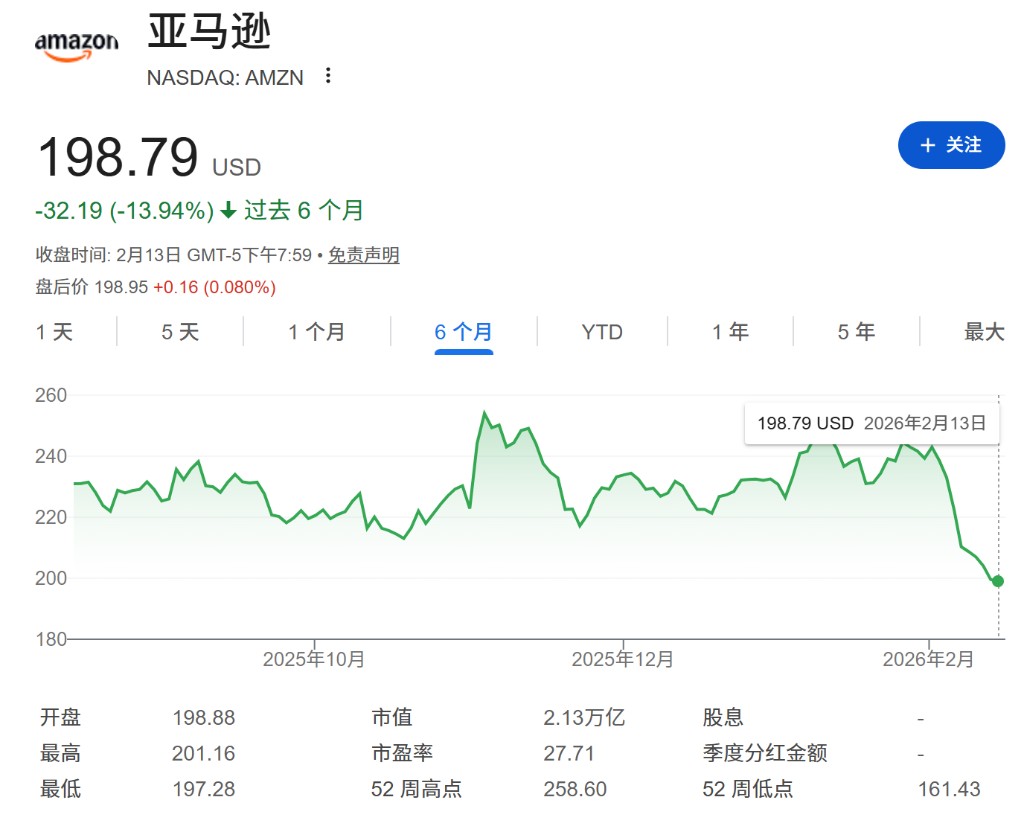
Amazon plans to invest $200 billion this year (the largest capital expenditure in history) to regain leadership in AI, focusing on AWS data centers, self-developed Trainium chips, and the Nova model. However, investors are concerned about slow returns, with the stock price falling over 20% from its peak; internal anxiety is spreading: AWS is lagging in order acquisition, self-developed models are jokingly referred to as "Amazon basic version," and engineers prefer to use competing product Claude
Amazon is launching its largest capital expenditure plan in history, attempting to regain momentum in the field of artificial intelligence through massive investments and defend its leading position in cloud computing. In the face of strong challenges from Microsoft and Google, this tech giant is trying to turn the tide by expanding data centers, developing chips, and building models.
According to the Financial Times, Amazon CEO Andy Jassy announced last week that the company's capital expenditure this year will rise to $200 billion, surpassing the spending levels of Google and Microsoft. This enormous investment will primarily focus on computing infrastructure, with about three-quarters of the budget allocated to its cloud computing division, AWS. Meanwhile, Jassy has not only integrated chips, models, and advanced research teams to unify the AI strategy but has also cut costs, eliminating about 30,000 corporate positions.
However, investors are uneasy about the scale of this gamble. Due to concerns that the massive spending will translate into returns too slowly, Amazon's stock price has fallen more than 20% from its peak last November. Despite facing market punishment, Jassy remains committed to this strategy, stating that the company has deep experience in understanding AWS demand signals and converting capacity into capital returns, and he is confident in this investment.
AWS employees reveal that the company's aggressive moves reflect internal anxiety that Amazon has not fully capitalized on its first-mover advantage in cloud computing. Particularly after OpenAI launched ChatGPT in 2022, Amazon's response speed in securing major AI supplier contracts has lagged behind its competitors.
The Largest Capital Expenditure in History
According to public documents, the $200 billion capital expenditure that Amazon plans to invest will be largely used for the expansion of AWS. In contrast, total spending by Microsoft, Google, and Oracle is expected to approach $400 billion this year. Jassy stated, Amazon plans to significantly increase data center capacity this year. By 2025, the company will have added nearly 4 gigawatts of capacity, equivalent to the annual energy consumption of over 3.2 million American households, and plans to double that capacity by 2027.
To support this expansion, Jassy adjusted the organizational structure last December, integrating the group's chip, model, and advanced research teams under a unified leadership structure. Jassy emphasized that the company will continue to operate like "the world's largest startup," maintaining a customer-centric, lean, and fast-moving state.
Competitive Anxiety Facing AWS
Despite AWS generating nearly $130 billion in sales last year and contributing over 60% of Amazon's total profits, it remains the largest cloud service provider in the world. However, analysts predict that as demand for AI-driven cloud services surges, Microsoft's cloud business will surpass AWS within the next three years According to more than a dozen current and former senior employees, AWS is losing ground in the race for enterprise AI contracts. A former senior AWS employee admitted, "We were completely unprepared for things to develop this quickly."
This lag is reflected in key deals. As one of the earliest investors in OpenAI, Microsoft secured an exclusive cloud computing contract with the ChatGPT maker early on. Amazon only signed a $38 billion cloud computing agreement with the startup last year after OpenAI allowed for a corporate restructuring. However, the scale of this agreement pales in comparison to the $250 billion contract OpenAI signed with Microsoft and the $300 billion deal with Oracle. Additionally, although Amazon invested $8 billion in Anthropic and built data centers for it, this investment was made only after Google supported the startup.
Chip Strategy and Computing Power Breakthrough
To reduce dependence on NVIDIA products and improve profit margins, Amazon is vigorously promoting its self-developed chips. The company claims that sales of its Graviton chips for general cloud computing and Trainium chips for AI training are expected to generate over $10 billion in annual revenue. In December last year, Amazon launched its latest generation of Trainium chips, promising significant performance improvements.
Insiders revealed to the media that Amazon is negotiating to join OpenAI's latest billion-dollar funding round, partly to ensure that the ChatGPT maker adopts its semiconductor products. However, competition remains fierce. Google has successfully attracted Anthropic to purchase its 1 million TPUs (Tensor Processing Units), with the deal valued at several billion dollars.
Ben Bajarin from the tech consulting firm Creative Strategies expressed skepticism about whether leading AI startups would adopt Amazon's chips. He pointed out that while Amazon emphasizes cost-effectiveness, some users prioritize extreme performance, even if Amazon's solutions have lower operating costs than NVIDIA's.
Self-Developed Model Mocked as "Amazon Basics"
In model development, Amazon is also investing in its AI model named "Nova," positioning it as a low-cost alternative to competitor models. However, independent benchmark tests show that Nova's performance lags behind the state-of-the-art models produced by OpenAI, Google, Meta, and Anthropic.
According to insiders, some AWS employees privately refer to Nova as "Amazon Basics," a term typically used to denote the group's generic low-cost home products, which has frustrated executives. Although the company encourages employees to use its own AI tools and has set a goal for 80% of developers to use AI for coding at least once a week, several company engineers stated that they prefer to use Anthropic's Claude model over Nova for coding tasks. One AWS engineer even bluntly stated, "I didn't even know we were supposed to have a model." This pressure to regain ground in the AI competition is weighing heavily on employees. Some employees are concerned that Amazon may slide into the "Day 2" state described by founder Jeff Bezos in 2018—where the business stagnates and then experiences an "extremely painful decline." A senior engineer at AWS stated, "The culture has changed, and the world around us has changed. We must prove our value."
