


The last time the argument of "software is doomed" occurred was 10 years ago. What happened afterward?
Barclays pointed out that the current panic over AI is reminiscent of the rise of AWS ten years ago, but history has shown that no software giants went bankrupt as a result; instead, companies like Microsoft achieved several times growth. Today, the valuation of the software sector has been significantly compressed, and indiscriminate selling has created huge mismatched opportunities, with companies that have moats being mispriced
Barclays believes that the market is replaying a historic panic, but this time it may be mistaken.
According to the Wind Trading Desk, on February 13, Barclays analyst Raimo Lenschow's team pointed out in their latest research report that investors' current reaction to generative AI (GenAI) is based on a "worst-case scenario assumption" — that is, believing that the terminal value of traditional software companies will drop to zero. This panic is reminiscent of the market's "death sentence" for the software industry when Amazon AWS rose to prominence a decade ago.
Historical data shows that extinction did not occur. Although AWS did capture market share, no mature software giant went bankrupt as a result. On the contrary, giants like Microsoft and Salesforce achieved several times or even tens of times growth in market value through evolution. For investors, the current indiscriminate sell-off (Software Sell-off) creates significant mispricing opportunities. GenAI will expand rather than simply replace the software market, and companies with core record systems and specific domain moats are mispriced.
Familiar "Doomsday Theory": From AWS to GenAI
Investor sentiment in the software sector is currently at an extremely unique moment. The market generally believes that GenAI will fundamentally change the world, leading to a simplistic investment logic: buy AI newcomers and short all traditional software.
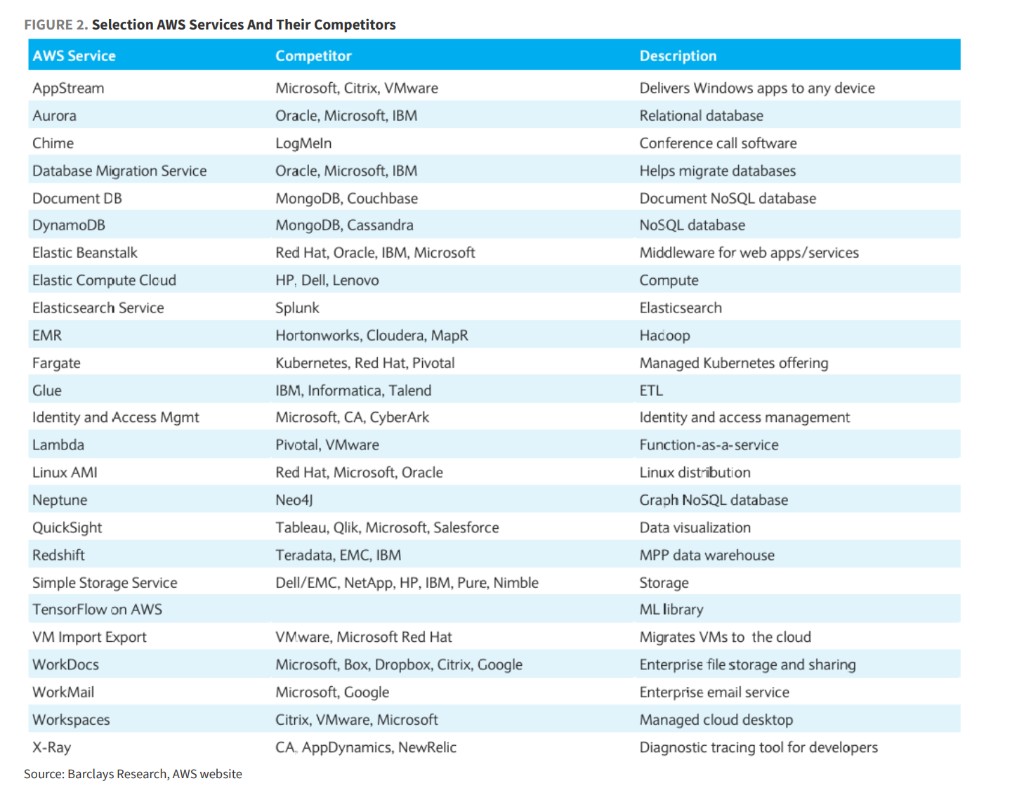
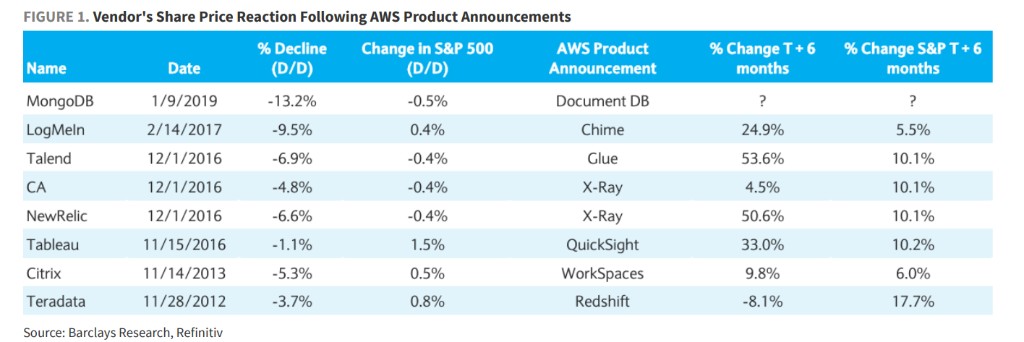
However, Barclays points out that this situation strongly resembles a decade ago (note: referring to the report's publication in 2026 looking back to around 2016). At that time, as AWS continued to grow and launched more proprietary software solutions (such as the database service Redshift), the market fell into a similar panic. Whenever AWS announced a new software product, the stock prices of mature software companies in the relevant fields would immediately suffer severe blows.
The bearish rhetoric at that time was identical to today: "The terminal value of these companies is zero," "AWS will swallow everything." The only difference is that AWS primarily impacted the infrastructure layer back then, while today's GenAI is more viewed as a threat to the application layer. But the market's panic mechanism is completely the same.
Historical Backtesting: Software Giants Did Not Perish, But Evolved Instead
Let's let the data speak. Looking back over the past decade, AWS has indeed achieved great success, capturing a significant market share, with many AWS products (such as Redshift and Hadoop services) performing exceptionally well. But did this "kill" the established software companies of that time?
The answer is no. According to Barclays' statistics, no mature software company went bankrupt due to competition from AWS (terminal value dropping to zero).
On the contrary, most companies continued to perform well in the market. The reality is that while AWS took a large slice of the pie, the entire market pie itself was also growing, and the established players were continuously evolving and responding According to data compiled by Barclays on "Software Stock Performance After AWS Product Launch" (as of the end of 2025):
- CyberArk (identity management): Since AWS launched competing services, its market value has soared from $885 million to $22.516 billion, an increase of 2443%, far exceeding the S&P 500 index's increase of 2201% during the same period.
- Microsoft (WorkSpaces competitor): Market value increased by 1048%, reaching $3.59 trillion.
- Google (WorkDocs competitor): Market value increased by 871%.
- Salesforce (QuickSight competitor): Despite facing competition from AWS analytics tools, its market value still grew by 373%, reaching $248 billion.
- MongoDB (Document DB competitor): Market value increased by 697%.
Of course, not all companies fared well. Some that failed to adapt performed poorly or were acquired:
- Teradata: Market value shrank by 73%, significantly underperforming the market.
- NetApp: Although its market value increased by 71%, it lagged significantly behind the S&P 500 index (behind by 357%).
- Tableau, Splunk, Red Hat: Ultimately acquired at a high premium, they did not face extinction.
The historical lesson for today is clear: While GenAI will create interesting new companies, it does not mean we need to write off the value of all existing software companies.
Market Misjudgment: Software Is Not Dying, It's Changing
The current market debate is overly simplistic. While IGV (software ETF) has fallen about 24% year-to-date (YTD 2026), and the S&P 500 index has remained basically flat, this is an irrational behavior of "throwing out the baby with the bathwater."
The market mistakenly views all existing software companies as "relics of the old era" that are about to be replaced by new players like OpenAI or Anthropic. Barclays believes that this "one-size-fits-all" perspective overlooks the complexity and moats of the software industry.
Investors should reassess the following three categories of assets that have been mistakenly harmed in the sell-off:
- Owners of System of Record: Such as Salesforce (CRM) and SAP. These companies hold the core data of enterprises, have a solid position, and are difficult to replace simply.
- AI tool providers: Companies that help enterprises implement AI, such as JFrog (FROG) or Snowflake (SNOW) (although analysts currently hold a neutral rating on the latter two, they acknowledge they belong to this category)
- AI computing power providers: such as Oracle (ORCL), DigitalOcean (DOCN), or CoreWeave.
Defensive Moats: Security and Vertical SaaS
In the current wave of AI disruption, not all software is equally vulnerable. Barclays specifically points out two areas with defensive attributes:
- Cybersecurity: The adoption of AI will lead to a more complex IT environment and increase the efficiency of hacker attacks, which in turn raises the demand for advanced security protections. Although there are rumors that AI companies like Anthropic may expand into the cybersecurity field, historically, attempts by large general-purpose platforms to dominate the security space have often had mixed results. Platform companies with strong cash flows and growing AI revenue streams, such as Palo Alto Networks (PANW), CrowdStrike (CRWD), and Zscaler (ZS), possess strong defensive characteristics.
- Vertical SaaS: such as Veeva Systems (VEEV), Tyler Technologies (TYL), and Autodesk (ADSK). These companies typically serve as "record systems" for specific industries, possessing deep domain-specific data moats that general AI finds difficult to replicate through simple code generation. Additionally, IT buyers in end markets such as government, pharmaceuticals, and financial services tend to be more conservative, providing these companies with extra cushioning.
In summary, GenAI is indeed changing the game, but betting on a "software apocalypse" was wrong a decade ago and is likely still wrong today. For savvy investors, the current panic selling is the best opportunity to find those industry leaders that have been mistakenly punished.
