


At the beginning of the new year, how to view the appreciation of the RMB?
On February 12, 2023, the RMB exchange rate broke through the 6.9 mark, reaching a 33-month high. Although some countries accuse the undervaluation of the RMB exchange rate of affecting trade, the market's view on RMB assets has shifted, beginning to focus on which Chinese assets are worth investing in. The weakening of the US dollar is one of the backgrounds for the appreciation of the RMB, but the pace of RMB appreciation needs further analysis
The RMB exchange rate has broken through a new threshold.
On February 12, the offshore and onshore RMB against the US dollar broke through the 6.9 mark, reaching the highest record in 33 months since May 4, 2023.
Exchange rate fluctuations are normal, but some countries blame the trade deficit with China on the "undervalued RMB exchange rate." Amid these accusations, certain countries have begun to urgently call for China to accelerate the pace of RMB appreciation, arguing that the current rate of appreciation is far from sufficient.
Such rhetoric often carries two underlying assumptions: one is that exchange rate fluctuations are implied to be "controllable operations" by China, and the other is that RMB appreciation is directly equated with a means to weaken China's exports.
Clearly, this is not the case. We know that exchange rates reflect market sentiment and are also influenced by economic fundamentals. At the beginning of the new spring, we need to be clear about one thing: what does this round of RMB rising to the "6 range" actually mean?
The market's tone towards China has changed
To answer this question, let's first listen to the market's voice:
Recently, many international institutions, when releasing asset allocation recommendations for the new year, have shifted their discussions on RMB-related assets from "should we allocate RMB assets" to "which Chinese assets are worth holding."
This shift itself reveals the key logic behind RMB appreciation. One background factor is the weakening of the US dollar itself.
Since 2025, the US dollar index has significantly declined over multiple time periods, with an overall trend being relatively weak in recent years.
One reason behind this is that the Federal Reserve's continuous interest rate cuts have weakened the interest rate advantage of dollar assets and lowered the return expectations for the dollar, creating conditions for the relative strengthening of the RMB. In 2025, the Federal Reserve cut interest rates three times within the year, each by 25 basis points, totaling 75 basis points.
At the same time, the expansion of the US fiscal deficit and the rising scale of debt, combined with the high level of uncertainty in trade policies, have eroded the credit foundation of the dollar.
Moving forward, even if the dollar exchange rate experiences a temporary rebound, to restore a sustained strong trend, improvements must occur simultaneously in fundamentals, interest rate differentials, and global confidence. Currently, these conditions are still not fully met.
However, merely stating "the dollar is weakening" is not enough to explain the pace of this round of RMB appreciation. Observing the RMB to USD exchange rate trend, a key time point can be identified—April 9, 2025.
- Before April 9, the RMB trend was not obvious, with fluctuations both up and down, showing high volatility.
- After the 9th, the RMB suddenly reversed its previous weak trend and began to appreciate continuously.
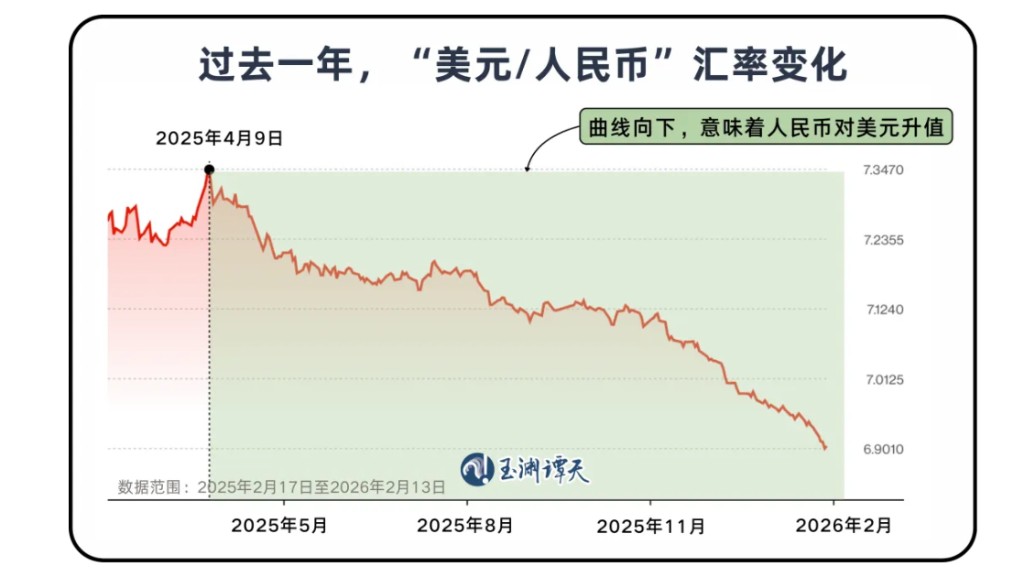
This time point coincides closely with the escalation of China-US trade frictions. On April 10, China's countermeasures against the so-called "reciprocal tariffs" from the US officially took effect. On that day, the US raised tariffs on China to 145%, and China subsequently retaliated According to common logic, an escalation in trade friction often means an increase in uncertainty, which would likely put pressure on the exchange rate. However, this time, the trend of the Renminbi has reversed. The Renminbi not only did not weaken but also turned around its previous weak trend and began to appreciate continuously.
Yang Changjiang, director of the International Finance Research Center at Fudan University, analyzed that one reason for this is the change in external expectations regarding the Chinese economy.
In early 2025, due to the threat of tariffs from the United States, there were doubts in the international market about the Chinese economy. The market was once lacking confidence in whether China could withstand external pressure. This expectation influenced the trend of the Renminbi exchange rate for quite a long time.
However, as China's countermeasures became more resolute, especially after China became the first country in the world to counter the United States' so-called "reciprocal tariffs" in April, market expectations began to shift from worry to trust.
In other words, the weakening of the US dollar provided an external environment, while the further changes in market expectations after April affected the specific pace of the Renminbi's appreciation.
At the same time, three realistic factors are also at play.
- First, macro policy deployment has left room for maneuver. The Central Political Bureau meeting in 2024 had already anticipated potential external shocks in 2025 and proposed at that time to "strengthen extraordinary counter-cyclical adjustments" to prepare for various situations. Looking back at the entire year of 2025, the operation of the Chinese economy achieved stability while seeking progress.
- Second, there is a lag effect in exchange rate transmission; orders, contracts, and pricing will not be completely influenced by exchange rates in the short term. Additionally, China is transitioning from exporting consumer goods to providing intermediate goods, so exchange rate changes will not easily lead buyers to cancel orders.
- Third, industrial competitiveness is also strengthening. Under policies such as "anti-involution," the profit margins of China's manufacturing industry are improving, the industrial structure is optimizing, and companies' ability to withstand exchange rate fluctuations is increasing.
With the combination of various factors, the market's judgment on the Chinese economy has become more stable, and the Renminbi exchange rate has also gained certain support.
The Renminbi is extending from a transaction currency to an asset currency
One special aspect of this round of appreciation is that the demand for the Renminbi from abroad is increasing, and the structure of that demand is changing. The usage scenarios for the Renminbi are expanding.
To understand where this change is occurring, we must first return to a more fundamental question: where does the international community's demand for the Renminbi primarily come from?
We can first look at our plans for the Renminbi.
At the Central Financial Work Conference in October 2023, we clearly proposed for the first time to accelerate the construction of a financial powerhouse. Building a financial powerhouse requires a series of key elements, one of which is "having a strong currency that is widely used in international trade, investment, and foreign exchange markets, and has the status of a global reserve currency."
This statement highlights three sources of international demand for the Renminbi:
First, payment and settlement in international trade and investment.
Second, trading and allocation in the market.
Third, the status of a reserve currency for global central banks.
This round of appreciation also indicates that the use of the Renminbi in cross-border trade settlement is increasing According to official data, about 30% of China's goods trade and more than half of China's cross-border transactions are being settled in RMB, an increase from nearly zero levels 15 years ago.
This change is particularly evident in emerging markets. The proportion of RMB settlements in trade with countries along the "Belt and Road" has increased even more significantly. In 2024, the growth rates of RMB settlement in trade with ASEAN and Africa reached 21.8% and 35.9%, respectively.
A portion of RMB settlements is also shifting from the SWIFT system dominated by Europe and the United States to China's Cross-Border Interbank Payment System (CIPS).
By 2025, the number of direct participants in the CIPS system has increased to 193, with 1,573 indirect participants, covering business in 190 countries and regions worldwide.
At the same time, the infrastructure for RMB in cross-border payments is accelerating its construction.
One manifestation is that China is enhancing the availability and usability of RMB overseas through its network of overseas clearing banks and currency swap mechanisms with global trading partners. China has signed currency swap agreements with over 40 countries and regions.
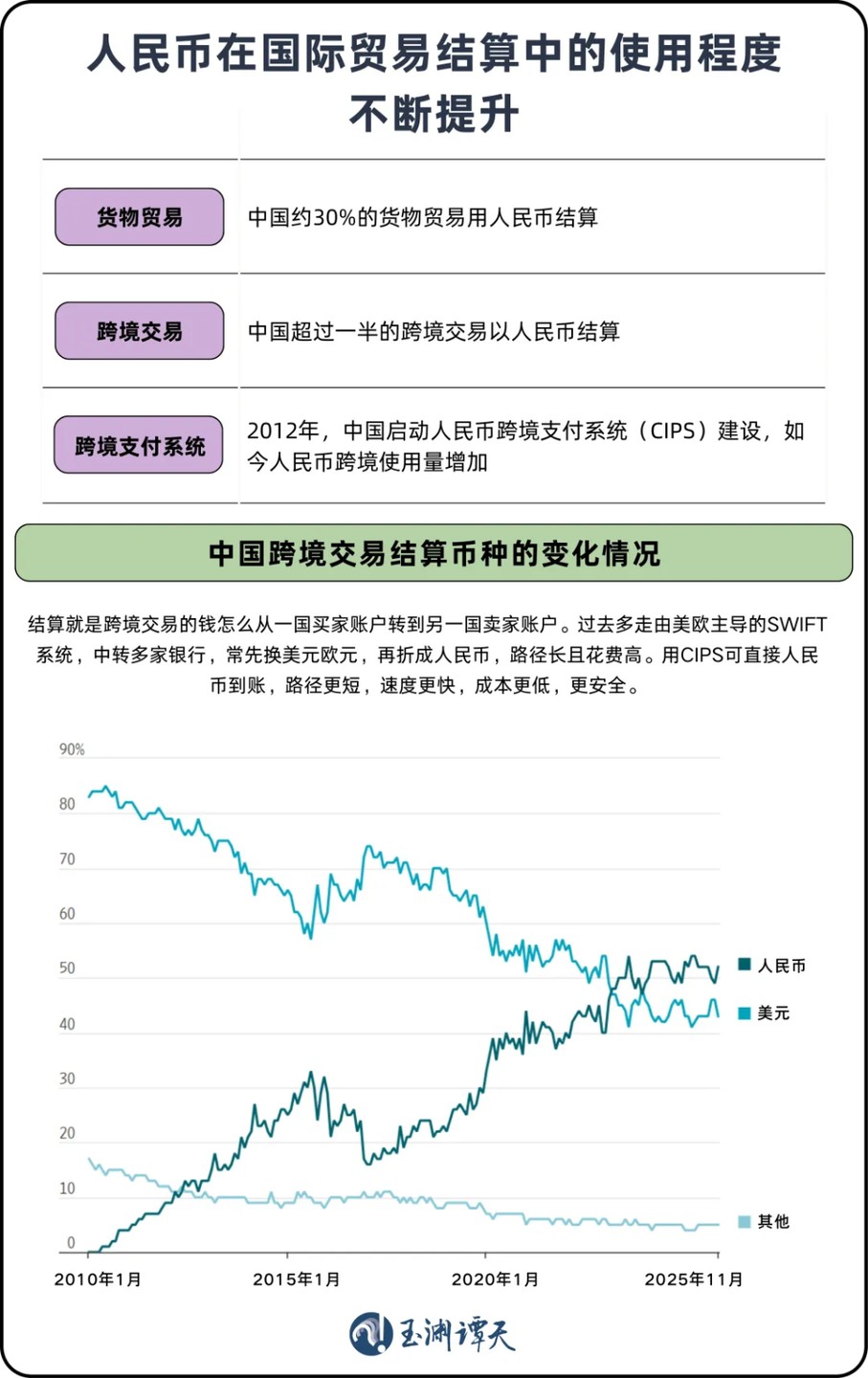
However, compared to trade settlements, a more noteworthy change at present is the rising presence of RMB.
On one hand, foreign investors are generally increasing their holdings of RMB-related assets.
By the end of the third quarter of 2025, the scale of RMB assets held by foreigners has increased to 10.42 trillion yuan, reaching a nearly 43-month high. Currently, the market value of Chinese stocks held by foreign investors exceeds 3.5 trillion yuan, making them an important participant in the Chinese stock market.
On the other hand, more issuers are starting to use RMB as an optional financing currency.
By 2025, the issuers of China's offshore financing instruments, "dim sum bonds" and "panda bonds," have also expanded.
These are two typical forms of RMB financing. "Dim sum bonds" refer to RMB bonds issued offshore, while "panda bonds" are RMB bonds issued by foreign entities in the domestic market.
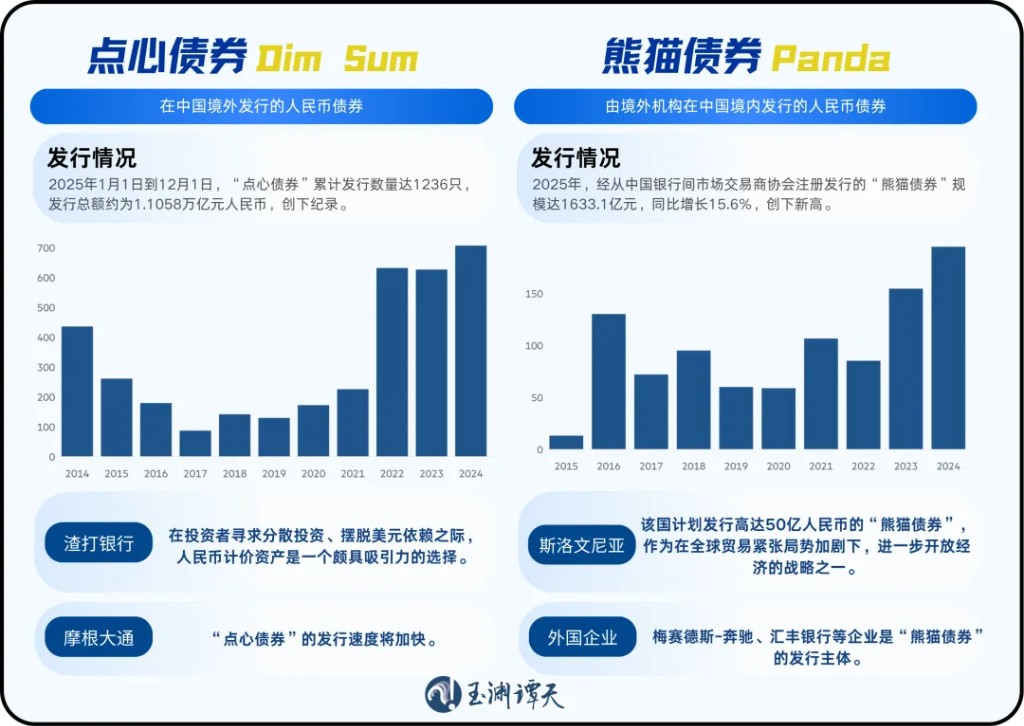
In recent years, market participants have been using RMB for financing in various ways.
Although the overall scale of these two markets still has room for further expansion, this change itself is a signal of the RMB's internationalization process.
Because for a long time, when we talked about RMB internationalization, we focused more on the first layer, which is trade and investment. But now when we talk about RMB internationalization, we can discuss various aspects beyond trade settlements.
A positive signal is that the third source of international demand for RMB—its proportion as a foreign exchange reserve currency—is also on the rise. An increasing number of countries are also considering using the renminbi as part of their diversified reserve currencies.
Tan Zhu has previously analyzed that although the renminbi's share in the global reserve currency system is still not high, changes are occurring. Central banks are optimizing their reserve structures by increasing their holdings of gold and renminbi, essentially promoting the diversification of reserve assets.
Currently, the external environment is changing, and the credibility of the US dollar is wavering; the status of currencies is changing, with multiple currencies replacing the position of the US dollar.
Returning to the initial question. What does it mean for the renminbi to rise to the "6 range"?
Future exchange rates may still fluctuate, but at least from the current trend, the renminbi is increasingly being viewed as a currency that can be traded, allocated, and financed.
In this deepening process of change, we will certainly encounter challenges.
But as we have seen, as long as we strengthen our internal capabilities and our economy remains resilient, there is no obstacle we cannot overcome.
In this sense, we can also say that the renminbi is standing at a new starting point.
Risk warning and disclaimer
The market has risks, and investment requires caution. This article does not constitute personal investment advice and does not take into account the specific investment goals, financial conditions, or needs of individual users. Users should consider whether any opinions, views, or conclusions in this article align with their specific circumstances. Investment based on this is at their own risk
