Storage giant's quarterly report "Five Key Points": Current cycle strength surpasses the 2017-18 "cloud boom cycle"

Bank of America Merrill Lynch pointed out that SK Hynix's inventory turnover days have dropped to a low of 127 days, with finished goods inventory remaining at only 2-3 weeks. Samsung's DRAM prices surged by 40% month-on-month, with spot prices reaching a 25-year high. Industry executives believe that the intensity of this cycle has surpassed the cloud boom period of 2017-18, and if the shortage continues until 2027, there is still room for price increases
With the disclosure of the fourth-quarter financial reports from storage giants, a clear signal is being released: the storage industry has not only emerged from its low point but has also entered an unprecedented "super cycle" driven by the AI wave.
According to the news from the Chase Trading Desk, this week, the Bank of America Merrill Lynch team summarized the highlights of the financial conference calls of storage giants and combined them with firsthand observations from the Semicon Korea semiconductor exhibition, pointing out that the current market is in a strong upward phase characterized by extremely low inventory, soaring prices, and significant capital expenditure expansion.
Five Key Signals from the Earnings Season
The Bank of America Merrill Lynch analyst Simon Woo's team distilled five core signals from the fourth-quarter financial reports of storage companies, which directly indicate a fundamental reversal in supply and demand relationships.
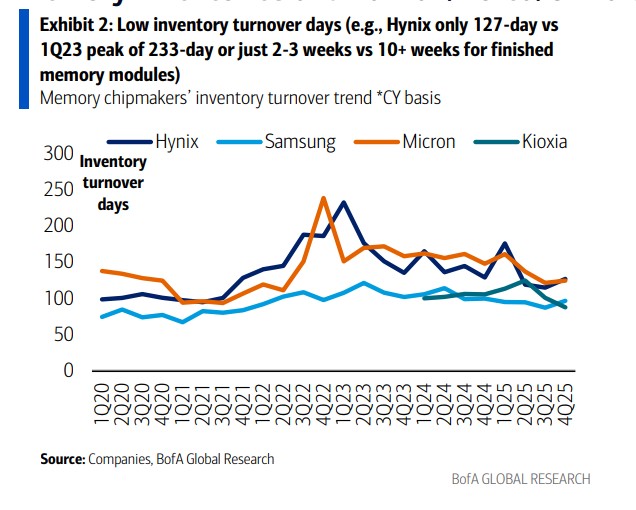
First, inventory levels have fallen below the "warning line." Taking SK Hynix as an example, its inventory turnover days have significantly decreased from a peak of 233 days in the first quarter of 2023 to just 127 days. Even more astonishing is that the inventory of finished storage modules can only last for 2-3 weeks, while the normal level is usually over 10 weeks. This means that any slight fluctuation in demand will put immense pressure on the supply chain due to shortages.
Second, the average selling price (ASP) of products is undergoing a "violent" recovery. Samsung Electronics' DRAM average selling price surged by 40% quarter-on-quarter, while SK Hynix's NAND price also increased by 32% quarter-on-quarter. Such price increases are rare in mature semiconductor cycles.
Third, giants are aggressively "burning money" to expand production. In response to the explosive demand for HBM (High Bandwidth Memory) brought by AI, manufacturers have launched aggressive capital expenditure plans. SK Hynix's capital expenditure is expected to soar from 7 trillion won in the fourth quarter of 2024 to 12 trillion won in the third quarter of 2025.
Fourth, the execution of HBM4 mass production exceeds expectations. Samsung and SK Hynix are making smooth progress in the mass production and shipment of the next-generation HBM4, which directly determines their future market share in AI computing power.
Finally, the industry outlook is extremely optimistic. This optimism is not only directed towards the first quarter of 2026 but also points to a long-term "storage super cycle." The president of Nanya Tech bluntly stated:
"Driven by AI, the current cycle is much better than the cloud server boom cycle of 2017-18."
He further explained that unlike highly customized wafer foundries, memory is still regarded as a commodity (following JEDEC standards), which means that if shortages persist until 2027, there is further room for price increases.
Bank of America's "Memory Indicator" also corroborates this. The indicator has rebounded to a "upward cycle" level of 124 in December, while the average for the first half of 2025 is only 103.

Spot Market: High Prices and Strong Export Data
Although recent DRAM spot prices have remained stable, this is based on a significant increase that has already occurred.
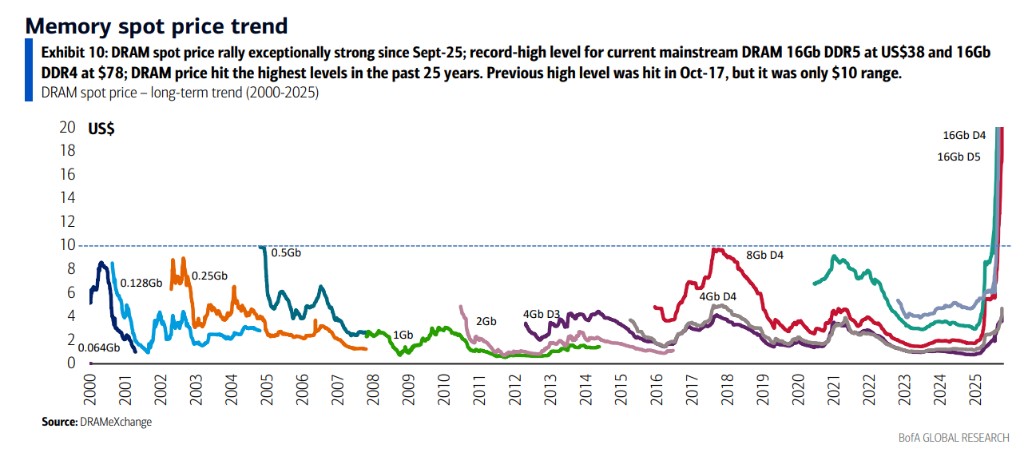
Currently, the mainstream 16Gb DDR5 spot price remains at a historical high of $38, with a year-on-year increase of up to 709%; the price of 16Gb DDR4 has even reached $78, soaring 2445% year-on-year. Bank of America Merrill Lynch pointed out that DRAM prices have reached the highest level in the past 25 years, far exceeding the $10 range during the peak of the last cycle in October 2017.
Although some OEM manufacturers have hinted at temporary shutdowns on assembly lines for low-end smartphones, tablets, and PCs due to skyrocketing storage costs or shortages, this has not hindered the overall strong shipping momentum.
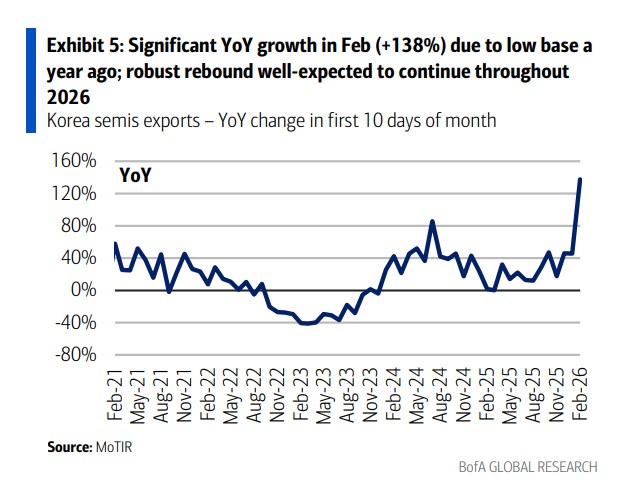
Data does not lie. The sales data from Taiwan in January showed strong performance, with monthly sales of manufacturers such as Nanya Technology, ADATA, Transcend, and Phison increasing by over 20% month-on-month and doubling year-on-year. South Korea's semiconductor exports in the first ten days of February also surged 138% year-on-year.

It is noteworthy that SSD (Solid State Drive) product prices surged significantly this week, with a week-on-week increase of 40% and a month-on-month increase of 60%, reflecting market concerns about potential shortages in the second half of the year.
Insights from the Korea Semiconductor Exhibition: A "Feast" for Equipment Suppliers
The Bank of America Merrill Lynch team visited the Korea Semiconductor Exhibition (Semicon Korea) held in Seoul, where the bustling atmosphere confirmed the industry's prosperity.
Exhibiting equipment suppliers revealed several key pieces of information:
-
Giants are not just customers, but also "financial backers": Samsung and SK Hynix's record capital expenditures have allowed equipment suppliers to reap substantial profits.
-
HBM production is extremely time-consuming: The manufacturing cycle for HBM is long, especially in the thermal compression bonding (TCB) stage. A single machine can only process a few wafers per day, so to maintain a capacity of 50,000 to 100,000 pieces per month, more than 100 TCB machines are needed.
-
Competition in technology routes: The adoption of HBM hybrid bonding technology may be delayed; even for 16-layer or 20-layer HBM, manufacturers still prefer to use NCF (non-conductive film) or MR-MUF (mass reflow molded underfill) technology.
-
Fluctuating orders for backend equipment but a positive outlook: Although backend equipment orders are currently weak, with the ramp-up of HBM4 capacity and the future launch of HBM4e, a recovery is expected in the second half of the year or by 2027.
The above wonderful content comes from Chasing Wind Trading Platform.
For more detailed interpretations, including real-time analysis and frontline research, please join the【 Chasing Wind Trading Platform ▪ Annual Membership】.