Morgan Stanley: AI is a capital expenditure black hole, with risks spreading to the credit market

Morgan Stanley pointed out that AI is shifting from a market hotspot to a source of structural pressure in the credit market. The "burning money" competition among tech giants has driven the capital expenditure expectations for 2026 up to $740 billion, with investment-grade bond issuance expected to reach a new high of $2.25 trillion. Meanwhile, the software sector has been sold off, and the pressure is being transmitted to leveraged loans and other credit areas. Morgan Stanley warned that although the default rate is low, price declines may deepen and expand
Morgan Stanley pointed out that artificial intelligence is transitioning from a mere hot topic in the capital markets to a real variable that triggers structural pressures in the credit market. The bank's North America fixed income research head, Vishwanath Tirupattur, believes that the market's perception of AI is showing significant divergence: on one hand, tech giants are continuously "burning money" on infrastructure, while on the other hand, the software sector is experiencing large-scale sell-offs. This divergence reflects investors' increasing vigilance that AI not only represents growth opportunities but also poses a survival threat to existing business models.
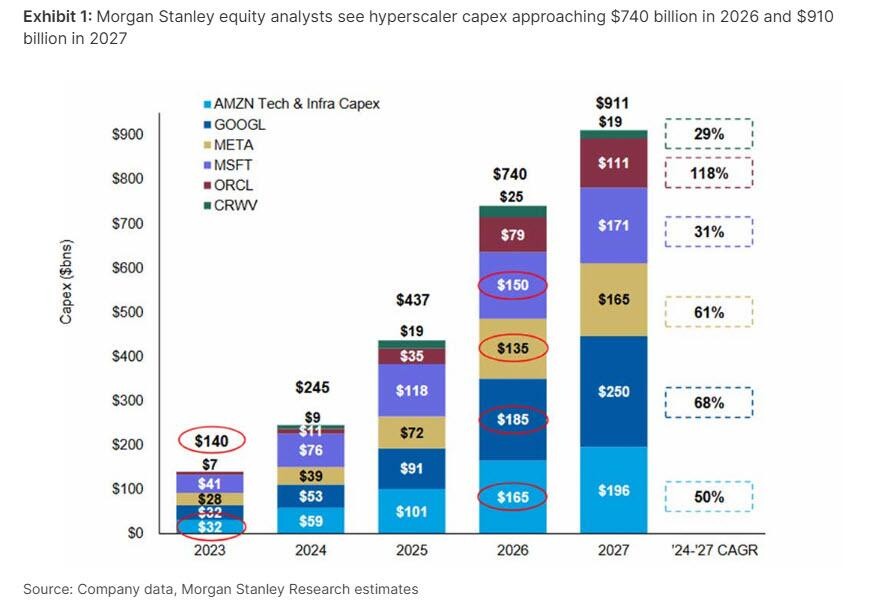
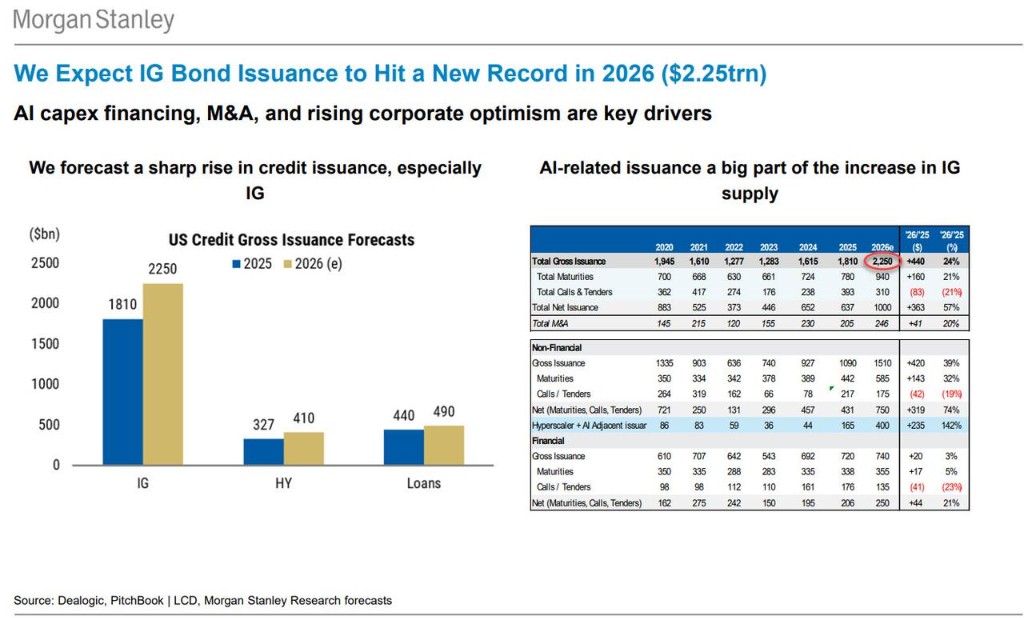
According to the Chasing Wind Trading Desk, the bank has significantly raised its capital expenditure expectations for hyperscale cloud service providers, forecasting that related spending will reach $740 billion by 2026. Driven by AI investment demand and a rebound in merger and acquisition activities, the bank expects the issuance of investment-grade bonds in the U.S. to reach a historic high of $2.25 trillion by 2026.
In this context, two key features are worth noting. First, the investment space remains vast. It is expected that by 2028, AI-related investments will grow cumulatively by 20%, but the actual investment currently falls short of even 20% of this scale. This means that the vast majority of investment opportunities are still ahead.
Second, the financing structure is undergoing changes. Unlike the spending phase of 2025 and earlier, the next phase of construction will rely more on diversified credit markets, including secured and unsecured financing, securitization and structured products, as well as joint venture models. The upcoming scale of capital expenditure is too large to be supported solely by equity financing; credit will play a core role in systemic financing.
Currently, the weakness in the stock market has transmitted to the credit market. Year-to-date, the S&P Software Index has fallen by 23%. This pressure is particularly evident in the credit sector, especially in areas with significant exposure to the software industry, such as leveraged loans and business development companies (BDCs).
Morgan Stanley warns that sentiment in related sectors may remain low, and credit investors may need to wait longer or for a more significant price correction before re-entering the market. Although the current default rate remains low, as AI applications accelerate and uncertainties persist, the price decline in the credit market may expand and deepen.
AI Investment Commitments Upgrade Reshaping Financing Landscape
The latest financial reports from large hyperscale cloud service providers confirm that investment commitments in AI infrastructure are accelerating. Morgan Stanley internet stock analyst Brian Nowak pointed out that leading platforms with the richest data resources and strongest investment capabilities are expanding their competitive advantages at an unprecedented pace, far exceeding expectations from just a few weeks ago.
Based on the latest guidance, the Morgan Stanley stock team has significantly raised its forecasts, expecting that capital expenditures for hyperscale cloud service providers will reach $740 billion by 2026, a sharp increase from the $570 billion predicted at the beginning of the year. The core logic remains solid: the demand for computing power continues to far exceed supply.
This financing demand is profoundly affecting the bond market landscape. Morgan Stanley expects that driven by AI-related capital expenditures and a rebound in merger and acquisition activities, the issuance of U.S. investment-grade bonds will rise to a record $2.25 trillion by 2026. An increase in supply may lead to a slight widening of investment-grade credit spreads before the end of the year. However, the bank believes that the current market situation is more akin to the scenarios of 1997-98 or 2005, where credit spreads widen against the backdrop of a rising stock market, but this does not necessarily indicate the arrival of a "cycle endpoint."

The Software Sector Faces Disruptive Shockwaves
Market concerns about the disruptive risks of artificial intelligence are continuing to ferment. This anxiety does not stem from doubts about the technological outlook, but rather from the market's increasingly clear recognition that the transformative power of AI is real, and massive capital expenditures are accelerating the conversion of this potential into reality. Recent reports indicate that advanced AI models are nearing the capability to perform most software engineering tasks, ringing alarm bells for investors and prompting the market to reassess two core issues: the speed at which the software industry is being disrupted and the breadth of the disruption's effects.
In the stock market, the software sector has become a hard-hit area. The S&P Software Index has fallen 23% year-to-date, while the S&P 500 Index has remained roughly flat during the same period. This significant divergence clearly outlines the market's pricing logic regarding AI disruption risks.
The weakness in the stock market is transmitting to the credit market, with pressure initially concentrated in areas with the largest exposure to the software industry. Data shows that U.S. software leveraged loans have declined by about 3.4% year-to-date, dragging the overall leveraged loan performance from positive to negative, recording a 0.4% decline. In contrast, high-yield bonds with smaller software exposure still recorded positive returns, indicating that risks have not yet fully spread.
The Credit Market Faces Ongoing Pressure
Morgan Stanley holds a cautious view on the current market outlook. The bank believes that sentiment in related sectors such as software may remain low, and it is currently unclear where the next catalyst for reversing the downturn will come from. Credit investors may need to wait longer or see more significant price corrections before re-entering the market.
Although the current default rate remains low, as AI applications accelerate and uncertainty continues to loom, the inability to identify which companies are truly facing survival risks may further expand and deepen the price declines in the credit market. Morgan Stanley warns that when default rates eventually rise, the recovery rates for defaults may be significantly lower than historical averages due to the generally asset-light nature of the affected companies.
From a more macro perspective, the bank points out that while a surge in supply may push investment-grade credit spreads wider, the current market situation is more akin to historical phases where credit and stock markets diverge but do not signify the end of the cycle. As credit strategists, Morgan Stanley is keenly observing the pressures accumulating within the credit market, with the core judgment being: the future productivity engine is catalyzing the current market pain.