


Industrial metals rise benefiting from the AI industry chain, AI disruption theory drags down US stock performance, Japanese summer fiscal events become the focus ---0218 Macro Dehydration

Since August 2023, the prices of precious metals and industrial metals have risen significantly, mainly driven by the AI industry chain. Despite the U.S. CPI being lower than expected, concerns about the profitability models of the financial, logistics, and real estate sectors being replaced by AI have led to poor performance in the U.S. stock market. Following the victory of Japan's Liberal Democratic Party, fiscal policy has tightened slightly, and several key fiscal events are expected this summer, including discussions on consumption tax reductions and the announcement of budget requests for the fiscal year 2027
- Since August 2023, the prices of precious metals and industrial metals have risen significantly. The driving factors of this cycle are different; the rise in gold prices is not due to loose monetary policy, and the rise in industrial metal prices is not due to traditional economic recovery, but rather the AI industry chain.
- Impacted by the "AI disruption theory," the market is concerned that the profit models of industries such as finance, logistics, and real estate may be replaced by AI, leading to a panic mentality of "sell first, ask questions later," and even the favorable news of the U.S. CPI inflation being lower than expected has not been able to stop the downward trend.
- After the victory of the Liberal Democratic Party in Japan, investors interpreted it as a slight tightening of fiscal policy, and the yen interest rates briefly flattened. The summer will see several key events, including discussions in the National Assembly on temporary consumption tax reductions, the formulation of basic guidelines in June, and the announcement of preliminary budget requests for the fiscal year 2027 in August.
I. Industrial Metal Prices Rise Benefiting from the AI Industry Chain
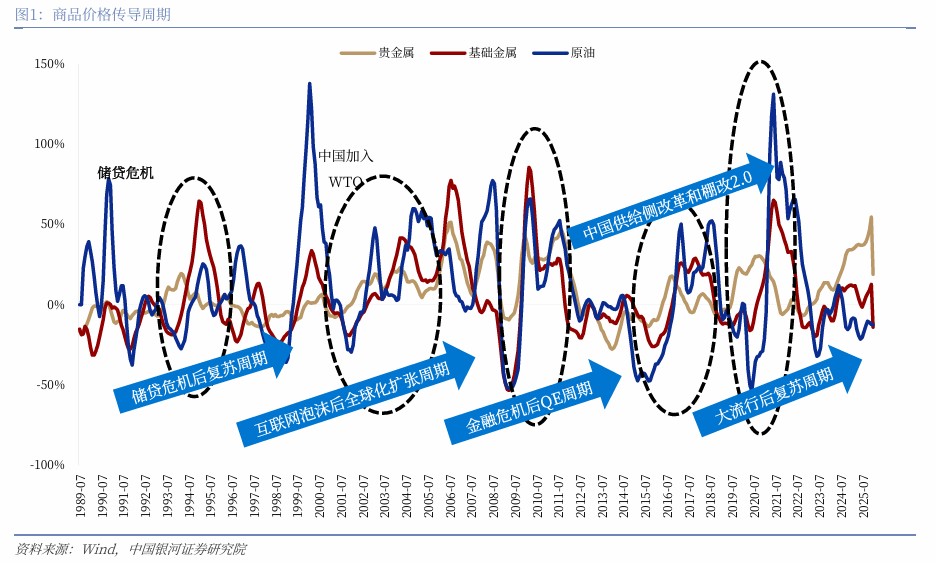
Industrial metal prices rise benefiting from the AI industry chain (China Galaxy)
China Galaxy pointed out that since August 2023, the prices of precious metals and industrial metals have risen significantly. The driving factors of this cycle are different; the rise in gold prices is not due to loose monetary policy, and the rise in industrial metal prices is not due to traditional economic recovery, but rather the AI industry chain.
-
Since August 2023, the prices of precious metals and industrial metals have risen significantly.
- The London gold price has increased by 45.6%, silver price has risen by 103%, and COMEX copper price has cumulatively increased by 15% since September.
- The market expects crude oil may become the next upward asset.
- Historically, the transmission logic of multiple commodity cycles from precious metals to industrial metals to crude oil has indeed been effective.
-
Compared to the past, the driving factors of this round of commodity cycle are slightly different.
- The rise in gold prices occurred in July 2023, when it was still in the Federal Reserve's interest rate hike cycle.
- Therefore, the main driving forces are expectations of de-dollarization, increased global central bank gold purchasing demand, and geopolitical risk premiums, rather than loose monetary policy.
- The rise in industrial metal prices is not driven by traditional economic recovery, but rather by the increased demand for copper from the entire AI industry chain, as well as the highlighted status of copper as an important strategic metal.
- With the acceleration of global electrification and the transition to clean energy, the growth rate of crude oil demand is slowing, and it cannot solely rely on traditional economic recovery to drive a rapid rebound in oil prices.
II. AI Disruption Theory Weighs on U.S. Stock Performance
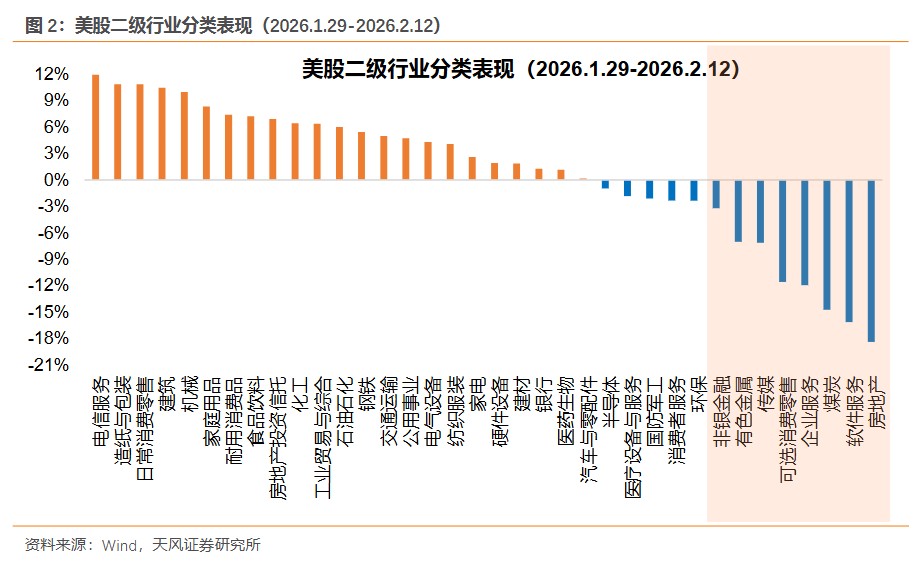
AI disruption theory weighs on U.S. stock performance (Tianfeng)
Tianfeng pointed out that impacted by the "AI disruption theory," the market is concerned that the profit models of industries such as finance, logistics, and real estate may be replaced by AI, leading to a panic mentality of "sell first, ask questions later," and even the favorable news of the U.S. CPI inflation being lower than expected has not been able to stop the downward trend.
- Under the "AI disruption theory," the market is re-evaluating the profit models of various companies that may be replaced by AI, leading to a panic mentality of "sell first, ask questions later," and all three major U.S. stock indices fell on February 12.
- In the financial services industry, there are concerns that AI tools may replace the business model of wealth management.
- In the logistics transportation industry, a small company called Algorhythm claims that its AI logistics platform can expand freight volume without increasing operational staff, impacting the business model of traditional logistics service companies.
- In the real estate sector, AI may lead to a significant decline in demand for office space.
- Despite the U.S. CPI inflation being lower than market expectations, the cooling of inflation still struggles to counter AI concerns, causing the three major U.S. stock indices to turn down after rising.
- Affected by overseas sentiment disturbances, A-shares weakened, U.S. Treasury yields declined, but the offshore and onshore RMB exchange rates broke the key level of 6.90 on February 12.
- The extended nine-day Spring Festival holiday may increase consumer spending, and the policy expectations for the Two Sessions are heating up, making it likely for A-shares to warm up after the holiday.
- Historically, small-cap growth stocks tend to outperform after the holiday, while large-cap growth and high-dividend assets are also expected to strengthen simultaneously.
III. Japan's Summer Fiscal Events Become the Focus
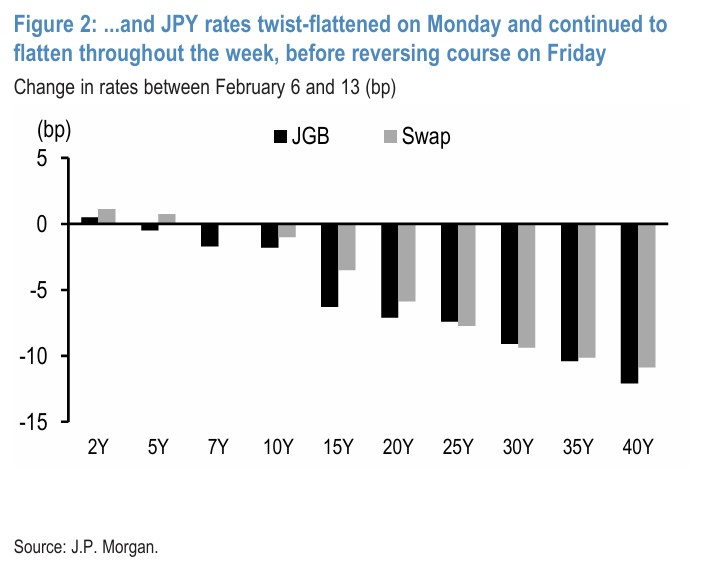
Japan's Summer Fiscal Events Become the Focus (Morgan Stanley)
Morgan Stanley pointed out that after the Liberal Democratic Party's victory in Japan, investors interpreted it as a signal that the fiscal stance would tighten slightly, leading to a flattening of yen interest rates. The summer will see several key events, including discussions in the National Assembly on temporary consumption tax reductions, the formulation of basic guidelines in June, and the announcement of preliminary budget requests for the fiscal year 2027 in August.
- After the Liberal Democratic Party achieved an overwhelming victory, yen interest rates continued to flatten until last Friday when the trend reversed.
-
Investors generally interpreted the Liberal Democratic Party's victory as a signal of a slightly less expansionary fiscal stance.
-
Fiscal risks have not dissipated, and key fiscal events will occur this summer:
- Discussions in the National Assembly on temporary consumption tax reductions and refundable tax credit systems, followed by the release of a mid-term report.
- Formulation of basic guidelines in June.
- Preliminary budget requests for the fiscal year 2027 announced in August.
-
The market may currently underestimate the likelihood of implementing consumption tax reductions.
- Despite the recent decline in the USD/JPY exchange rate, overnight index swap pricing has remained almost unchanged.
- If the Bank of Japan raises interest rates this spring, it will break the rhythm established so far.
- The market is likely to begin reflecting a cycle of raising interest rates once each quarter, leaving room for repricing.
- Recently, there have been successive reports about a series of $550 billion investment plans.
- Minister Akizawa Ryozo visited the United States, but no projects were announced by either side
- Media reports indicate that three projects are under consideration in the first batch, with an expected total business scale of approximately $42.5 billion.
Risk Warning and Disclaimer
The market carries risks, and investments should be made with caution. This article does not constitute personal investment advice and does not take into account the specific investment objectives, financial situation, or needs of individual users. Users should consider whether any opinions, views, or conclusions in this article align with their specific circumstances. Investing based on this is at one's own risk
