


Foreign capital sweeps Japanese stocks, with net purchases in a single week reaching the highest level since 2014!
The fiscal expansion plan of Takashi Saito, the weakness of the yen benefiting exporters, and global investors seeking more reliable sources of returns outside the U.S. market have jointly driven this wave of foreign capital inflow
Foreign capital is flooding into Japanese stocks at the fastest pace in a decade. In the week following the victory of high-profile candidate, overseas investors' net purchases of Japanese stocks and index futures reached a new high in over ten years.
Data released by the Japan Exchange Group on Thursday showed that for the week ending February 13, foreign net purchases of Japanese stocks and index futures totaled 1.78 trillion yen (approximately 11.5 billion USD), marking the largest single-week inflow since November 2014. This influx of funds closely followed the election victory, with market expectations for political stability and increased government spending driving buying activity.
So far this year, the Japanese stock market has significantly outperformed the U.S. stock market. The Tokyo Stock Exchange Index has risen 10% year-to-date, while the S&P 500 Index has only recorded a slight increase. Global investors are seeking more reliable sources of returns outside the U.S. market, benefiting the Japanese market.
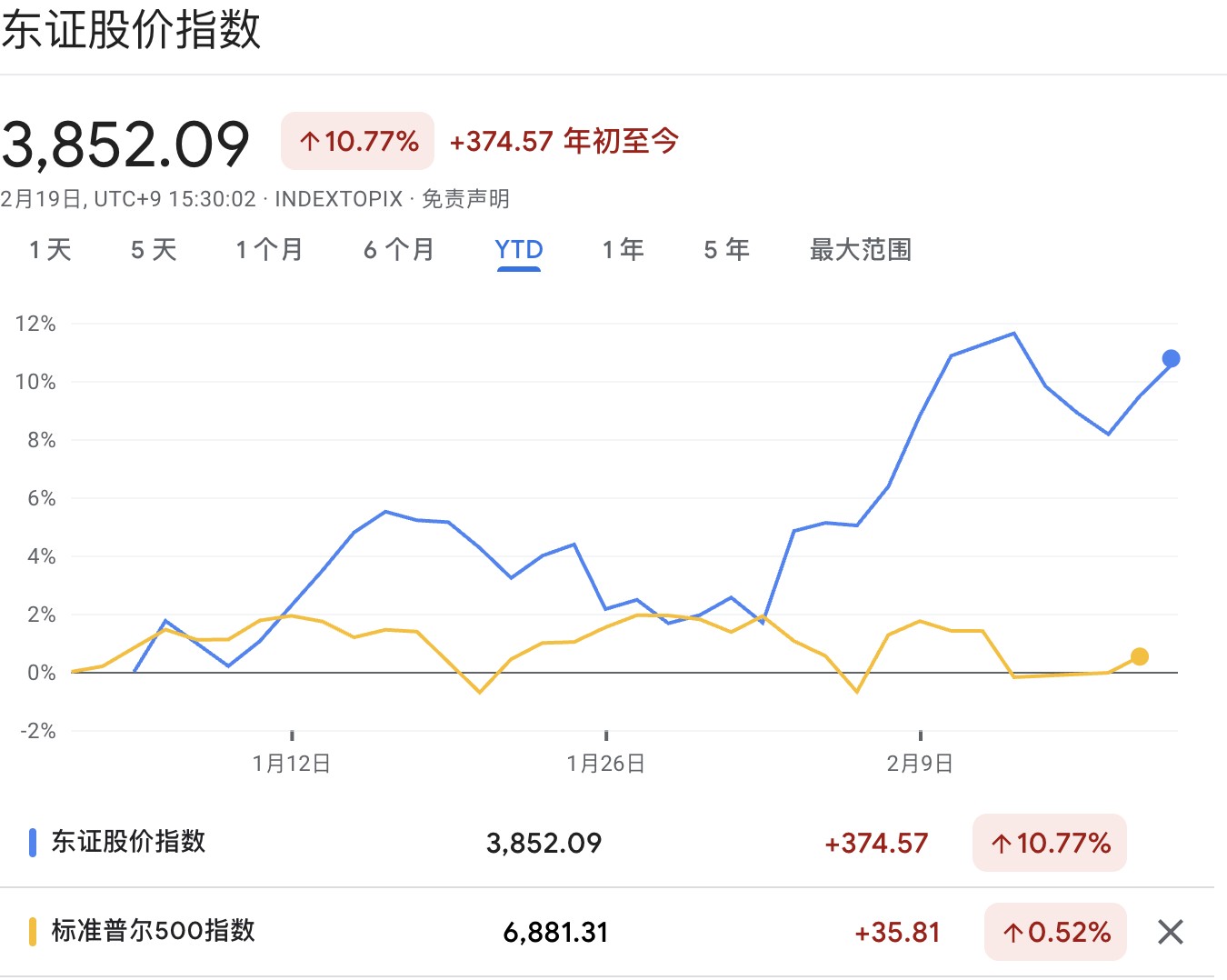
Multiple factors, including high-profile candidate's fiscal expansion plan, the weak yen benefiting exporters, and continued pressure from aggressive investors, have collectively driven this wave of foreign capital inflow.
Expectations of Fiscal Expansion Boost Market Sentiment
Russell Shor, a senior market strategist at Tradu based in Johannesburg, stated that if one is looking for investment opportunities outside the U.S. right now, Japan is one of the top choices.
He pointed out that the political stability following the election is significant, not just for the stability itself, but more importantly, for the advantages of high-profile candidate's victory. This makes Japan highly attractive, as the election win has injected confidence in policy continuity into the market.
The optimistic expectations for high-profile candidate's fiscal expansion plan have become the main driving force behind the influx of funds. Investors anticipate that his policies will boost multiple industries, from artificial intelligence and energy to shipbuilding, creating growth opportunities for related sectors.
At the same time, the continued weakening of the yen provides a tailwind for export-oriented companies, further enhancing the attractiveness of the Japanese stock market. The pressure from aggressive investors on Japanese companies is also driving improvements in corporate governance and increased shareholder returns.
Diminishing Allure of U.S. Stocks Drives Capital Shift
In recent months, market volatility related to artificial intelligence and geopolitical concerns have weakened the attractiveness of the U.S. stock market. Shor noted that against this backdrop, the stock risk premium in Japan is particularly appealing to international fund managers.
Global investors are actively seeking to diversify their portfolios and reduce reliance on the U.S. market. With its relative valuation advantages, expected policy support, and stable political environment, the Japanese market has become an important destination for capital reallocation
