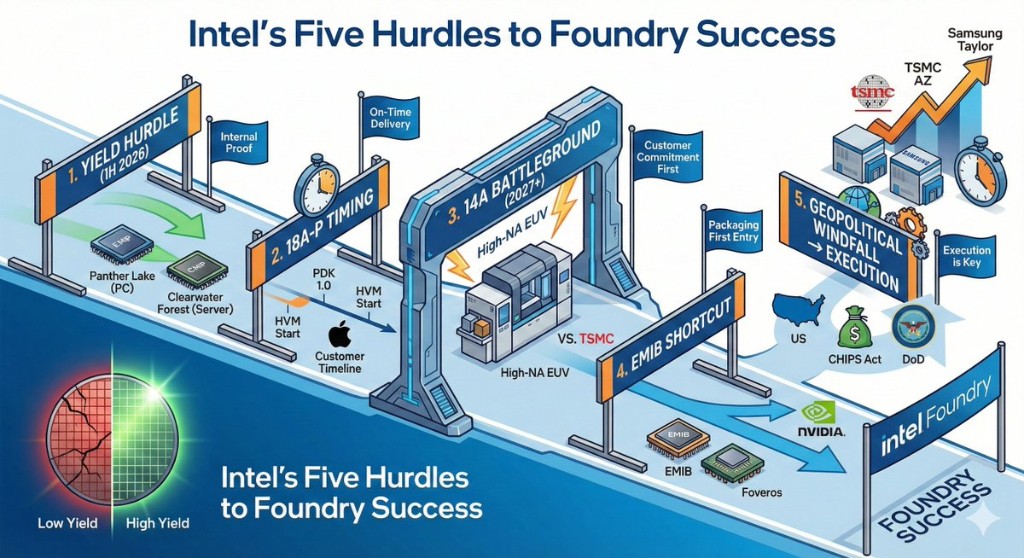
Intel foundry – the last "opportunity window"
Intel's foundry business is in trouble: a massive loss of $2.5 billion in Q4 2025, with no external customers to date, caught in a vicious cycle of "over-investment and insufficient demand." The 18A process technology has advantages but is lagging in ecosystem development. It must secure orders from Apple, Nvidia, and others in 2026-2027 to prove itself; otherwise, it will face strategic contraction after the geopolitical window closes
Recently, Silicon Valley chip engineer Damnang2 published an in-depth analysis titled "Intel Foundry: The Last Chance" on social media platform X.
The analysis points out that Intel's foundry business is at a critical crossroads. Despite Intel's aggressive bets on technology, attempting to reshape the landscape through the 18A process, severe financial data reveals its structural dilemma: it must find a breakthrough in the vicious cycle of massive losses and the absence of external customers.
The financial report for the fourth quarter of 2025 shows that Intel's foundry business recorded $4.5 billion in revenue, accompanied by an operating loss of up to $2.5 billion. CEO Lip-Bu Tan admitted that the company "invested too much and too quickly" in the face of insufficient demand. This statement echoes the risk warnings in documents submitted by Intel to the U.S. Securities and Exchange Commission (SEC), which clearly indicate: the company has not yet secured any external foundry customers of meaningful scale at any of its nodes.
The analysis believes that this situation is not only a matter of trust deficit but also a deep structural challenge. The moat of the foundry industry is built on decades of technological accumulation, from the compatibility of design tools to the yield learning curve in mass production, making it extremely difficult for newcomers. Meanwhile, TSMC's capacity layout in the U.S. and Japan, along with Samsung Electronics' resurgence, is rapidly squeezing Intel's survival space as an "alternative option."
For investors, the core focus has shifted from technological blueprints to execution. The market is closely watching whether Intel can convert the geopolitical dividends into actual customer orders and yield data within the narrow "opportunity window" from 2026 to 2027. If it fails to establish a positive business cycle during this period, its foundry strategy may face irreversible contraction pressure.
Technical Barriers and the Dilemma of the "Nth" Entrant
The analysis points out that the core threshold of the foundry business is not a single technology, but rather a systemic barrier built on the compounding effects of time and output. Every step from chip design to mass production poses severe challenges for followers.
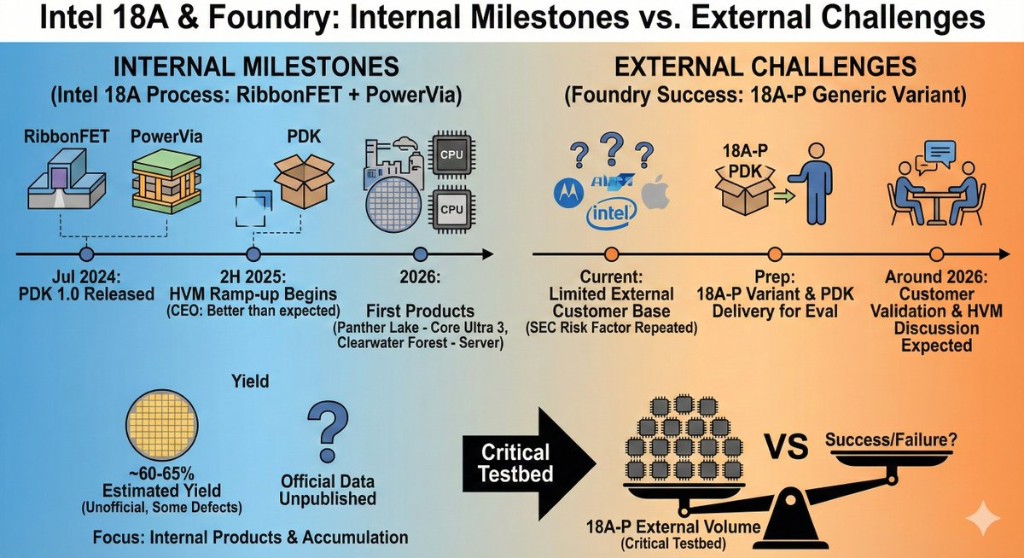
The primary obstacle lies in the process design kit (PDK) and model hardware correlation (MHC). PDK serves as the bridge connecting design and manufacturing, with its core metric MHC determining whether the silicon performance meets simulation expectations. TSMC, with over thirty years of data accumulated from serving thousands of customers, can continuously calibrate model accuracy. In contrast, Intel's 18A PDK 1.0 was only released in July 2024, and although it claims to have over 100 tape-outs, its validation maturity is still far behind competitors in industry assessments. Additionally, the lack of an IP ecosystem creates a "chicken-and-egg" problem: TSMC has thousands of silicon-validated IPs due to a large customer base and high returns; whereas Intel has fewer customers, leading to fewer IPs, which in turn makes it even harder to attract customers.
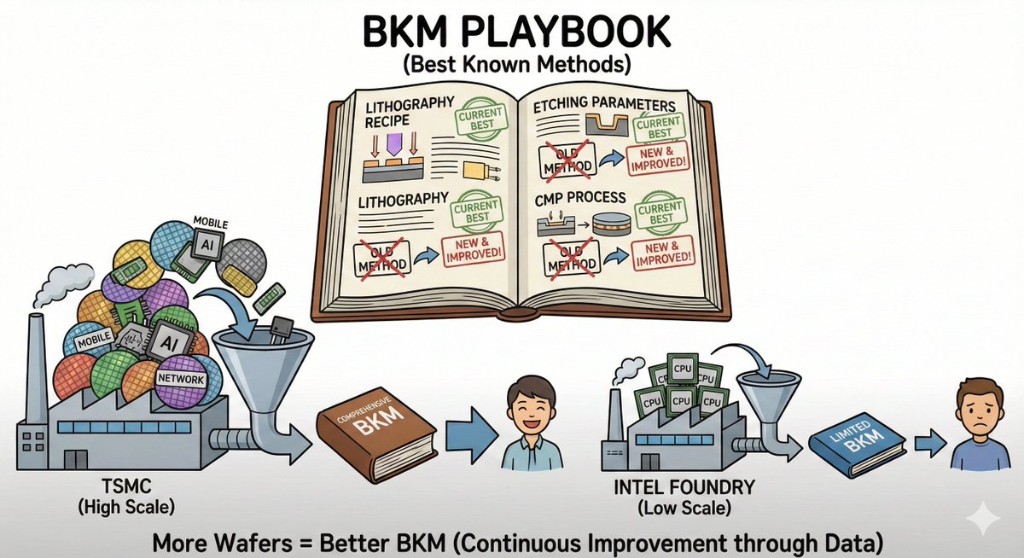
On the manufacturing side, the accumulation of Best Known Methods (BKM) also relies on scale. BKMs originate from repeated runs and defect corrections of massive wafers and diverse design patterns. TSMC has accumulated rich process data by handling chips from various customers, while Intel mainly relies on its own x86 processors, lacking process experience for diversified designs such as mobile APs and AI accelerators.
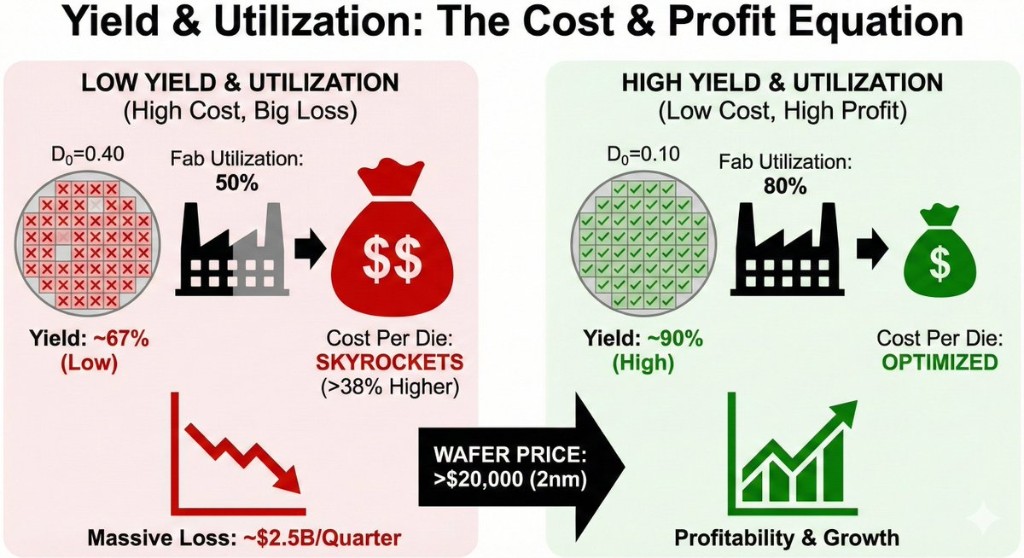
This technological gap ultimately translates into harsh economic realities. The core of foundry economics is yield and capacity utilization. At advanced nodes, the cost of a single wafer exceeds $20,000, and improving yield from 65% to 90% means a reduction in the cost of a single chip by over 38%. Meanwhile, low capacity utilization leads to enormous fixed cost allocations. Intel's current losses in foundry operations are a structural consequence of the dual impact of low yield and low utilization. The lack of external output leads to insufficient learning data, slow yield ramp-up, which in turn raises costs, weakens competitiveness, and makes it difficult to acquire new customers—this is a negative cycle that urgently needs to be broken.
The Reality of 18A and the Game on the 2nm Battlefield
Analysis indicates that as Intel's core weapon for counterattack, the 18A process is set to enter production in the second half of 2025, with initial products including Panther Lake (PC side) and Clearwater Forest (server side). Although Lip-Bu Tan is optimistic about the progress, the current advancements are mainly limited to Intel's own products. The real test lies in the external customer-facing 18A-P version, which is expected to see large-scale mass production and customer validation by 2026.
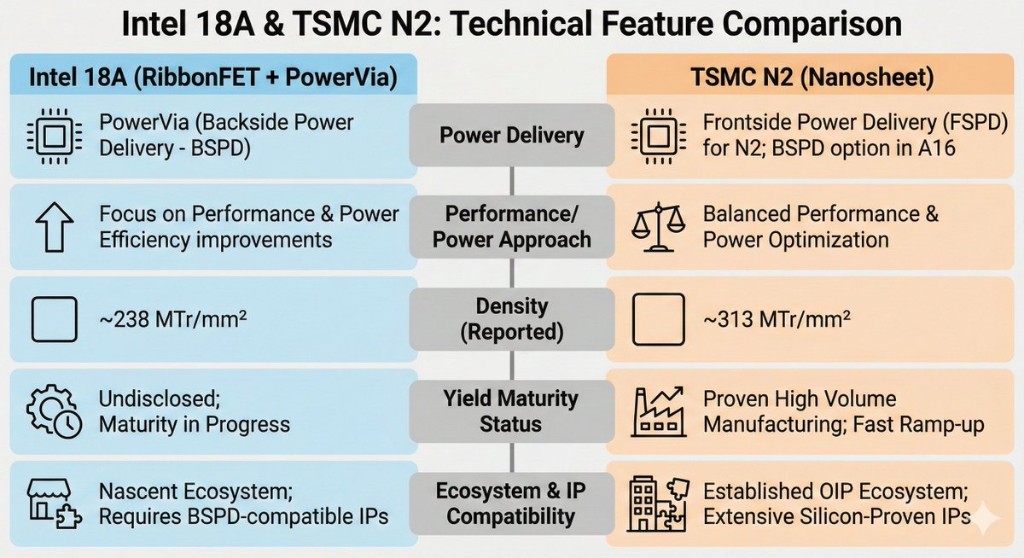
In the direct competition with TSMC's N2, both sides have their respective advantages. Intel claims to have an edge in performance and energy efficiency with PowerVia (backside power delivery technology), which theoretically alleviates wiring bottlenecks. However, in terms of density, TSMC's N2 clearly leads with 3.13 billion transistors per square millimeter compared to Intel's 2.38 billion for 18A. Higher density means lower cost per chip. Additionally, while PowerVia is advanced, it requires customers to redesign their power wiring architecture, increasing migration costs. In contrast, TSMC retains the front-side power delivery option on N2, providing customers with a smoother transition path.
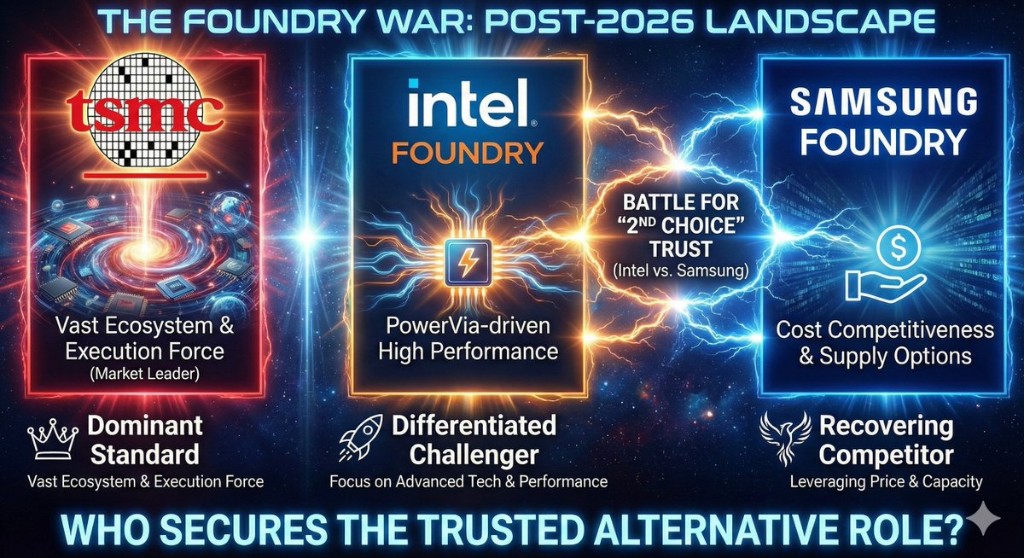
 At the same time, Samsung Electronics is returning to the battlefield, becoming a threat that Intel cannot ignore. Despite losing Qualcomm orders due to yield issues, Samsung is making a comeback with its SF2 (2nm) process. Reports indicate that Samsung has signed a long-term supply agreement worth $16.5 billion with Tesla, and there are signals of Qualcomm's return. Samsung not only has an aggressive pricing strategy, but its wafer fab in Taylor, Texas, directly undermines Intel's uniqueness in domestic manufacturing in the United States.
Customer Breakthrough: Apple, Nvidia, and the Countdown to Survival
Analysts believe that in this landscape, the "multi-sourcing" strategy of non-foundry customers represents Intel's last opportunity.
According to analyst Ming-Chi Kuo, Apple has received Intel's 18A-P PDK and is conducting internal simulations, with results meeting expectations. The market speculates that Apple may entrust the entry-level chips for the MacBook Air or iPad Pro to Intel in 2026. For Apple, this is to reduce its single reliance on TSMC and avoid geopolitical risks. However, this deal has not yet been finalized, and the first half of 2026 will be a critical decision point.
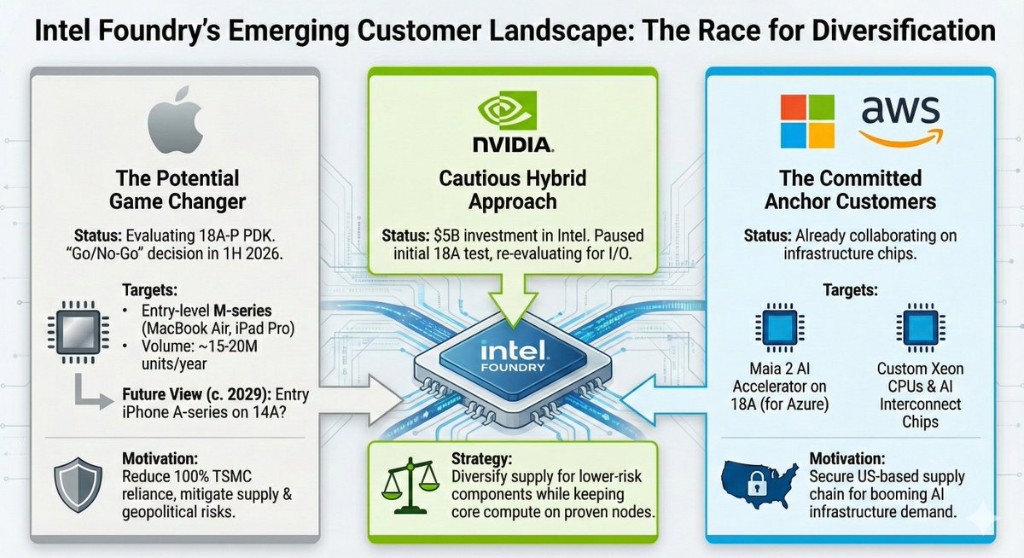
Nvidia's attitude is more cautious. Although Nvidia has invested $5 billion in Intel and holds about 4% of its shares, the signals regarding collaboration in wafer manufacturing remain ambiguous. Reuters reported that Nvidia has paused testing of the 18A, but DigiTimes later pointed out that Nvidia is exploring the use of Intel's 18A or 14A processes to manufacture the I/O modules for the next-generation GPU (codenamed Feynman), combined with Intel's EMIB advanced packaging technology. This model of "leaving the computing core to TSMC while trying Intel for the peripheral modules" may be the most pragmatic entry point.
Additionally, Microsoft and Amazon AWS have planned to utilize Intel's 18A to produce AI accelerators and custom server chips, but this is more of a strategic defense based on supply chain resilience rather than a purely technical choice.
The time window facing Intel is closing. As TSMC's Arizona plant and Samsung's Taylor plant release capacity, the "geopolitical premium" of "domestic manufacturing in the United States" that Intel currently enjoys will be diluted. If Intel cannot prove the stability of its yields and the maturity of its ecosystem between 2026 and 2027, major customers may continue to lock in TSMC or turn to the recovering Samsung.
For Intel's foundry business, this is no longer a narrative about "potential," but rather a decisive battle about "proof." Only by successfully introducing 18A-P to external customers and establishing mass production scale can it kickstart the yield learning flywheel, thereby securing survival space for the subsequent 14A process. Otherwise, its foundry strategy may face another strategic contraction