


U.S. GDP grew only 1.4% in the fourth quarter! Government shutdown dragged down by 1 percentage point, Trump "fires" Powell early
The initial actual GDP for the United States in the fourth quarter of 2025 grew at an annualized rate of 1.4%, significantly lower than the expected 2.8%, and a sharp slowdown from the previous value of 4.4%. The government shutdown dragged down GDP by about 1 percentage point, with federal spending declining at an annualized rate of 16.6%. Although the economy still grew by 2.2% for the year, the decline in consumption and exports, concerns in the labor market, and persistent inflation have made the economic outlook more complex. Before the data was released, Trump criticized the shutdown and pressured for interest rate cuts, drawing market attention
The U.S. Department of Commerce's Bureau of Economic Analysis released data on Friday, indicating that due to a record-length government shutdown, consumer spending, and trade factors, the preliminary estimate for the U.S. real Gross Domestic Product (GDP) growth in the fourth quarter of 2025 was 1.4% on an annualized basis, falling short of the expected 2.8% growth. The real GDP growth for the third quarter of the U.S. was 4.4%, with an overall economic growth of 2.2% for the year 2025.
The preliminary report for the fourth quarter of 2025 was originally scheduled for release on January 29, 2026, but the timing was rescheduled due to the government shutdown from October to November 2025.
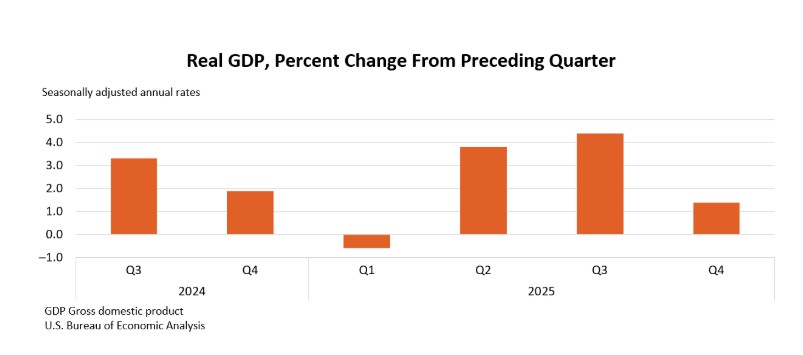
The growth rate for this quarter has significantly slowed compared to the strong performance of 4.4% in the third quarter. The U.S. Department of Commerce stated that the slowdown in real GDP in the fourth quarter, compared to the third quarter, primarily reflects a decline in government spending and exports, while the growth rate of consumer spending has also slowed. The U.S. government was in a shutdown for nearly half of the three months in this quarter. The Bureau of Economic Analysis indicated that the government shutdown dragged GDP down by about 1 percentage point, with federal government spending declining at an annualized rate of 16.6% in the fourth quarter.
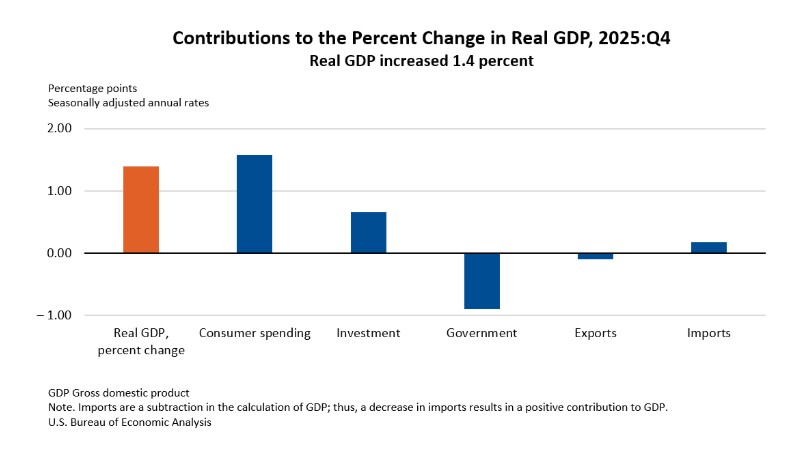
However, the acceleration in investment partially offset the negative impacts mentioned above. The decline in imports was smaller than in the previous quarter. The "real final sales of domestic private purchasers" (which is the sum of consumer spending and private fixed investment) grew by 2.4% in the fourth quarter, compared to a growth of 2.9% in the third quarter.
Structurally, personal consumption expenditures were the main driver of growth in the fourth quarter, contributing 1.6% to overall GDP. The AI boom continues to drive growth. Investment in information processing equipment contributed 0.65% to growth, while software investment contributed 0.17%.
Additionally, the domestic final purchase price index rose by 3.7% in the fourth quarter, compared to a 3.4% increase in the third quarter. The Personal Consumption Expenditures (PCE) price index increased by 2.9%, up from 2.8% in the third quarter. Excluding food and energy, the PCE price index rose by 2.7%, compared to a 2.9% increase in the third quarter.

In 2025, the domestic final purchase price index rose by 2.6%, compared to a 2.4% increase in 2024. The PCE price index rose by 2.6%, unchanged from 2024. Excluding food and energy, the PCE price index rose by 2.8%, compared to a 2.9% increase in 2024.
Trump's Early Comments Spark Controversy
Less than an hour before the data was released, U.S. President Trump posted on social media that the government shutdown would cause the U.S. to "lose at least two percentage points of GDP."
"The Democrats' shutdown has cost the U.S. at least two percentage points of GDP. This is why they are trying to shut down again in a small-scale form. No more shutdowns!"
"Also, lower interest rates. 'Too late, Mr.' Powell is the worst!!!"
Media reports indicate that the president and his economic team typically receive a brief report the day before important economic data is released and should not publicly discuss this data at least 30 minutes before the official release. In January of this year, Trump posted a chart of employment market data on his social media account, which was scheduled to be released to the public the following morning.
It is unclear whether Trump's remarks were a reaction to the economic data being released early or simply a frustration with the partial government shutdown affecting the Department of Homeland Security. Democrats have stated that their vote for additional funding is conditional on the government implementing new immigration enforcement measures following high-profile violent incidents involving federal officials in Minnesota.
Relatively Strong Annual Performance
For the full year of 2025, U.S. real GDP is expected to grow by 2.2% (from the full-year level of 2024 to the full-year level of 2025), compared to a growth of 2.8% in 2024. The growth in real GDP for 2025 is primarily driven by increased consumer spending and investment.
Media reports indicate that despite a slowdown at the end of the year, these data still mark a relatively strong year for the U.S. economy. In the first quarter of the year, the U.S. economy contracted due to a surge in imports ahead of tariff implementation. Subsequently, the economic growth rate rebounded in 2025, achieving one of the strongest growth performances in recent years.
This rebound occurred after Trump rolled back some of the most severe tariff measures and the Federal Reserve cut interest rates. These factors propelled the stock market to record highs and allowed wealthier Americans to continue their spending.
When Trump returned to the White House last year, he promised to bring a "golden era" to America, including pushing for the return of manufacturing to the U.S. and lowering the cost of living. However, manufacturing activity has only just begun to recover after a prolonged slump. Meanwhile, inflation in 2025 showed little significant decline, making "affordability" a core issue in this year's midterm elections.
According to the latest economist survey by The Wall Street Journal, the U.S. economy is expected to grow by 2.2% in 2026. This growth will benefit from ongoing investments in artificial intelligence, as well as tax cuts and incentives from the large tax and spending bill passed last summer. A weaker dollar will also help U.S. exporters.
Labor Market Remains Concerning
Media reports indicate that despite the unemployment rate remaining low, the labor market remains concerning. Employment growth stagnated in 2025 as businesses weighed decisions amid uncertainties regarding tariffs and immigration policies, and readjusted their workforce after large-scale hiring following the pandemic. At the same time, productivity-enhancing artificial intelligence may reduce potential demand for labor, making many employers more cautious in hiring Although a strong stock market and real estate investments have allowed high-income Americans to continue spending, lower-income groups—who have been fatigued by years of high inflation—are feeling anxious about their job and income prospects. In January, consumer confidence fell to its lowest level in over a decade in a survey by the Conference Board. The proportion of respondents indicating that "jobs are hard to find" has increased.
On Thursday, Walmart stated that consumers remain cautious in their spending, particularly among low-income groups. Walmart's Chief Financial Officer John David Rainey noted that the spending gap between high-income and low-income households is slightly widening.
The CEO of Colgate-Palmolive Company mentioned in a recent earnings call that consumers are uncertain about the economic outlook. This has led shoppers to delay replenishing pantry supplies and to refrain from buying extra tubes of toothpaste even when promotions are available
