Digital gold, future payments, speculative choice? The "narrative" of Bitcoin is collapsing one by one at the "peak of faith"

The story that gives Bitcoin its allure - digital gold, free currency, and speculative functions are simultaneously collapsing, while tokenization, blockchain-driven derivatives, and cross-border stablecoin payments are becoming credible use cases, all without the need for Bitcoin's participation. Meanwhile, gold and silver have experienced a volatile rebound this year, while cryptocurrencies have only declined. Additionally, Bitcoin's grip on speculative culture is slipping, and prediction markets are becoming the next trend for investors who enjoy the speculative nature of cryptocurrencies
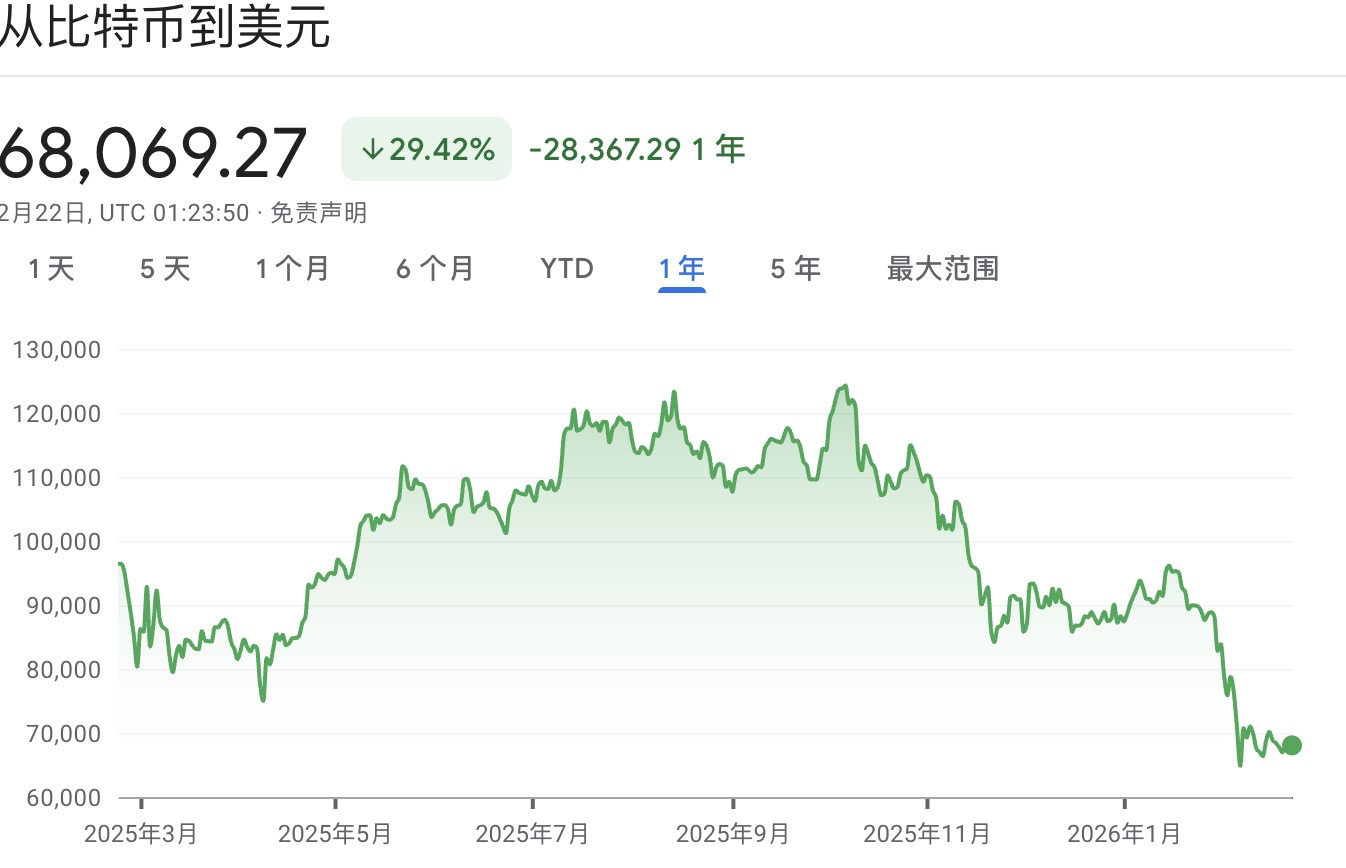
Bitcoin is caught in an unprecedented identity crisis. The world's largest cryptocurrency has plummeted over 40% from its peak, but the real issue is not the price itself; rather, it is that the core narrative supporting its value is simultaneously collapsing. As "digital gold" loses to real gold, payment functionality loses to stablecoins, and speculative fervor loses to prediction markets, Bitcoin is forced to confront a question it has never needed to answer: what is its true purpose?
Ironically, this crisis occurs after Bitcoin has achieved everything it desired. Washington's regulatory stance has never been so friendly, institutional adoption has never been so deep, and Wall Street has never been so accepting. Yet these victories have not prevented a market cap evaporation of over $1 trillion. The conventional rebound script has failed—bottom-fishing buyers have disappeared, and the forces that typically drive rebounds are now working in reverse.
According to Bloomberg on Saturday, unlike stocks or commodities, Bitcoin lacks fundamental support, and its value relies almost entirely on belief—on the narratives that persuade new buyers to enter the market. And these narratives are shaking. Retail investors who bought in during the Trump-induced rally are now deeply trapped. More critically, Bitcoin now has to compete with more alternatives, which are "easier to understand and easier to explain to trustees, clients, and boards."
Owen Lamont, a portfolio manager at Acadian Asset Management, stated:
The core story of Bitcoin is "price going up," but we don't have that now; what we have is "price going down," and that's not a good story.
A Complete Collapse on the Payment Battlefield
A clear signal emerged last November. One of Bitcoin's most outspoken corporate evangelists, Jack Dorsey, announced that his Cash App would begin supporting stablecoins. For years, Dorsey viewed Bitcoin minimalism as a creed, and his shift signaled that the payment race has changed battlegrounds.
In Washington, stablecoins have become the focus. The bipartisan-supported Genius Act passed easily, and regulators openly encouraged the infrastructure for dollar-backed tokens. Even within the cryptocurrency space, Bitcoin is no longer the sole focus. Tokenization, blockchain-driven derivatives, and cross-border stablecoin payments are becoming credible use cases—none of which require Bitcoin's involvement.
"If there is any connection, stablecoin activity may be related to activities on Ethereum or other chains. Stablecoins are used for payments," said Carlos Domingo, co-founder and CEO of tokenization platform Securitize. "I think today no one views Bitcoin as a payment mechanism."
The Bankruptcy of the "Digital Gold" Narrative
Even after years of "digital gold" hype, Bitcoin has still not passed the most important macro test. Despite geopolitical tensions and a persistently weak dollar, gold and silver have staged volatile rebounds this year, while cryptocurrencies have only declined. The flow of funds confirms this divergence According to data compiled by Bloomberg, in the past three months, U.S.-listed gold and gold-themed ETFs attracted over $16 billion in funds, while spot Bitcoin ETFs saw an outflow of about $3.3 billion. Bitcoin's market value has shrunk by over $1 trillion.
"People are realizing that Bitcoin is just what it has always been—a speculative asset," said Tom Essaye, president and founder of Sevens Report and former Merrill trader. "Bitcoin will not replace gold; it is not digital gold, it does not serve the same purpose, and it cannot provide the utility that gold offers. It is not an inflation hedge—frankly, there are better hedging tools without the volatility to worry about. It is also not a chaos hedge."
The digital asset treasury model was supposed to become Bitcoin's corporate identity. Companies like Strategy Inc. hoarded Bitcoin during the bull market and issued stocks based on it, creating a self-reinforcing cycle that conjured up billions in market value and provided institutional investors a way to express their beliefs without directly touching the asset. This worked for a time. But now the cycle has reversed—along with it, the collapse of the model's credibility. The largest digital asset treasury companies have plummeted over the past year—some have fallen far more than Bitcoin itself. Many companies are now trading below the value of their held assets.
Speculative Frenzy Shifts to Prediction Markets
Bitcoin's grip on the speculative culture is also slipping. Prediction platforms like Polymarket and Kalshi—offering binary outcomes, quick settlements, and real-world stakes—have now become the new playground for dopamine hunters who once chased meme coins. This is not a fringe phenomenon: Polymarket's weekly nominal trading volume has surged over the past year. Even Coinbase Global Inc. has added prediction contracts. The dopamine hasn't disappeared; it has merely shifted venues.
"Prediction markets are becoming the next craze for DIY investors who enjoy the speculative nature of cryptocurrencies," said Roxanna Islam, head of industry research at ETF company TMX VettaFi. "This could mean a decrease in overall interest in cryptocurrencies." However, she added, "It could also mean a shift towards more long-term, serious investors."
Moreover, there is an increasingly widening mismatch between how Bitcoin is accessed and how it is traded. Spot ETFs have made purchasing easy, but Bitcoin prices are still influenced by the offshore derivatives market, where traders often use 100x leverage. These venues employ automatic liquidation engines: when positions breach margin thresholds, they are forcibly liquidated and sold into the order book, triggering a chain liquidation that can cause spot prices to crash within minutes. The crash in October last year fully exposed this mechanism, with billions in leveraged positions being liquidated in an instant.
The Divide Between Resilience and Correlation
None of this means Bitcoin is finished. It remains the most liquid digital asset, with a deeper order book and broader exchange coverage than any competitor. Spot ETFs have made Bitcoin a permanent fixture in investment portfolios. More importantly, it has survived crises: Mt The collapse of Gox, the crash of 2022—and many other crises. Each time, the network survived, and prices began to set new records. Resilience is not without meaning.
"There are always people spreading fear, uncertainty, and doubt. There are always questions," said Dan Morehead, founder of Pantera Capital. "I just think that those who are skeptical about how important mobile-based currency is to the world naturally want to find new points of concern."
The bullish case does not lie in the narrative of Bitcoin being flawless, but rather in the fact that it does not need to be—just persistent enough to endure each successive crisis of confidence. So far, history is on its side. According to Bloomberg data, Bitcoin has previously recovered from several major downturns.
But history also shows that survival and relevance are not the same. Bitcoin's biggest threat is not competitors—but drift. When there is no single narrative to sustain it, the slow loss of attention, capital, and belief follows. The asset still exists, the network is still running, but the stories that give Bitcoin its gravity—digital gold, free currency, institutional reserve—are simultaneously unraveling. Whether this is a temporary crisis or a permanent shift is one of the biggest questions of the digital economy era.
"For many people, it's like a religion, and religious beliefs are hard to shake," said Michael Rosen, Chief Investment Officer of Angeles Investment Advisors. "It's just that this is not my religion."