


Brazilian stock market is highly sought after: surged 17% in January, foreign capital inflow exceeds last year's total, investment tycoons heavily invested
Druckenmiller accurately bottomed out in Brazil in the fourth quarter of last year, massively buying 3.5 million shares of Brazilian ETFs and call options. In January of this year, the ETF surged 17%, marking its best performance in three years. With the triple benefits of a weaker dollar, rising commodity prices, and expectations of interest rate cuts, foreign capital inflows reached 34 billion reais, as global funds competed to bet on this underweighted emerging market
With the improvement of fundamentals and the shift in global asset allocation logic, the Brazilian stock market became a hotspot for global capital chasing in early 2026. Driven by a weaker dollar, rising commodity prices, and expectations of interest rate cuts, the Brazilian market not only welcomed a long-awaited strong rebound but also attracted a massive inflow of overseas funds, including top hedge funds.
According to Bloomberg citing recent regulatory filings, billionaire investor Stanley Druckenmiller's Duquesne Family Office made significant investments in Brazil in the fourth quarter of last year. The family office purchased approximately 3.5 million shares of the iShares MSCI Brazil ETF (EWZ) during the three months ending December 31, while also buying call options on the fund, accurately betting on the subsequent market explosion.
This positioning quickly paid off. The iShares MSCI Brazil ETF surged 17% in January this year, marking its best monthly performance since 2020. This increase was mainly due to the weaker dollar and higher commodity prices, which drove significant double-digit gains in heavyweight stocks, including mining giant Vale SA and state-owned oil producer Petroleo Brasileiro SA.
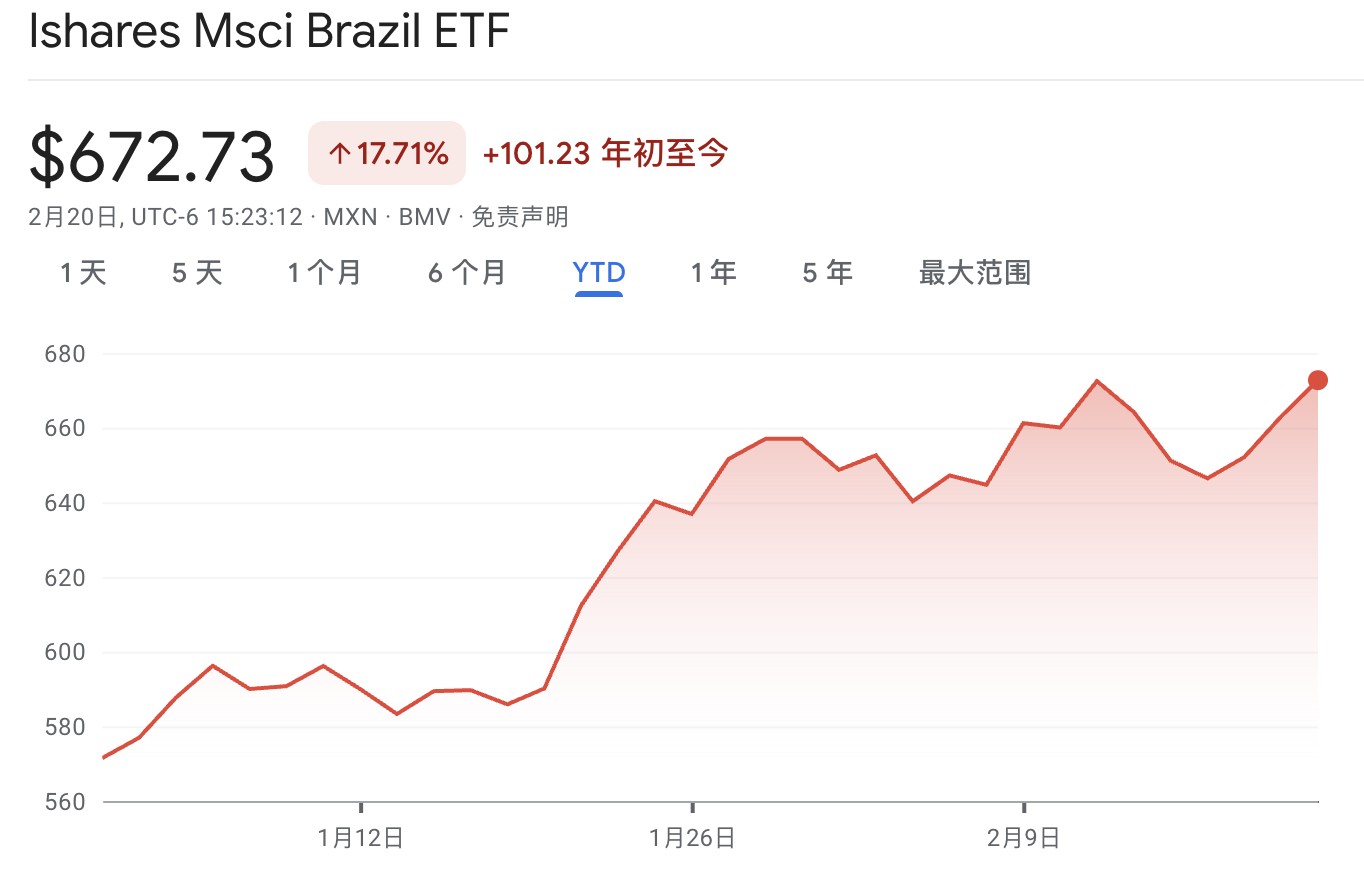
The reversal of market sentiment triggered a rush of foreign capital. Data shows that foreign investors have poured over 34 billion Brazilian Reais (BRL) into the Brazilian stock market this year. Strategists point out that global fund managers are ending their "underweight" stance on Latin America and are seeking to diversify in emerging markets to hedge against the risks of being heavily invested in the U.S. market.
Investment Tycoons Positioning Early
Regulatory filings revealed Stanley Druckenmiller's precise entry timing. As one of the most watched macro investors globally, his family office, Duquesne Family Office, made significant purchases of the iShares MSCI Brazil ETF at the end of last year. This ETF, with a size of $9.1 billion, is the largest exchange-traded fund tracking Brazilian stocks.
In addition to directly holding about 3.5 million shares, the filings show that the institution also purchased call options on the fund, indicating a strong bullish sentiment towards the Brazilian market.
Meanwhile, the Duquesne Family Office liquidated its holdings in the Global X MSCI Argentina ETF, showing a clear shift in its investment focus within the Latin American region.
Dual Benefits from Exchange Rates and Commodities
The current rise in the Brazilian stock market is led by the most liquid large-cap stocks, which are typically the preferred targets for foreign investors. The 17% increase in January was backed by a significant improvement in the macro environment.
The weakness of the dollar alleviated exchange rate pressures on emerging markets, while the strength of commodity prices directly boosted the valuations of Brazil's core resource assets In addition, expectations for a shift in monetary policy have also supported market sentiment. The market generally expects that Brazil, as the largest economy in Latin America, will begin to cut interest rates next month. This expectation further enhances the attractiveness of equity assets and drives the overall valuation recovery in the market.
Influx of Foreign Capital and Institutional Expectations
Global funds are voting with real money. According to Bloomberg data, foreign capital inflows into the Brazilian stock market have exceeded 34 billion reais so far this year.
Daniel Gewehr, a strategist at Itau BBA, and others noted in a report that after concluding roadshows in seven North American cities, they observed a significant increase in global investors' interest in Brazil. The report stated that global investors seem to be reducing their "underweight" positions in the Latin American region, with multi-asset funds seeking to increase their exposure to Brazilian stocks through tools like EWZ.
Institutions remain optimistic about the market outlook. According to a Bank of America survey of Latin American fund managers, about 64% of respondents expect the Brazilian benchmark stock index, the Ibovespa, to rise above 190,000 points by the end of 2026. This target price implies an upside potential of about 2% compared to last Friday's closing price.
With emerging market assets performing strongly at the start of this year, the trend of capital inflows may continue based on fundamental improvements and the demand for global diversification
