


From the "June 2028 Research Report": When AI Exceeds Expectations, the Economy Collapses
Citrini Research's memo fabricates a "AI Prosperity Crisis": In 2028, despite AI productivity soaring beyond expectations, a "economic plague" arises due to the complete disruption of white-collar employment. While corporate profits and computational power hegemony expand, the collapse of household income extinguishes the consumption engine, resulting in "phantom GDP." As SaaS, intermediaries, and financial payment models collapse due to "friction disappearance," risks transmit from private credit to the life insurance and mortgage markets, dragging the world into a systemic repricing abyss
Citrini Research and Alap Shah's "Macroeconomic Memo from the Future" presents a fictional proposition: AI repeatedly exceeding optimistic expectations does not necessarily benefit assets and the economy; on the contrary, abundant machine intelligence may trigger a demand contraction and financial repricing through squeezing labor income and the consumption cycle, leading to a "productivity boom."
In this thought experiment anchored in "June 2028," the U.S. unemployment rate rises to 10.2%, 0.3 percentage points higher than expected, causing the market to drop 2% after the data release, with the S&P 500 experiencing a cumulative decline of 38% from its "October 2026 peak." The memo states that traders have become numb to shocks, as similar data six months ago could have triggered a circuit breaker.
The report breaks down the crisis path into two mutually reinforcing chains: One occurs in the real economy, where enhanced AI capabilities lead to the replacement of white-collar jobs, causing real wage growth to collapse and shrinking the "human-centered" economy, which has a high consumption ratio, forming a negative feedback loop with "no natural brakes." The market initially focuses solely on AI, but the economy itself begins to deform, giving rise to what is termed "Ghost GDP," where output is counted in national accounts but struggles to circulate in the real economy.
The other chain occurs in the financial system, where the structural damage to income expectations begins to erode asset pricing based on white-collar cash flows, such as private credit and housing mortgages, and forces regulatory and policy discussions to accelerate. However, the report emphasizes that policy responses continue to lag, and public confidence in the government's "rescue capability" is declining, amplifying the risk of a deflationary spiral.
Perhaps, as Citrini puts it, "When the output generated by machines equals that of 10,000 white-collar workers without consuming a penny of social services, this is not called an economic miracle; this is called an economic plague."
Attractive Profit Margins Do Not Equate to Economic Health: Money No Longer Flows Through Households
In the scenario, the first wave of layoffs resulting from "humans becoming obsolete" in early 2026 aligns well with stock market preferences: lower costs, rising profit margins, and earnings exceeding expectations lead to rising stock prices. By October 2026, the S&P 500 nearly approaches 8,000 points, and the Nasdaq surpasses 30,000 points. Corporate profits are reinvested into AI computing power, forming an accelerator.
The macro surface also looks "beautiful": nominal GDP records annualized mid-to-high single-digit growth multiple times, and the real output growth per hour reaches levels the author describes as "unseen since the 1950s"—AI agents do not sleep, take sick leave, or require health insurance.
However, the memo emphasizes that wealth primarily flows to "owners of computing power," while labor income collapses. Real wage growth turns negative, white-collar workers are forced to sink into lower-paying jobs, and consumption, which accounts for about 70% of GDP at that time, begins to shrink. The author nails down the logic with a straightforward rhetorical question: How much do machines spend on discretionary consumption? The answer is zero.
SaaS Takes the First Hit: When "Writing One's Own" Becomes a Routine Procurement Option
The first domino in this chain comes from software. The author places the turning point at the end of 2025: the capabilities of agent-based programming tools experience a "step-like leap." A qualified developer, in conjunction with Claude Code or Codex, can replicate the core functions of a mid-range SaaS product within weeks—imperfect, but enough to make the CIO ask one more question in the face of a $500,000 annual renewal: Can we do it ourselves? Due to the fact that corporate fiscal year budgets are often locked in during the fourth quarter of the previous year, mid-2026 has become the first window for making procurement decisions "with real usability." The article provides a negotiation detail: a procurement manager from a Fortune 500 company told the author that he used "discussions with OpenAI about replacing suppliers with forward deployed engineers using AI tools" as leverage to negotiate a 30% discount on the renewal; meanwhile, "long-tail SaaS" companies like Monday.com, Zapier, and Asana are in a worse position.
More critically, how this "self-built as an option" changes the industry structure: differentiation is accelerated and flattened by AI development and iteration, and price wars turn into "knife fights against both old rivals and new challengers," where the moat is no longer functionality, but cost and financing endurance.
Companies Threatened by AI Are the Most Aggressive: The Reflexive Cycle Begins Here
One point the memo emphasizes that is "different from history textbooks" is that the disruptors of 2026 have no choice but to "resist." The author contrasts this with the paths of Kodak, Blockbuster, and Blackberry, arguing that under the impact of AI, many companies "cannot die slowly," but must take swift action to save themselves.
In this scenario, ServiceNow shows clear signals in its Q3 2026 report: net new ACV growth rate drops from 23% to 14%, while announcing a 15% layoff, with the stock price falling 18% on the same day. The reason is not mysterious: it sells seat licenses, and if customers lay off 15% of their employees, they will mechanically cancel 15% of their licenses; the reason customers are laying off is precisely due to the efficiency gains brought by AI.
Thus, the memo describes a "collective rationality, overall disaster": companies save money from layoffs and continue to invest in AI tools, which enhances AI capabilities and makes the next round of layoffs possible. Each company's actions make sense individually, but together they dismantle the brakes.
As "Friction" Approaches Zero, Intermediary Layers Begin to Collapse: From Subscriptions, Commissions to Card Organization Fees
By early 2027, the author sets the use of LLMs as the default configuration, with many people using AI agents "like using autocomplete," often without realizing it. Subsequently, Qwen's open-source "agent-based shopping assistant" becomes a catalyst, with various assistants quickly integrating agent-based e-commerce functions; model distillation allows agents to run on phones and laptops, reducing marginal costs of inference.
What concerns the author the most is that agents do not need to be activated; they run continuously in the background according to preferences. By March 2027, the average American individual consumes about 400,000 tokens daily, a tenfold increase from the end of 2026. Transactions are no longer a series of discrete human decisions but become continuous optimization 24/7.
This directly strikes at the rent layers built on "human limitations" over the past fifty years: subscription auto-renewals, quiet price increases after trials, brand familiarity replacing diligent price comparisons... These friction-based profit models are transformed by agents into "negotiable coercive situations."
The article lists a series of "first to fall" intermediaries: travel booking platforms, insurance reliant on renewal inertia, financial advisors, tax preparation, and routine legal work. Even real estate agents could not escape through "relationships": after AI agents gained access to MLS and historical transaction data, the median buyer commission in major U.S. metropolitan areas was compressed from 2.5%-3% to below 1%, with more and more transactions on the buyer's side no longer requiring human agents After agents take control of trading, they will continue to look for bigger "paper clips": the 2%-3% interchange fees in machine-to-machine trading become glaring. The author sets many agents to settle using stablecoins on Solana or Ethereum L2, with costs close to "a fraction of a cent." In this section, Mastercard is described as an "irreversible inflection point": management mentioned "agent-driven price optimization" and "optional consumption under pressure" in their earnings report, leading to a drop in stock prices; risks further spill over to card issuers and single credit card institutions that rely more on interchange fees and reward systems, with AmEx being hit hardest by a "double whammy" (white-collar clients being laid off + fee rates being bypassed).
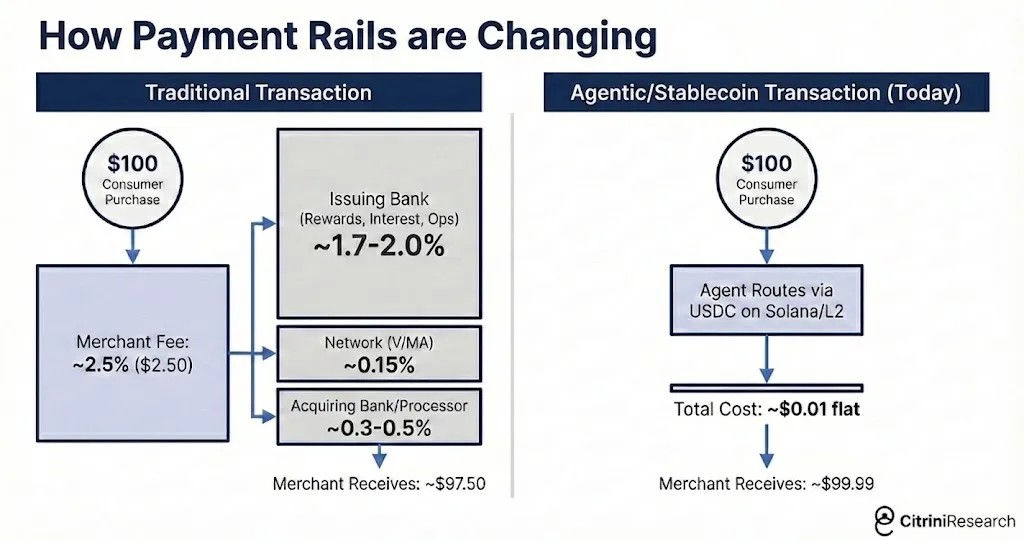
This is not an "industry prosperity" issue: the demand side of the white-collar service economy has been leveraged through
In 2026, the market still views the negative impact as part of the "sector story" for software, consulting, payments, etc. The rebuttal in the memo is very direct: The U.S. is a white-collar service economy, with white-collar workers accounting for about 50% of employment, yet driving about 75% of optional consumption.
More pointed data follows: the author emphasizes consumption concentration— the top 10% of income earners in the U.S. contribute over 50% of consumption, while the top 20% contribute about 65%. Therefore, as long as the impact is concentrated on high-income white-collar workers, even if the unemployment rate is not exaggerated, it will still be a "small for big" blow to optional consumption. The text uses a magnitude example to illustrate leverage: a 2% decline in white-collar employment could correspond to a 3%-4% decline in optional consumption; moreover, white-collar workers have savings buffers, and the impact appears with a lag, once it appears, it could be deeper.
The inflection point signal on the employment side is written very specifically: in October 2026, JOLTS job openings fell below 5.5 million, a year-on-year decrease of 15%; white-collar jobs collapsed while blue-collar jobs remained relatively stable. The bond market first trades on consumption shocks, with the 10-year U.S. Treasury yield falling from 4.3% to 3.2%.
Meanwhile, AI investment has not slowed down due to weakened demand, as the author defines it as "OpEx replacement" rather than a traditional CapEx cycle: companies gradually shift the $100 million originally spent on labor to AI budgets, total spending decreases but AI spending multiplies. Thus, a glaring divergence appears: the AI infrastructure chain remains highly prosperous—NVIDIA's revenue hits a record high, TSMC's utilization rate exceeds 95%, and large-scale cloud vendors' quarterly data center capital expenditures still amount to $150-200 billion; while the replaced consumption side begins to bleed.
The author also extends this discrepancy to the national level: South Korea, as a "pure convex" beneficiary, significantly outperforms; India's IT service exports (with a scale given in the text of over $200 billion annually) face accelerated contract cancellations due to "the marginal cost of AI coding agents being close to electricity prices," leading to an 18% depreciation of the rupee against the dollar within four months, and by the first quarter of 2028, the IMF has already had "preliminary discussions" with New Delhi.
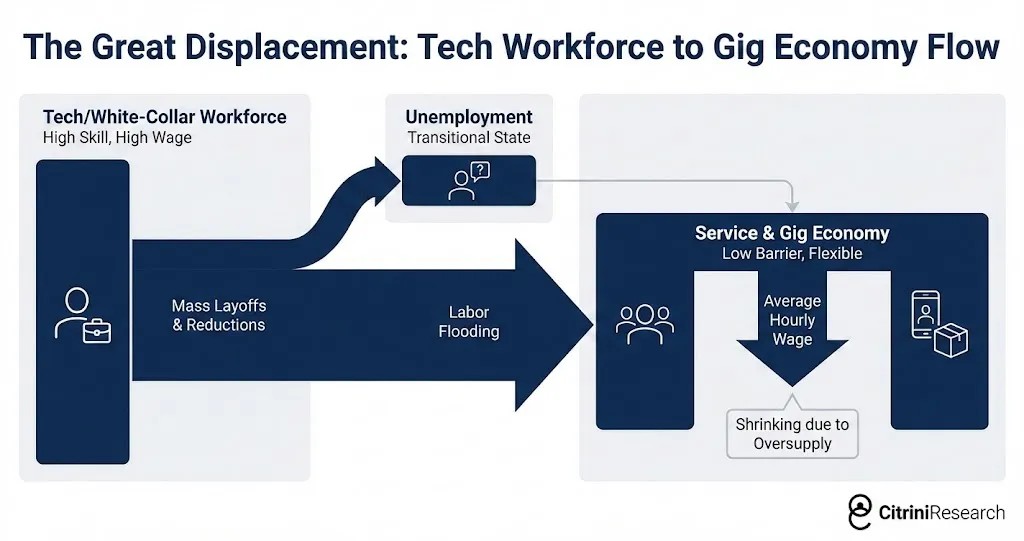
Private Credit is Not "Closed and Safe": Life Insurance Liabilities Drag It into the Spotlight
The first fuse at the financial level comes from private credit. The memorandum outlines the scale changes: private credit has grown from less than $1 trillion in 2015 to over $2.5 trillion by 2026, with a significant portion directed towards software and technology LBOs, assuming that SaaS revenues can "grow steadily and compound over the long term."
When AI penetrates the "sustainability" of ARR, the issue is not the losses themselves, but the moment the losses are acknowledged. The article arranges several key events: in April 2027, Moody's downgraded 14 issuers in one go, totaling $18 billion in PE-backed software debt; starting in the third quarter of 2027, software-backed loans began to default. Zendesk is marked as the "smoking gun": its $5 billion direct loan facility supported by ARR was marked down to 58 cents, becoming a "record-level" private credit software default case.
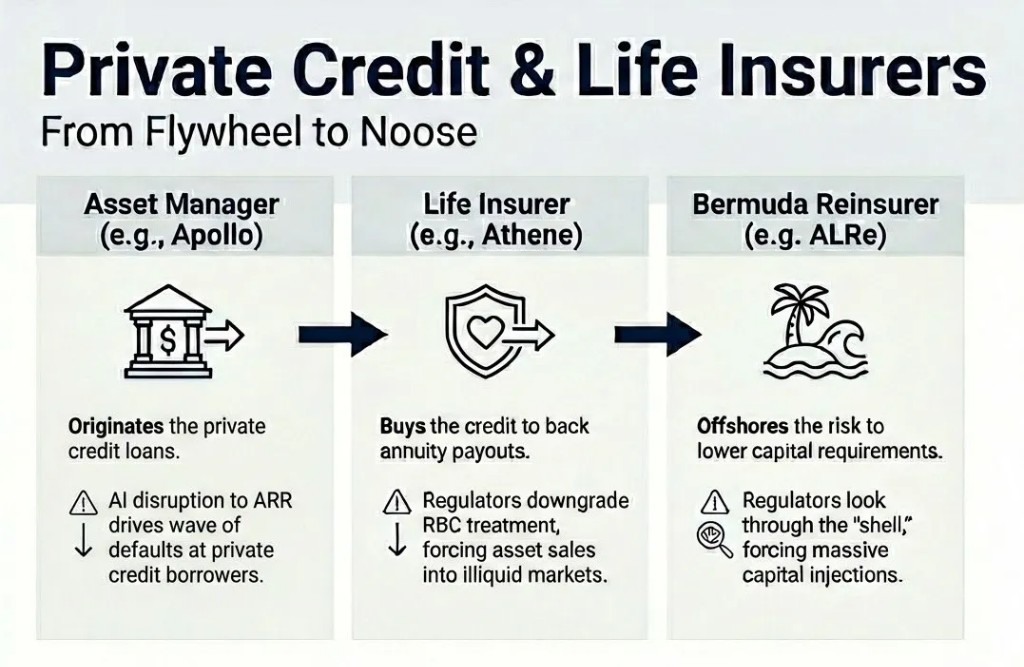
If it stopped here, the author admits it should have been "controllable"—private credit is mostly closed-end and locked in, theoretically without forced selling due to a run. But "permanent capital" reveals another side in this scenario: large alternative asset managers have turned life insurance companies into the financing base for private credit by acquiring them (the article names Apollo/Athene, Brookfield/American Equity, KKR/Global Atlantic). As software defaults spread, insurance regulators began tightening the risk capital requirements for these assets, forcing institutions to replenish capital or sell assets, while the market environment does not allow them to transact at reasonable prices. After Moody's placed Athene's financial strength rating on negative outlook, Apollo's stock price fell 22% in two days, impacting similar institutions.
The author adds another layer of "frightening complexity": Offshore reinsurance and SPV structures make the attribution of losses highly opaque, making it difficult to answer "who is actually bearing the losses" in a short time. The market crash in November 2027 is described as the moment when market perception shifted from "cyclical pullback" to "systemic chain"; during an emergency FOMC meeting (as set in the scenario), Federal Reserve Chairman Waller used a phrase to describe it: this is a series of "daisy chains correlating bets on white-collar productivity growth."
The Real Big Trouble is in Mortgages: The Loans Were Good Initially, but the World Changed Later
The memorandum leaves the "harder to price and more deadly" issue to housing mortgages. The U.S. residential mortgage market is approximately $13 trillion, with underwriting assumptions that borrowers will maintain relatively stable employment and income for a long time (often 30 years).
In this scenario, the terrifying aspect of the risk is: this is not the "loans were bad from the start" situation of 2008. On the contrary, borrowers are the "model cornerstones" with 780+ FICO scores, 20% down payments, verifiable income, and clean credit histories. The problem is that after AI leads to a structural downgrade in white-collar income expectations, the future cash flows of the originally "cornerstone" borrowers are no longer credible—people are borrowing against a future they increasingly dare not believe in The author presents a set of "pre-default" pressure signs: HELOC utilization, early withdrawals from 401(k), rising credit card debt, while mortgage payments remain timely; subsequently, delinquencies begin to appear in places like San Francisco, Seattle, Manhattan, and Austin. By June 2028, the Zillow Home Price Index year-on-year shows: San Francisco -11%, Seattle -9%, Austin -8%; Fannie Mae warns that areas with a high percentage of technical/financial employment (over 40%) in high-end (primarily jumbo) zip codes are experiencing higher early delinquencies.
The author deliberately maintains boundaries: the scenario "has not yet entered a full mortgage crisis," and delinquency levels are still significantly lower than in 2008, but risks are "on the trajectory." If mortgages truly crack in the second half of that year, the author predicts that the stock market pullback could approach 57% of the global financial crisis, with the S&P possibly pointing to around 3,500 points—close to the level before the "ChatGPT moment" in November 2022.
The greatest enemy of policy is time: the tax base is built on human time
The memorandum is quite harsh in its judgment of policy: traditional tools (interest rate cuts, QE) can save the financial engine, but are difficult to repair the real engine, because the ailment of the real economy is not "money being too expensive," but "human intelligence being less valuable."
More specific constraints are on the fiscal side. The author summarizes the tax base in one sentence: federal government revenue is essentially a tax on human time—people working, businesses paying wages, and the government taking a cut. By the first quarter of 2028 in the scenario, federal fiscal revenue is 12% lower than the CBO baseline. Productivity is soaring, but the gains are flowing more towards capital and computing power ownership, no longer returning to the household sector through income and payroll taxes.
The long-term decline of labor income as a percentage of GDP is treated as a backdrop: from 64% in 1974 to 56% in 2024; and in the four years following the exponential improvement in AI, it further drops to 46%, which the author calls "the steepest decline on record."
Thus, the fiscal situation faces a structural paradox: it needs to transfer more funds to households while receiving less tax from them. In the scenario, the government begins discussing the "Transition Economy Act" (direct transfers funded by deficits + taxing AI reasoning computing power), as well as the more radical "Shared AI Prosperity Act" (establishing public claims on "returns from intelligent infrastructure," similar to sovereign funds or AI output royalties, to support transfers through dividends). Political divisions are sharply drawn: the right labels the transfers as Marxism, fearing that computing power taxes will yield to China; the left worries that the tax system will be captured by incumbents; fiscal hawks emphasize that deficits are unsustainable, while doves cite the premature tightening after the GFC as a counterexample.
Social friction is also brought to the forefront: in the scenario, "Occupy Silicon Valley" protesters block the entrances to Anthropic and OpenAI's San Francisco offices for three weeks, with media attention even overshadowing unemployment data. The author's conclusion is that the pace of institutional change cannot keep up with the pace of technological change, and the feedback loop will make political decisions
"Intellectual Premium" Retreat: The Cash Flow Assumptions of the Old World Need to Be Recalculated
The memo ultimately attributes all of this to a more fundamental pricing change: throughout modern economic history, human intelligence has been a scarce resource, with labor markets, mortgage underwriting, tax systems, and even corporate moats built around this scarcity. Now that machine intelligence has become a substitute and continues to get cheaper, the "intellectual premium" is beginning to retreat, and the financial system can only painfully reprice.
The author also leaves room for interpretation: repricing does not necessarily mean inevitable collapse; the economy may find a new equilibrium. The challenge is whether a new framework can be established before the feedback loop completes its next chapter. As of the writing point in February 2026, the S&P remains at a high level, and negative feedback has not yet started, making the author's reminder more like a self-check question for investors: how much of their assets and cash flows are actually based on the assumptions that "friction will not disappear, white-collar incomes will remain stable, and the household sector will continue to be the demand engine." The final sentence also hits the point: the canary is still alive
