


Is it time to bottom fish? Oppenheimer upgrades Oracle rating: A buying opportunity after the big drop
Oracle has fallen over 25% year-to-date, and Oppenheimer has upgraded its rating from "Market Perform" to "Outperform," setting a target price of $185. Analysts point out that the price-to-earnings ratio has dropped by more than half since September, making the risk-reward ratio extremely favorable. Bernstein's stress tests show that even if the AI business were to go to zero, the core business would still support a valuation of $137, providing an 85% margin of safety. Market concerns about the $248 billion lease liabilities and hardware risks are overstated, and pessimistic expectations have been overly priced in
Oracle's stock price is under pressure, having fallen over 25% year-to-date, but Wall Street investment bank Oppenheimer believes this actually provides an entry opportunity for investors. The firm upgraded Oracle's rating from "market perform" to "outperform," setting a target price of $185, corresponding to a 27% upside.
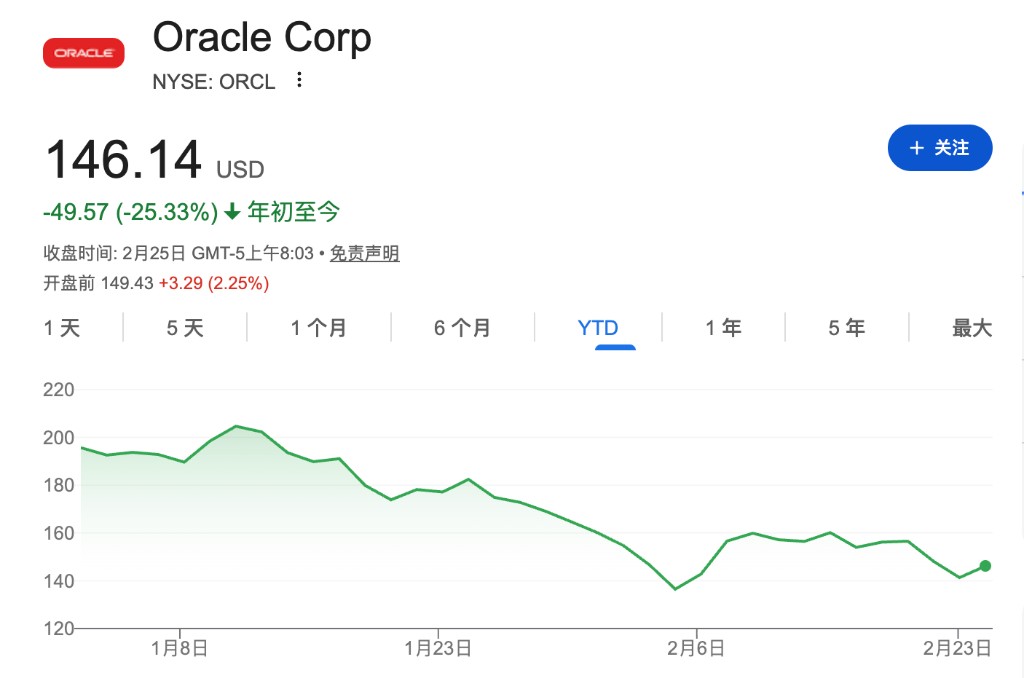
Oppenheimer analyst Brian Schwartz stated, Oracle's price-to-earnings ratio has dropped by more than half since September last year, and the current risk-reward ratio is extremely favorable, making it a highly attractive buying point.
Schwartz described Oracle as "a company with strong compound earnings growth per share," expecting earnings per share to potentially grow two to three times by fiscal year 2030. He pointed out that as large-scale financing plans progress, the counterparty risk related to OpenAI is easing, while the cloud infrastructure business is relatively less affected by AI disruption.
He believes that this round of selling has not changed Oracle's fundamental logic, but rather created a more attractive entry price. Compared to other software companies, its downside risk is lower.
Meanwhile, Bernstein's extreme scenario stress tests show that even if the AI business were to completely collapse, Oracle's downside potential would be only about 15%. In the current market context of ongoing concerns about customer concentration and capital expenditure risks, the stress test results provide investors with a clear valuation anchor.
$248 billion lease liabilities are not an "unbearable burden"
Bernstein further dissected the market's concerns regarding Oracle's massive data center lease contracts. The scenario investors fear most is that if customers default, Oracle would be forced to bear up to $248 billion in idle costs. However, the research report indicates that this risk is significantly overestimated.
First, these lease contracts have terms of 15 to 19 years, with capacity coming online in phases until fiscal year 2030, and the annual maximum risk exposure is actually only $13 to $16.5 billion, peaking only by 2030. Second, as long as the world does not fall into an "AI winter," data center demand will remain high, and Oracle is fully capable of utilizing or subleasing the idle space.
More importantly, even excluding generative AI, the global IaaS/PaaS market has a potential scale of $12 trillion to $14 trillion, and the data center capacity consumed by traditional enterprise cloud migration is sufficient to absorb this leased space. In other words, Oracle's long-term contract structure has ample cushioning, and the market's panic over its capital commitments lacks substantial support.
Hardware risks are controllable and will not be "trapped" by GPU inventory
In response to market concerns about hardware capital expenditure risks, Bernstein pointed out that its actual exposure is quite limited. The procurement cycle for servers and GPUs typically occurs 3 to 6 months before capacity goes live; if customers cancel contracts, Oracle can flexibly cancel or postpone orders before delivery without incurring significant penalties Even though the hardware has been delivered, most computing assets such as storage, networking, and memory devices remain highly versatile and can be seamlessly repurposed for traditional SaaS and OCI businesses. The research report further estimates that for every $1 of annual AI revenue, there corresponds about $2 to $2.5 of computing assets, with an asset lifespan of 6 years. This means that even in the event of customer defaults, at most only 1 to 2 years of computing expenditures are at risk. Overall, the risk of capital expenditure in hardware being stranded is significantly overestimated.
Strong Fundamentals of Core Business
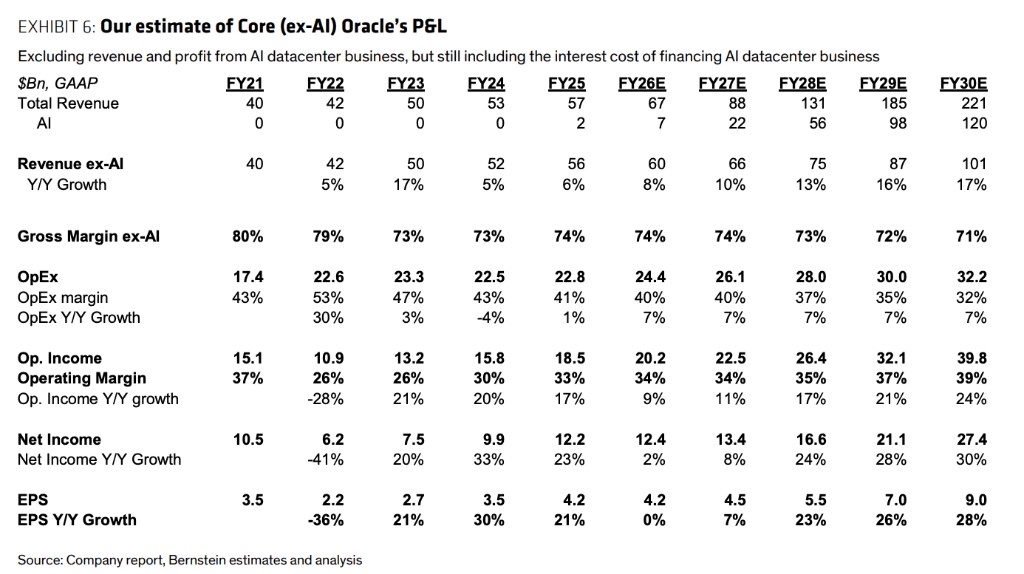
Bernstein further separates the AI business in its latest model, clearly outlining the independent value of Oracle's core business. Even if AI data center-related revenues are completely excluded, the company's total revenue from traditional databases, SaaS, and OCI businesses can still reach $101 billion by the fiscal year 2030.
More critically, after bearing the interest costs of the debt raised for AI infrastructure (including the recent $25 billion financing), its earnings per share can still achieve $9.0. Referring to the 27.3 times price-to-earnings ratio level of software peers like Microsoft, SAP, and Salesforce, this earnings expectation corresponds to a valuation of $137 per share. In other words, even if the AI business were to completely zero out, Oracle could still support about 85% of the current stock price with its core business alone, highlighting the robustness of its cash generation capability.
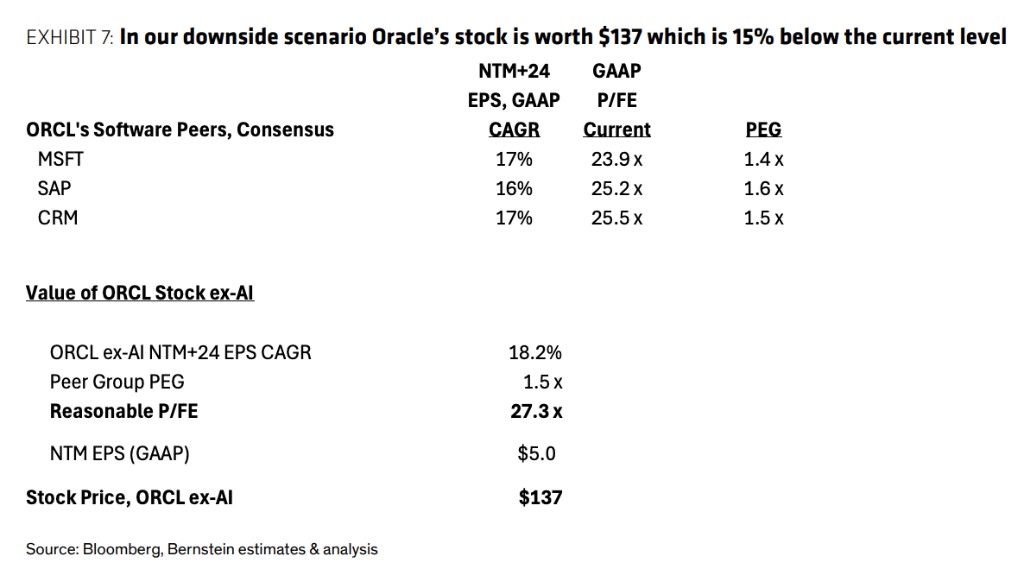
Bernstein believes that Oracle's current stock price has overly priced in pessimistic expectations, and the risk-reward ratio is entering a highly attractive range. With the recent $25 billion debt and an equivalent amount of equity financing coming to fruition, the funding bottleneck for data center construction has been substantially alleviated. The report emphasizes that as long as the world does not fall into an extreme scenario of an "AI winter," the current valuation level provides investors with ample safety margin and asymmetric profit potential
