


Technical failure at CME causes interruption in natural gas and metal futures trading, all orders placed on Wednesday were canceled
This is the second systematic trading interruption at CME within about a month, coinciding with the expiration date of the March natural gas futures contract on Wednesday. Market participants stated that the "freeze" occurring before the market close is "extremely bad timing," and "all participants using futures as pricing and hedging tools have been affected."
The Chicago Mercantile Exchange (CME) Group experienced a technical failure this Wednesday, forcing a trading interruption of over half an hour in its natural gas and metal futures markets. This is another systemic trading interruption in the CME market following the abnormal halt of benchmark natural gas futures a month ago, coinciding with the expiration date of the March natural gas futures contracts, making the market impact significant.
CME announced the suspension of CME Globex metal and natural gas futures and options trading at 12:15 PM North American Central Time on February 25, and approximately 25 minutes later, it released the resumption schedule: the natural gas futures market reopened at 12:50 PM, while the metal futures market was delayed until 1:45 PM.
CME also announced that all orders placed on that day and GTD orders marked with that day's date would be completely canceled, while only confirmed GTC orders would remain valid.
After the failure occurred, Bloomberg data showed that starting at 2 AM Beijing time on February 26, trading data for COMEX gold, silver, copper futures, and NYMEX natural gas futures began to show "missing" entries. Trading for natural gas futures resumed after 3 AM Beijing time, with the increase expanding to over 3%, refreshing the intraday high to $3.017.
Nicky Shiels, head of metal strategy at MKS PAMP SA, stated that a "freeze" occurring before the market close is "extremely bad timing," and "all participants using futures as pricing and hedging tools were affected."
Timeline of the Failure: Four System Alerts in 25 Minutes
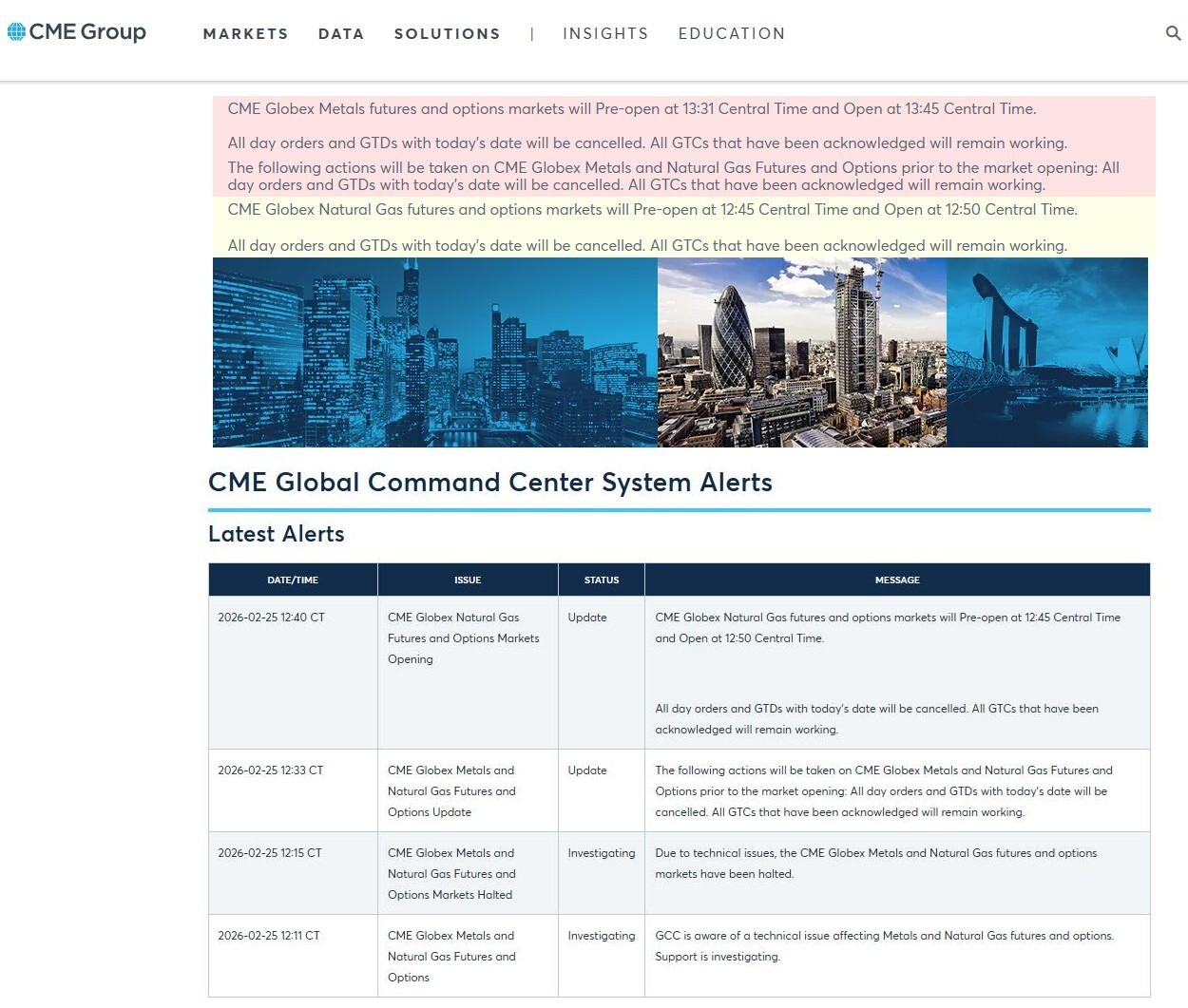
The system alerts published on the CME website clearly outline the incident handling process.
At 12:11 PM Central Time on February 25, the CME Global Command Center (GCC) alerted that it was aware of a technical issue affecting metal and natural gas futures and options and was investigating.
Four minutes later, at 12:15 PM, CME officially announced that the aforementioned markets "had suspended trading."
At 12:33 PM, CME issued an operational notice explaining the arrangements for order handling before the market's resumption.
At 12:40 PM, CME further announced the specific resumption time for the natural gas futures market. The resumption notice for the metal futures market was subsequently issued, with the opening time delayed by about 55 minutes compared to natural gas futures.
CME did not specify the exact cause of this technical failure.
Second Trading Halt in a Month, Compounding Issues on Natural Gas Contract Expiration Date
The timing of this failure is particularly sensitive.
The March natural gas futures contract in the U.S. expired on February 25, and the trading interruption directly interfered with the normal settlement process of the contracts nearing expiration, leaving position traders facing additional operational uncertainty.
This is the second trading interruption in the CME's natural gas futures market within about a month.
According to previous reports, during a record surge in natural gas futures prices on January 27, the New York Mercantile Exchange (Nymex) under CME implemented an abnormal halt lasting two minutes during the market close phase, which caused discrepancies in the settlement price, leaving traders, who were already tense due to demand expectations fluctuating sharply due to cold weather, confused The occurrence of trading interruptions twice within a month has significantly raised market concerns about the stability of the CME trading system.
Nicky Shiels' statement reflects the general worries in the market: any failure of trading infrastructure during critical price discovery windows could have a substantial impact on institutional investors who rely on futures for pricing and risk management
