Record funds have poured in, yet it has resulted in the worst relative performance in 15 years! The halo of U.S. stocks fades, and the dollar alarm sounds?

Wallstreetcn
2026.02.26 03:22
portai
I'm PortAI, I can summarize articles.

Deutsche Bank stated that U.S. stocks are expected to receive a record capital inflow equivalent to about 2% of GDP in 2025, but will underperform globally, marking the worst relative performance in 15 years. As valuation premiums remain high and non-U.S. earnings momentum rebounds, overseas funds may reassess their overweight position in U.S. stocks; if net capital inflows cool down or even reverse, the dollar may face downward pressure similar to the early 2000s

The US stock market is currently facing the awkward situation of "the more you buy, the more you lose," with Deutsche Bank warning that once the record foreign capital inflow into US stocks reverses, the dollar will face severe downside risks.

According to the Wind Trading Desk, on February 25, Deutsche Bank macro strategist Tim Baker released a report indicating that despite unprecedented global capital flowing into the US stock market, the relative performance of US stocks has been surprising. "The US market has lagged behind—cheaper and more cyclical markets have performed better."

In Deutsche Bank's view, the key issue is not just the change in stock market rankings, but whether it could trigger a larger chain reaction: Will overseas investors' "faith" in the overweighting of US stocks be shaken, and will this shake-up pull funds away from the inertia of "buying US stocks and allocating dollars"?

Funds accounting for 2% of GDP flow into US stocks

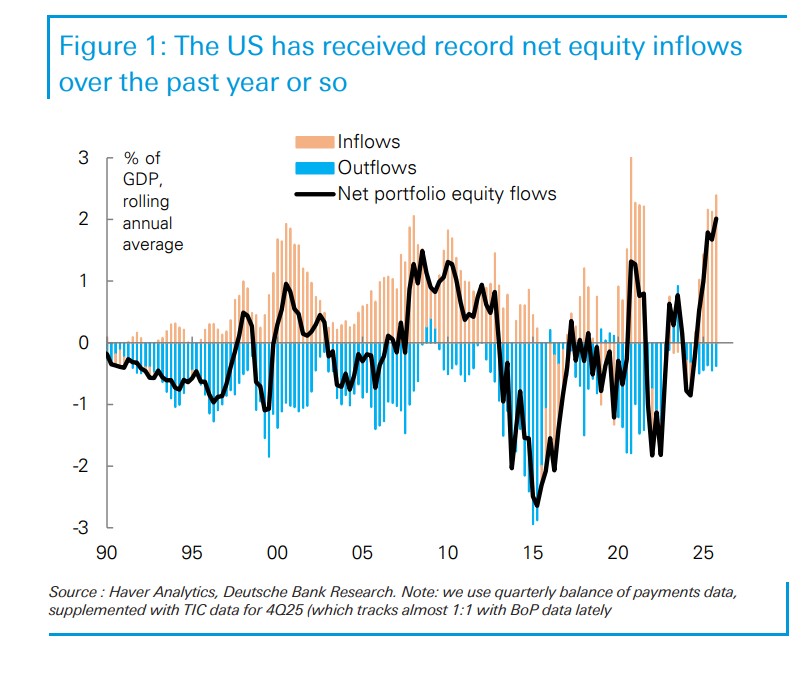
"The level of enthusiasm for the US stock market across the entire market is unbelievable. Net stock inflows have never been this strong," Tim Baker stated in the report. "Throughout 2025, net inflows reached a staggering level of 2% of US GDP."

This is an extremely large number. Deutsche Bank pointed out that this record net inflow of stocks alone is enough to single-handedly finance two-thirds of the US current account deficit.

In this capital feast, not only are foreign investors frantically buying US stocks, but domestic investors in the US have also shown a strong "home bias." The report indicates that American investors' willingness to purchase foreign stocks is weak. Over the past year and a half, the US has appeared out of place among G10 countries. With the exception of the UK, which is barely close, the vast majority of G10 countries have experienced net outflows of stock funds.

"The worst year in 15 years": buying the most but underperforming globally

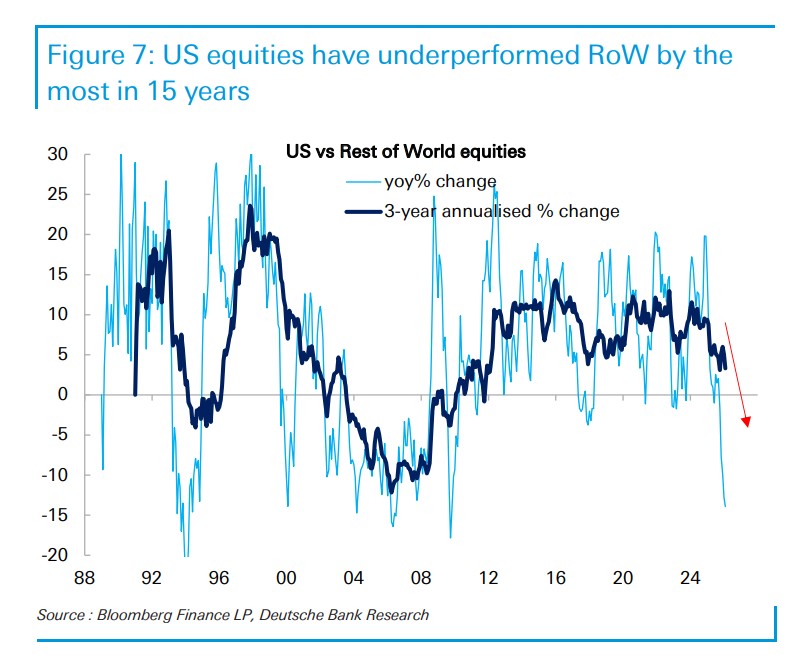
However, the frenzy of capital has not translated into commensurate returns. In hindsight, this frenzied buying of US stocks seems extremely ill-timed.

For over a decade, buying US stocks on dips has been a surefire strategy in the global market. But the rules of the game have changed dramatically over the past year. Deutsche Bank has observed that the strongest performers are no longer US stocks, but those cheaper and more cyclical stock markets.

Embarrassingly, US stocks are neither cheap nor belong to cyclical sectors.

"The extent to which US stocks have underperformed non-US assets has already been evident in the year-on-year calculations in recent months. Such a scale of relative underperformance has not been seen in the past 15 years," Tim Baker stated. Although looking at a three-year period, US stocks still show robust performance, they have now also fallen to recent lows.

Why are cheap and cyclical markets starting to outperform? The logic lies in the strong global macro backdrop.

The momentum of global economic data exceeding expectations has persisted for more than a year, setting the record for the second-longest consecutive positive streak on record. Positive economic data is typically highly correlated with rising global stock markets. Particularly for companies, the current environment is extremely favorable.

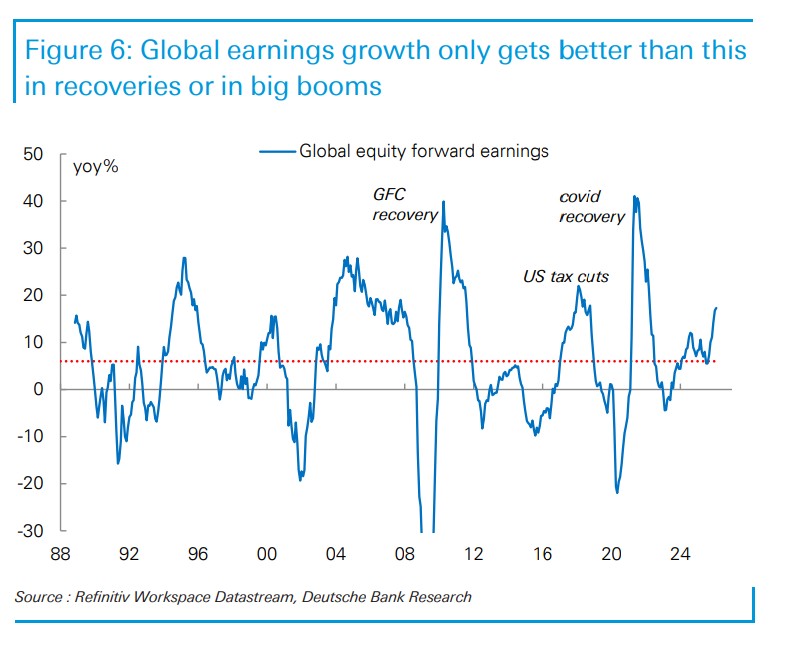
"Global corporate earnings are growing at over 15%. This is not unprecedented, but it usually only occurs during recovery periods after economic recessions (such as in 2010 and 2021) or at special macroeconomic junctures (such as the U.S. tax cuts in 2017 or the emerging market boom in the 2000s)."

Non-U.S. Assets Welcome a Comeback Moment

In the face of the worst relative performance in 15 years, coupled with an already overweight position in U.S. stocks, long-term investors have ample reason to reconsider the direction of their funds.

The shift of capital requires a core premise: non-U.S. markets (RoW) must be capable of at least keeping pace with U.S. stocks. According to Deutsche Bank, this premise is not only valid now but also very reasonable.

First is the impetus for valuation repair. Over the past year, while the valuation gap between U.S. stocks and non-U.S. markets has narrowed, the gap remains significant. Deutsche Bank data shows that the price-to-earnings (PE) premium of U.S. stocks once reached as high as 70%, and although it has since fallen, it still maintains an absolute high of 40%.

The more critical catalyst lies in the reversal of earnings fundamentals. This is a turning point with significant imaginative potential.

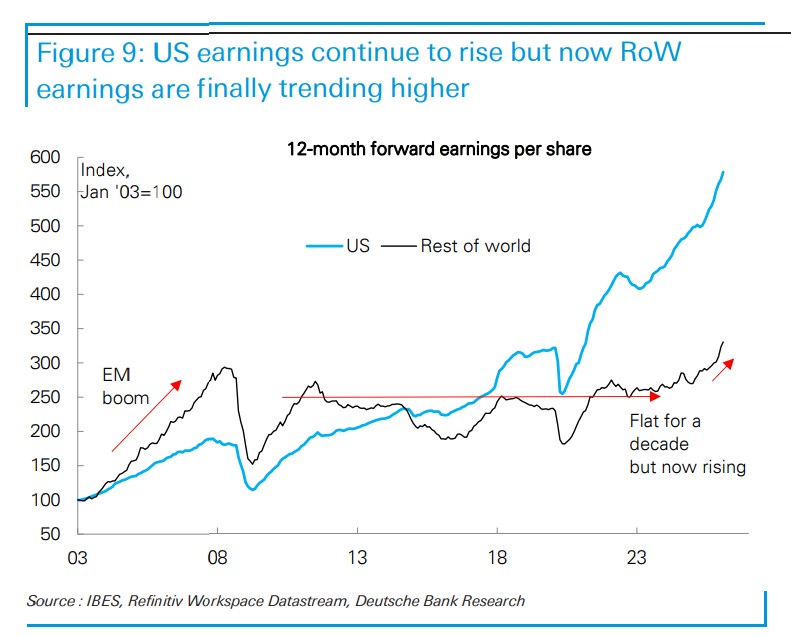
"The earnings story for non-U.S. markets has finally begun to shift in a favorable direction. For 15 years, the earnings of non-U.S. assets have stagnated, while during the same period, U.S. stock earnings have nearly tripled," Tim Baker emphasized in the report. "But now, earnings in non-U.S. markets are showing a significant upward trend—growing by 14% in the past six months."

Of course, Deutsche Bank also maintains objective restraint. The report points out that this convergence of valuations and earnings has its limits. The profitability of U.S. companies still far exceeds that of other regions in the world. The return on equity (ROE) for U.S. stocks is at a high of over ten percent, while non-U.S. markets are only at a low of over ten percent.

This structural earnings gap means that valuations cannot fully align. However, Deutsche Bank believes that it is entirely possible for the valuation premium of U.S. stocks to fall to a reasonable range of 20%-30%.

Additionally, the market needs to be wary of a potential risk: the record capital expenditures (Capex) being undertaken by U.S. companies, if ultimately not converted into high returns, will directly drag down their future earnings metrics.

Core Deduction: How Does Capital Withdrawal Sound the Dollar Alarm?

If funds choose to leave due to the declining cost-effectiveness of U.S. stocks, the foreign exchange market will face an inevitable earthquake. This is also the macro transmission logic that investors need to pay the most attention to at present.

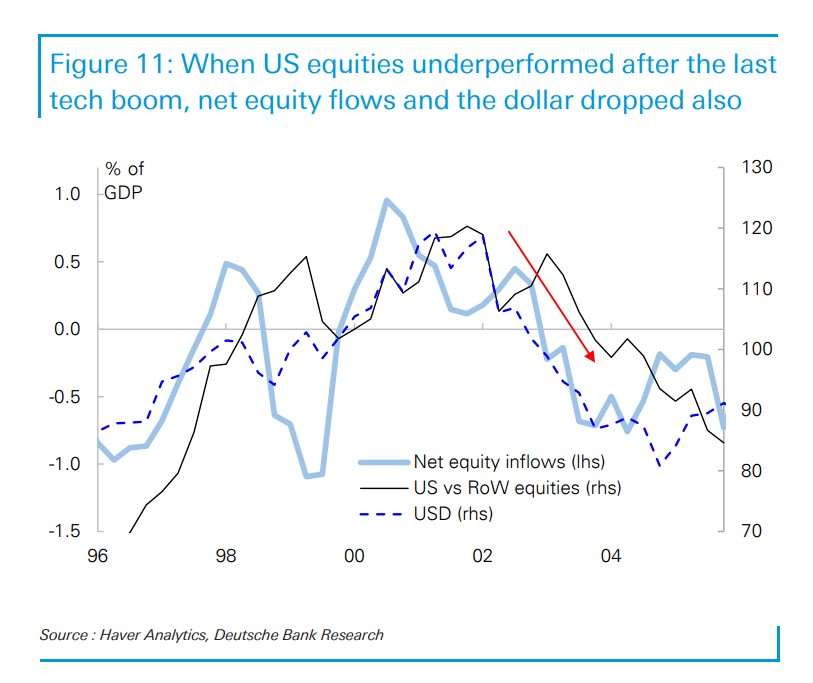
Deutsche Bank clearly pointed out that the underperformance of U.S. stocks has led to a weakening of capital inflows, which in turn drags down the U.S. dollar, with a clear historical precedent.

Turning the clock back to the late 1990s. After the boom and bust cycle of tech stocks, starting in 2002, the U.S. stock market began to significantly underperform globally. Subsequently, the net capital inflow into U.S. stocks sharply reversed to negative, and the dollar began a multi-year depreciation cycle.

"Although the magnitude of this decline may not necessarily repeat the severity of that time, as that period was also accompanied by an epic boom in China and emerging markets. However, the direction of capital movement back then has strong indicative significance for the present," warned Tim Baker.

Looking at the longer cycle, the pricing logic of the foreign exchange market is very clear: the long-term trend of the dollar is closely synchronized with the performance of the U.S. stock market relative to emerging markets (EM).

Although these two are mutually causal, it perfectly fits the current macro deduction logic: faced with high valuations and underperforming results, if record foreign capital stops buying or even withdraws from U.S. stocks, turning to emerging markets and other non-U.S. regions in search of more cost-effective assets, the dollar will lose this capital support, which accounts for 2% of GDP each year, and the downward alarm will be fully sounded.


The above wonderful content comes from [追风交易台](https://mp.weixin.qq.com/s/uua05g5qk-N2J7h91pyqxQ).

For more detailed interpretations, including real-time analysis and frontline research, please join the【 [追风交易台▪年度会员](https://wallstreetcn.com/shop/item/1000309)】.

[![](https://wpimg-wscn.awtmt.com/3c4a713c-7a38-4582-9850-d0eabaf0e7ad.png)](https://wallstreetcn.com/shop/item/1000309)