Minimax continues to dig deep into "lobster meat"

Goodbye to "bankruptcy" and "turbulence."

When the "lobster farming" craze swept the entire AI circle, Minimax took the opportunity to launch the "zero-threshold" revolution of AI intelligent agents.
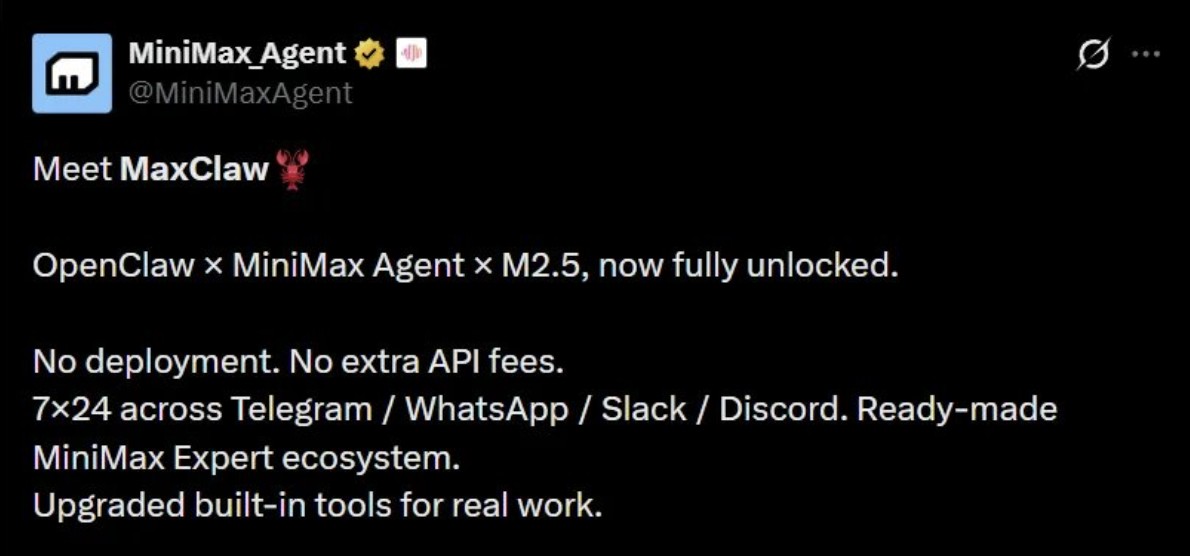
On February 26, Minimax launched the cloud-based AI assistant MaxClaw built on OpenClaw (lobster).
This new tool, directly integrated into the Minimax Agent web interface, boasts three core selling points: zero deployment (click to use), no additional API fees, and 24/7 cloud presence. Users only need to have a basic subscription to Minimax Agent to experience it.
In fact, Minimax has already made moves to lower the threshold for using intelligent agents. Previously, the Minimax Agent client version had already supported one-click local deployment, allowing many players tired of cumbersome environment configurations to enjoy the benefits.
The MaxClaw cloud hosting service integrated into the web interface is a further step in overcoming the computational power and hardware thresholds, following the built-in one-click local deployment feature in the desktop client. Minimax aims to leverage the "deployment dividend" of OpenClaw.
Before the emergence of MaxClaw, having a truly personal "lobster" OpenClaw was not as simple as one might imagine.
For the vast majority of ordinary users attracted by the powerful demonstration videos of OpenClaw, although there is an official one-click deployment script, they had to deal with various installation environment errors during the configuration process. After successful deployment, the challenges only increased. Users were forced to act as "cyber operators," manually configuring interfaces and managing various tokens, which hardly provided a true automated experience.
More daunting than the technical threshold is the "bill of Damocles" hanging over every OpenClaw player's head.
The OpenClaw framework itself is free, but the "brain" driving it requires users to fill in API keys from various model vendors.
When an incredibly active agent is deployed in a group chat, continuously processing context and summarizing lengthy discussions 24/7, the backend billing based on tokens can explode exponentially.
Many have experienced the painful lesson of integrating Claude or GPT-4 in pursuit of an ultimate experience, only to wake up to find their API account balance wiped out because the agent went into a frenzy of replies in the group. This fear of unknown bills has directly led to users becoming cautious when using AI, losing the desire for deep exploration.
In response to these pain points, Minimax has proposed a breakthrough solution—"You just use it, and I'll take care of the rest."
Relying on Minimax's cloud infrastructure and its flagship model M2.5 with 10 billion parameters, MaxClaw has transformed the open-source framework OpenClaw, which originally required a geek spirit to navigate, into a "foolproof" cloud hosting service Zero deployment and all-weather standby are its primary weapons. Users do not need to understand any code or purchase servers; they just need to click lightly on the web page, and the dedicated cloud container will start. This 7×24 hour cloud mounting means that even if you turn off your computer or unplug the network cable, the AI assistant is still on duty around the clock across various social platforms and workflows.
More importantly, it shatters billing anxiety.
MaxClaw binds API consumption with basic subscription membership. Users no longer need to apply for an API Key themselves, nor do they have to anxiously check Token consumption every day. By transforming the uncontrollable "pay-as-you-go" into a predictable and controllable fixed subscription fee, it gives users peace of mind.
Minimax's ambition is gradually emerging. It has seen the explosive popularity of OpenClaw but also discovered its inability to quickly penetrate the many issues faced by most ordinary users. Therefore, it personally engages with OpenClaw, introducing the zero deployment concept to prepare for capturing market mindshare later. This is also a significant move for Minimax in the commercialization and ecological layout of AI.
In today's increasingly fierce competition of homogeneous large models, those who develop the developer ecosystem will dominate the market. The OpenClaw community has already accumulated a wealth of excellent plugins and cross-platform adaptation solutions. The launch of MaxClaw by Minimax is equivalent to effortlessly appropriating this community wisdom.
It does not need to painstakingly develop the access code for each platform; as long as it is compatible with OpenClaw, it instantly opens up a highway to countless application scenarios worldwide. This "standing on the shoulders of giants" approach greatly accelerates the landing process of Minimax's model capabilities.
Secondly, this is a verification of the commercial closed loop of large models.
In the past, users' willingness to pay for large models was often limited to a single web dialogue scenario. However, through MaxClaw, Minimax has effectively delivered a mature "digital workforce" to users. When AI can truly delve into such high-value automated workflows, users' willingness and stickiness to pay for Minimax subscriptions will achieve a qualitative leap.
Finally, this overt scheme brings high-frequency real interaction data to Minimax's underlying model.
Feedback from real application scenarios of OpenClaw will become the fuel for the continuous evolution of Minimax's underlying model capabilities, forming a data flywheel that is difficult for other vendors relying on a single web dialogue box to reach.
The emergence of MaxClaw may be the starting point for pushing agents from "developer toys" to "mass consumer products."
In the current chaotic battle of agents, whoever can quickly transform model capabilities into zero-threshold productivity will seize the entrance to the next era. Minimax is already ahead of the curve