


In two months, it surged 50%, rising to become the ninth largest stock market in the world. How much longer can the South Korean stock market go crazy?
Driven by the dual forces of the AI wave and corporate governance reforms, South Korean stocks have surged nearly 50% this year, with a market capitalization surpassing France, rising to ninth place globally. Goldman Sachs believes that the upward trend has not yet peaked: the expansion of capital expenditures by tech giants has led to a severe shortage of memory chips, corporate earnings have far exceeded expectations, and combined with attractive valuations, they set the KOSPI target price at 6,400 points. The prosperity of the semiconductor industry chain remains the main theme going forward
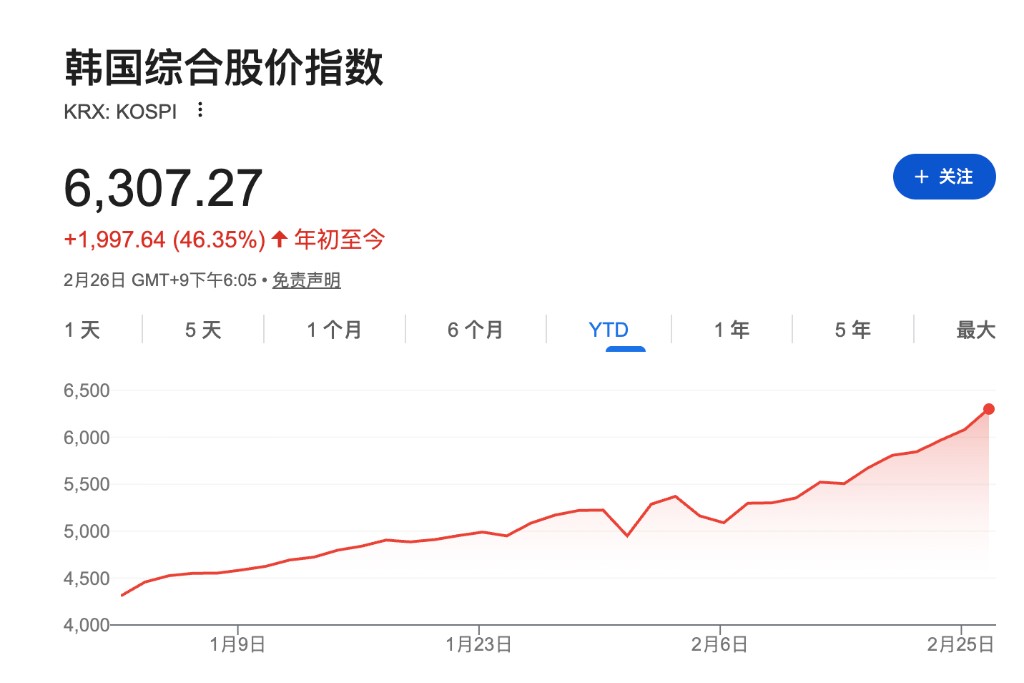
Driven by the surge in global semiconductor demand triggered by artificial intelligence and the reform of corporate governance among domestic companies, the Korea Composite Stock Price Index (KOSPI) has risen nearly 50% this year, becoming the strongest major market globally and propelling the Korean stock market to the ninth largest exchange in the world.
According to Bloomberg data compiled as of February 25, the total market capitalization of the Korean stock market has risen to USD 3.76 trillion, with a cumulative increase of approximately USD 2.23 trillion since the beginning of the year, surpassing the French market's USD 3.69 trillion.
On February 26, the KOSPI index continued to rise by 3.67%, closing at 6307.32 points, and briefly reaching a historical high of 6313.27 points during the session. This year, Korean stocks have consistently surpassed those of France and Germany, fully reflecting the rapid reassessment of valuation logic by the capital market. Since the beginning of the year, the KOSPI has accumulated a rise of about 46%, while the French CAC 40 index has only increased by around 4.5% during the same period.
Goldman Sachs stated in a report released on February 14 that the MSCI Korea Index, priced in US dollars, leads the Asia-Pacific market in terms of growth. In the face of this strong upward trend, Goldman Sachs did not recommend taking profits but instead raised the KOSPI's target price for the next 12 months to 6400 points.
The basis for this adjustment is that the earnings recovery momentum of Korean companies far exceeds expectations, with the core driving force coming from the tightening supply of memory chips triggered by the capital expenditure expansion cycle of global tech giants. For investors focusing on emerging markets in Asia-Pacific, Goldman Sachs' view indicates that the strong performance of Korean stocks has not yet peaked, and the prosperity of the semiconductor industry chain will continue to be a key focus for the market.
The Core Driving Force is the Imbalance of Semiconductor Supply and Demand
The recent surge in the Korean stock market is fundamentally driven by the structural imbalance of supply and demand in the semiconductor industry. SK Hynix's stock price has increased about sixfold since early 2025, while Samsung Electronics' stock price has nearly quadrupled.
Goldman Sachs pointed out in the report that capital expenditures for cloud computing and hyperscale data centers in the United States continue to grow rapidly. It is expected to reach USD 666 billion by 2026, significantly up from the initial estimate of USD 548 billion at the beginning of the year. However, the growth rate of memory chip supply has not kept pace with demand, leading to record supply gaps for both DRAM and NAND. This situation gives memory chip manufacturers strong pricing power and significantly boosts profits through high operating leverage.
Additionally, SK Hynix is collaborating with SanDisk to promote the global standardization of High Bandwidth Flash (HBF), with both parties establishing a working group under the OCP framework, aiming for commercialization by 2027. HBF achieves a balance of high bandwidth and large capacity through NAND stacking, optimized specifically for AI inference scenarios, with its long-term market size expected to surpass that of High Bandwidth Memory (HBM).
Goldman Sachs Raises KOSPI Target to 6400 Points
Goldman Sachs has raised the KOSPI's target price for the next 12 months to 6400 points in its report and maintains an overweight rating on the Korean stock market Analysts Timothy Moe and John Kwon proposed four major supporting logic points. First, earnings growth is exceptionally strong. Following a 36% growth in 2025, Goldman Sachs predicts that earnings per share in the South Korean stock market will grow by 120% in 2026 (the market consensus expectation is +115%). Just at the end of November 2025, the market's earnings growth expectation for 2026 was only +30%. Second, the technology hardware sector contributes the majority of the earnings growth in 2026 (about 88 percentage points), although other sectors such as finance and automotive also contribute.
Third, valuations remain attractive. The 12-month forward price-to-earnings ratio of KOSPI is still below its historical average, providing a margin of safety for future market performance. Fourth, the benefits of policies and reforms continue to be released. The strong support for the stock market from South Korean President Lee Jae-myung and the advancement of corporate governance reforms, combined with the upturn in the robotics industry driving significant increases in related stocks such as Hyundai Motor, together form the institutional basis for market revaluation.
Foreign Capital Inflow and Valuation Discount Coexist
From the perspective of capital flow, during the week the report was released, there was a significant divergence between foreign and institutional funds: foreign capital net bought about 3.47 billion Korean won in KOSPI, while institutional investors net bought about 5.43 billion Korean won, and retail investors significantly net sold about 9.63 billion Korean won. Goldman Sachs data shows that the South Korean equity risk barometer (ERB) has rebounded from a deep risk-averse range to -0.7.
In terms of valuation, despite experiencing a significant rise, the expected price-to-earnings ratio of KOSPI for 2026 remains at about 9 times, which represents a significant discount compared to the MSCI Global Index and the MSCI Asia Pacific (excluding Japan) Index. Meanwhile, its P/B and ROE matching degree is in a relatively favorable range within the Asia-Pacific market, providing relative valuation support for continued foreign capital inflow
