


Bullish bets double, could rise another 5% this year? The RMB is showing an independent trend, what’s the outlook ahead?
Bullish bets on the Chinese yuan in the foreign exchange options market have surged, with market expectations for a 5% appreciation within the year significantly heating up. The trading volume of dollar-yuan options has risen sharply, with the trading volume of put options betting on yuan appreciation reaching USD 100 million, indicating investor confidence in the yuan's appreciation. The yuan has recently performed strongly, setting the longest consecutive rise since 2010, with the offshore yuan exchange rate briefly breaking above 6.83. Although the yuan is expected to maintain a slight appreciation trend, Chinese regulatory authorities have begun to implement counter-cyclical adjustment measures to prevent excessive fluctuations in the exchange rate
With a surge in bullish bets in the foreign exchange options market, the Renminbi is showing a strong independent trend. Amid the release of substantial foreign exchange settlement demand and improvements in macroeconomic fundamentals, market expectations for further appreciation of the Renminbi this year have significantly intensified, with options traders aggressively building positions, and some funds locking in year-end target prices around a 5% appreciation.
According to data from the Depository Trust & Clearing Corporation (DTCC), the trading volume of US dollar against Renminbi options soared on Thursday, becoming the second-largest options product in global trading volume. Among them, the trading volume of put options betting on Renminbi appreciation reached USD 100 million or more, which is twice that of call options betting on its decline. Reports from foreign investment banks indicate that clients are actively purchasing option structures to lock in current profits and maintain bullish exposure, targeting levels as low as 6.50 or even lower.
In the spot market, the Renminbi has also shown a significant independent trend. This week, the Renminbi set a record for the longest consecutive rise against the US dollar since 2010, with the offshore Renminbi exchange rate briefly breaking the 6.83 mark in late February, reaching a new high since April 2023. Against the backdrop of a recent overall rebound in the US dollar, the Renminbi has led the way against major non-US currencies, demonstrating a solid upward logic.
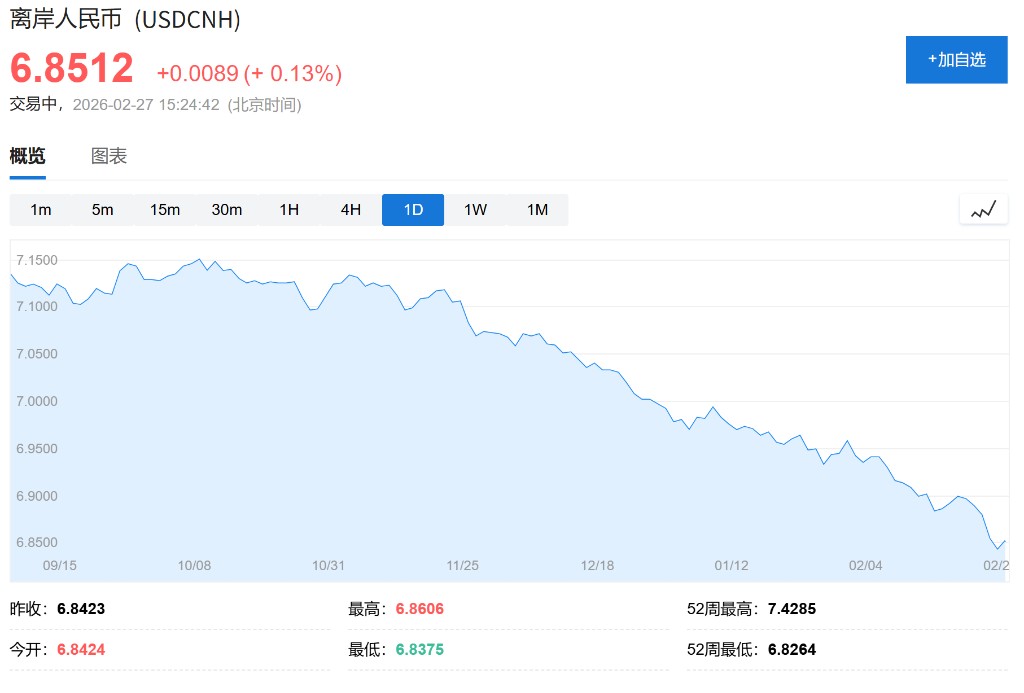
This strong performance has directly reshaped the exchange rate expectations of multinational corporations and investors, prompting a reassessment of the return on Chinese assets in the market. Although most institutions expect the Renminbi to maintain a slight appreciation trend this year, in order to prevent excessive exchange rate adjustments and maintain two-way fluctuations, Chinese regulatory authorities have begun to implement counter-cyclical adjustment measures, and the options market also shows that investors are hedging against potential short-term pullbacks.
Surge in Bullish Bets in the Options Market, Targeting 6.50
According to Bloomberg, traders in the current foreign exchange options market are massively positioning for Renminbi appreciation, generally setting year-end targets around 6.50. Akshay Saxena, head of Asian foreign exchange options trading at Citigroup, stated that recent bullish bets on the Renminbi have been supported by a trend of lower central parity, indicating that the central bank is moderately tolerant of the Renminbi's strength.
“We are seeing strong demand for put option spreads, digital put options, and other strategies for the US dollar against offshore Renminbi, which represents a broad consensus in the market for continued appreciation of offshore Renminbi in the medium term, with a typical year-end target of 6.50,”
Akshay Saxena noted that these low-cost option strategies can profit when the US dollar against the Renminbi declines.
Meanwhile, Standard Chartered Bank also reported an increase in demand for structured products benefiting from the strength of the offshore Renminbi. Saurabh Tandon, global head of foreign exchange options at Standard Chartered Bank SG Ltd., pointed out:
"Now we are starting to see some accounts extend their structures downward to lock in profits from initial trades."
In addition, the recent rise of the renminbi has further boosted bullish confidence, with Macro Hive CEO Bilal Hafeez more optimistically predicting that the currency pair will drop to 6.40.
Release of Settlement Demand Resonates with Fundamental Improvement
The current independent trend of the renminbi is supported by solid macro data and corporate settlement behavior. Xingzheng Strategy pointed out in its research report that the renminbi is currently completing an "active appreciation" and clearly stated:
"The accelerated release of renminbi settlement demand has become an important support for the recent strengthening of the renminbi exchange rate."
Research report data shows that the net settlement amount for banks on behalf of clients reached USD 99.9 billion in December last year and USD 88.8 billion in January this year, remaining at historically high levels.
The large foreign exchange surplus accumulated previously is being converted into substantial buying in the spot market. GF Macro noted in its research report:
"We have simply estimated the remaining settlement volume from 2022 to 2026 in two ways, which is approximately in the range of USD 0.725-1.14 trillion, averaging USD 93.22 billion. A large portion of the holding costs is in the range of 7.0-7.2, and currently about 79.8% of the holding positions are in a 'floating loss state'. Thus, this round of settlement may not just be a short-term behavior."
GF Macro data also shows that the total goods trade surplus for the entire year of 2025 is expected to reach USD 1.189 trillion, and the ratio of "surplus turning into surplus income" has also risen to nearly a ten-year high of around 77.6%.
In addition to the strong performance on the balance of payments side, the stabilization of domestic inflation data and the improvement in capital market returns are also core driving forces. In January, the domestic CPI rose by 0.2% month-on-month, and the PPI rose by 0.4% month-on-month, with a clear trend of price improvement. Chinese equity assets, represented by the Wind All A index, recorded significant positive returns at the beginning of the year, surpassing the performance of the three major U.S. stock indices during the same period, further attracting global capital's attention.
Moderate Policy Regulation, Future May Show Two-Way Fluctuation
In response to the rapid unilateral appreciation of the renminbi, Chinese regulators have begun to signal the prevention of excessive exchange rate adjustments. On February 27, the People's Bank of China announced that it would cancel the additional charges for shorting the renminbi in the foreign exchange derivatives market starting from March 2, in order to ease the pace of the renminbi's rise. At the same time, the recent midpoint rate of the renminbi has also begun to show signs of slight adjustment towards the weaker side, thereby maintaining basic stability at a reasonable equilibrium level for the exchange rate.
The pricing structure of the options market also reveals cautious sentiment behind the unilateral expectations. Although the trading volume of put options is large, the options market still shows a premium for call options on the U.S. dollar compared to put options. Ivan Stamenovic, head of G-10 currency trading at Bank of America in the Asia-Pacific region, analyzed this: "This is more about the market protecting spot short positions rather than someone looking for a sharp reversal in the spot market." Looking ahead, the market generally believes that after a rapid appreciation, the volatility of the Renminbi will revert to the mean. GF Macro provided the following conclusion in their research report:
"Considering the above two conditions, our judgment on the Renminbi exchange rate is that the unilateral trend in 2026 will converge compared to the past two quarters, with bilateral characteristics strengthening, but the annual trend will still maintain a slight appreciation."
Based on a macro quantitative model, the institution expects the Renminbi to continue appreciating after bilateral fluctuations, stabilizing around 6.85 to 6.87 by the end of the year.
Risk Warning and Disclaimer
The market has risks, and investment should be cautious. This article does not constitute personal investment advice and does not take into account the specific investment objectives, financial situation, or needs of individual users. Users should consider whether any opinions, views, or conclusions in this article are suitable for their specific circumstances. Investment based on this is at one's own risk
