


The bankrupt private credit giant MFS still has "big risks"! Creditors warn that double pledges may lead to a $1.3 billion gap
Creditors believe that the dual pledges of Market Financial Solutions (MFS) may lead to more than 80% of its £1.2 billion debt having "unexplained gaps." Financial experts say that having £230 million in collateral against £1.2 billion in debt is catastrophic. It has been reported that MFS obtained financing from multiple Wall Street institutions before its bankruptcy, with total borrowings exceeding £2 billion; Barclays, which has the largest risk exposure to MSF, has an exposure of about £600 million, while Atlas under Apollo has an exposure of about £400 million, and Jefferies has about £100 million
The storm in the UK private credit market has not yet subsided, and new crisis signals have emerged.
According to reports on Friday, Eastern Time on the 27th, some creditors of the UK mortgage institution Market Financial Solutions (MFS) warned that this bridging loan company, which has entered bankruptcy management procedures, may have a collateral shortfall of up to £930 million (approximately $1.3 billion) due to double pledging, accounting for more than 80% of the total related debt.
The two companies that previously forced MFS into bankruptcy—Zircon Bridging Ltd. and Amber Bridging Ltd.—accused MFS of repeatedly pledging the same asset to different lenders to obtain multiple financings.
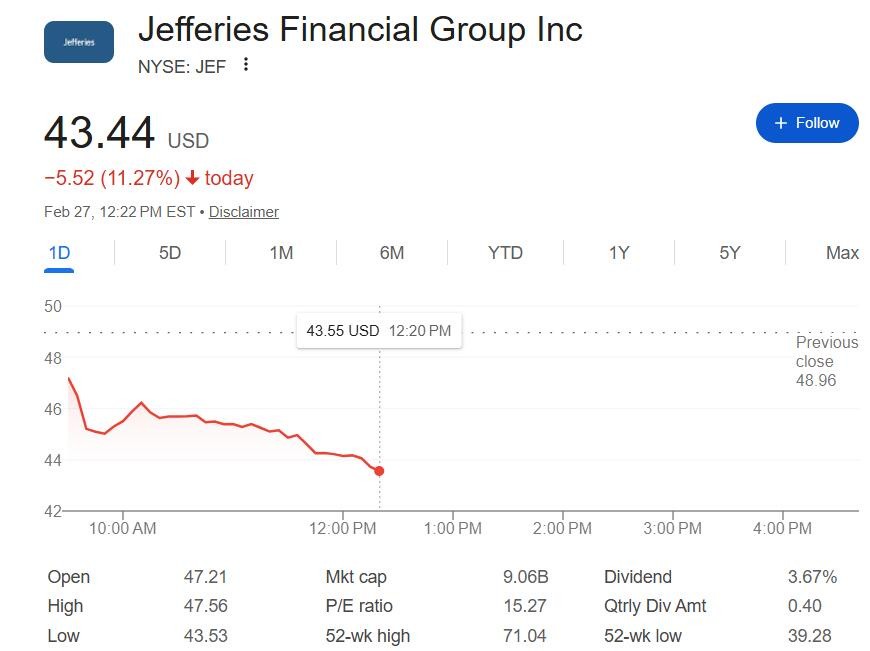
The news of MFS's bankruptcy and the aforementioned collateral shortfall has continued to impact the market in recent days, leading to significant declines in the stock prices of related institutions. On Friday, during U.S. stock trading, Jefferies, which fell over 3% on Thursday, dropped more than 10%; Santander Bank's European stock fell by 3.7% during trading; Barclays' London-listed shares fell by more than 5%, underperforming the UK FTSE 100 index, which set a record high for the third consecutive day.
An article from Wallstreetcn on Friday mentioned that MFS's crisis has implicated Wall Street institutions including Barclays, Santander, Wells Fargo, Jefferies, and Apollo Global Management's Atlas SP Partners, with a total risk exposure exceeding £2 billion.
Doubts about Double Pledging: How the $1.3 Billion Shortfall Was Formed
According to court documents obtained by the media, Zircon Bridging and Amber Bridging, which forced MFS into bankruptcy management, accused MFS of "double pledging," meaning that the same collateral was used to guarantee multiple financings simultaneously without proper disclosure to the respective lenders.
This accusation implies that multiple creditors believed they had priority security rights over the same batch of assets, but in reality, these assets had been repeatedly pledged.
An official from the bankruptcy management firm AlixPartners wrote in related documents: "'Double pledging' means 'different financing parties provided funds for the same asset.' I understand this to mean that the same collateral was simultaneously used to secure multiple financing arrangements without adequate disclosure, leading multiple creditors to believe they each had security rights over the same asset."
According to the creditors' claim documents, MFS's aforementioned operations may have resulted in more than 80% of its £1.2 billion debt having an "unexplained shortfall," with the shortfall amounting to approximately £930 million (about $1.3 billion) Angela Gallo, a finance lecturer at the Bayes Business School in London, pointed out that the collateral value in MFS-type transactions should typically correspond to 105% to 120% of the loan amount. She stated, "To put it bluntly, having £230 million in collateral against £1.2 billion in debt is catastrophic. It looks absolutely like a complete mess."
However, AlixPartners was just appointed this week as the bankruptcy administrator, and the related work is still in its early stages. The actual scale of losses for creditors is still undetermined. MFS founder and CEO Paresh Raja did not respond to media requests for comments sent via social media.
Wall Street Institutions Involved: What Are the Risk Exposures?
According to media reports this week, MFS obtained financing from multiple Wall Street institutions before its bankruptcy, borrowing a total of over £2 billion (approximately $2.7 billion).
Among the disclosed exposures, Barclays is the single institution with the highest risk. According to court hearings, Barclays has a risk exposure of about £600 million in MFS, and it also operates MFS's bank accounts, which have been frozen in recent weeks.
Apollo Global's structured credit division, Atlas SP Partners, confirmed it holds a risk exposure of about £400 million, accounting for approximately 1% of its balance sheet, and stated it is "maximizing recovery through all legal avenues."
Additionally, media reports indicate that Jefferies' exposure is about £100 million, approximately $135 million. Santander and Wells Fargo are also among the lenders, but their specific exposures have not been publicly disclosed.
Analysts suggest that there should be some leeway in estimating Barclays' actual loss scale. Citigroup analysts pointed out that "there is a fundamental difference between arranging loans and retaining risk on the balance sheet," and it is currently unclear "whether provisions have been made for this and the scale of those provisions."
Spokespersons for Barclays, Santander, Wells Fargo, and Jefferies all declined to comment. Apollo did not immediately respond to requests for comments.
How the Bridge Loan Platform Collapsed
MFS was established in 2006 and is headquartered in Mayfair, London, founded and led by Paresh Raja as CEO. The company claims to provide "complex, property-backed loans," with its core product being short-term bridge loans aimed at various real estate investors.
MFS's business model relies on borrowing from Wall Street institutions to maintain operations: MFS arranges financing through multiple affiliated entities under its group, while it serves as the servicer for the entire loan portfolio, responsible for collecting repayments. Zircon and Amber are part of Raja's network of affiliated companies, borrowing funds from lenders and then using the proceeds to issue short-term bridge loans to property buyers, with MFS acting as the servicer.
This model created the illusion of rapid growth in a short period. MFS's loan book size once soared to a peak of about £2.5 billion. In a 2024 performance statement, Paresh Raja attributed the growth to the "strong strength of institutional financing partnerships," revealing that £1.3 billion in new institutional financing was added that year, and existing financing was also "expanded and renegotiated," reaching £1.1 billion However, behind this expansion is an extremely fragile capital structure. According to public financial data, MFS has a net asset of only about £15.9 million and 149 employees.
On Wednesday, Zircon and Amber proactively applied to place MFS under bankruptcy management due to concerns over account irregularities and financial violations. The two companies mentioned in court documents that there are "real and serious concerns" about "serious mismanagement" of MFS and its subsidiaries.
Crisis Spreading: Frequent "Cockroaches" in the Private Credit Market
MFS is not an isolated incident but the latest link in a chain of recent explosions in the private credit market, raising widespread alarm on Wall Street.
The dual pledge allegations had previously emerged in the bankruptcy cases of U.S. auto parts supplier First Brands Group and subprime auto lender Tricolor Holdings last year, with Santander and Jefferies also deeply involved in those incidents, now facing similar predicaments again.
JP Morgan CEO Jamie Dimon referred to such incidents as frequently emerging "cockroaches" in a speech to investors on Monday, explicitly warning that the current market reminds him of the scenes before the 2008 financial crisis. Dimon said:
"Unfortunately, we did see almost the same situation in 2005, 2006, and 2007—rising tides, everyone making money. I see some people doing stupid things now."
Nicole Byrns, founder of asset-backed financing fund Dumar Capital Partners, questioned the industry's ability to prevent fraud:
"For the past six months, the market has been discussing how to prevent fraud, forming special task forces and developing new anti-fraud products. MFS once again shows that there may still be significant gaps in the ability to detect fraud."
At the same time, other risk signals in the private credit market are also accumulating.
A week before MFS's bankruptcy, Blue Owl had just announced the suspension of quarterly redemptions for one of its private credit funds aimed at retail investors, triggering a new round of liquidity concerns in the market. A business development company (BDC) under Apollo also lowered its quarterly distribution and wrote down its portfolio.
Bruce Richards, chairman of Marathon Asset Management, compared the debt risks in the software industry to a "train coming into view from a distance," warning that "the market has just begun to wake up."
So far, no government agency has filed misconduct charges against any individuals involved in the MFS incident.
MFS's statement last Saturday characterized the event as a "procedural issue with major banking service providers," and Raja insisted that "the current situation does not reflect a failure of the underlying business or asset quality issues." The work of the bankruptcy management firm AlixPartners has just begun, and the final scale of losses is yet to be assessed
