Bank of America Hartnett: "The 'Private Credit Crisis' is a 'Leading Indicator'"
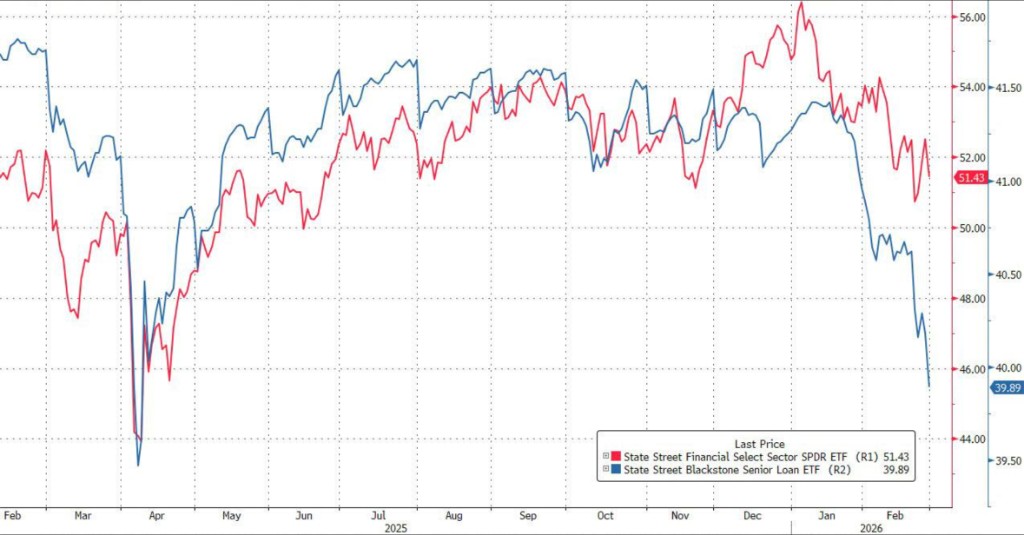
Bank of America strategist Hartnett warned in the latest report that the private credit market is sounding alarm bells. Two key indicators of bank loan funds have both broken down, with SRLN falling below $40 and XLF losing the $52 mark, indicating that credit risk is beginning to transmit to the financial system. Historical patterns show that the loosening of bank loan funds always precedes broader market shocks, as seen in the 2020 pandemic and the 2022 UK pension crisis, without exception
The technical signals from the private credit market are sounding alarms.
Michael Hartnett, Chief Investment Strategist at Bank of America, stated in the latest Flow Show report: Bank loan funds, as the "outpost" of the financing chain, have historically been a leading signal for risk events when they fall below key levels. Currently, two key indicators have both fallen below warning thresholds: the SRLN Senior Loan ETF closed at $39.89, breaching the critical support of $40; the financial sector ETF XLF reported $51.43, falling below the $52 mark.
Hartnett previously made it clear that once these two levels are simultaneously breached, it indicates that credit risk is beginning to transmit to the financial system, triggering the conditions for a "full flush" of risk assets that he has warned about, and could potentially lead to a systemic sell-off.
The SRLN tracks bank loans, which are floating-rate loans issued by financial institutions to businesses, positioned at the front end of the financing chain and highly sensitive to marginal changes in credit risk. The XLF covers the U.S. financial sector, including banks, investment banks, and asset management firms, serving as a "connector" between the credit market and the capital market. Hartnett views these two as dual probes for monitoring the health of the financial system: one focused on credit itself, and the other on the transmission hub of credit.
In his view, such shocks will price the market through two pathways: first, a significant strengthening of the U.S. dollar. When risk assets face sell-offs, capital tends to flow back to the U.S. for safety, pushing up the dollar exchange rate. He expects the dollar index DXY may rise to the 100 mark, which will further tighten global financial conditions and put pressure on emerging markets and commodities. Second, a substantial rise in long-term bonds. Funds simultaneously flow into the treasury market seeking safety, pushing up bond prices and lowering yields, reflecting increased market concerns about growth prospects.
Private Credit: An Indicator That Senses Danger Earlier Than the Market
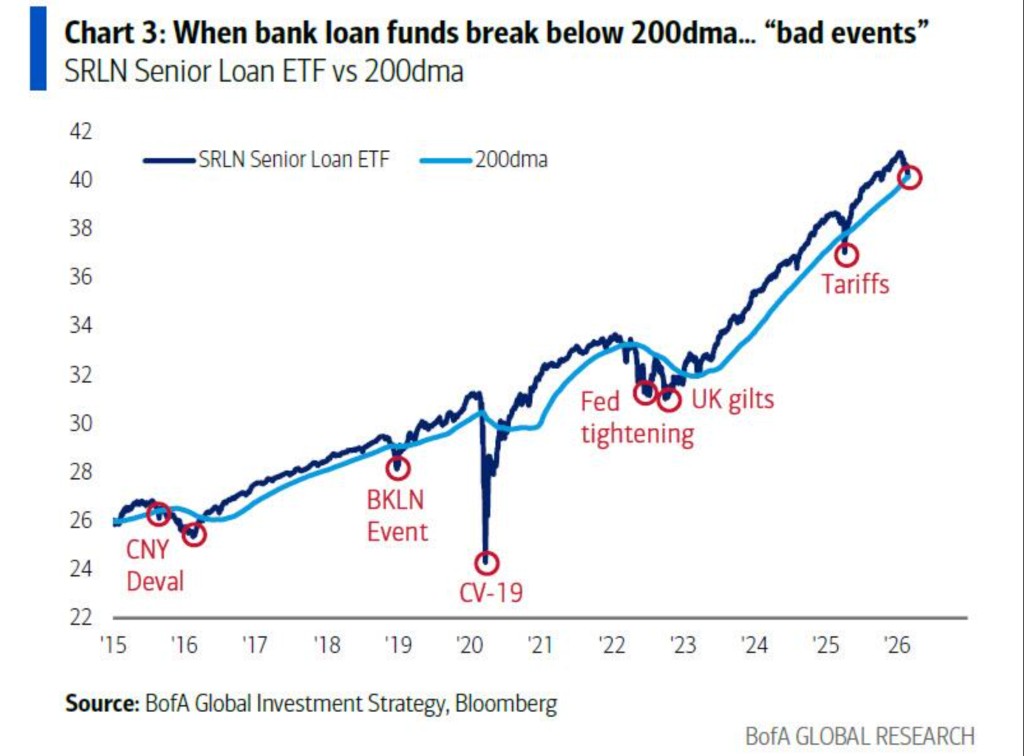
Hartnett emphasized the historical correlation between bank loan funds and market risk events in the report: whenever they fall below the 200-day moving average, it often signals significant market turbulence, with no exceptions in 2015 during the depreciation of the yuan, the pandemic in 2020, and the UK pension crisis in 2022.
In his view, the private credit market is either the most forward-looking early warning indicator or itself a catalyst for triggering broader market contagion. With both SRLN and XLF breaching key levels, Hartnett determines that the "proper flush" conditions he previously described have indeed been established.
South Korean Stock Market: Bubble Alarm Has Sounded, Short-Term Gains for Safety
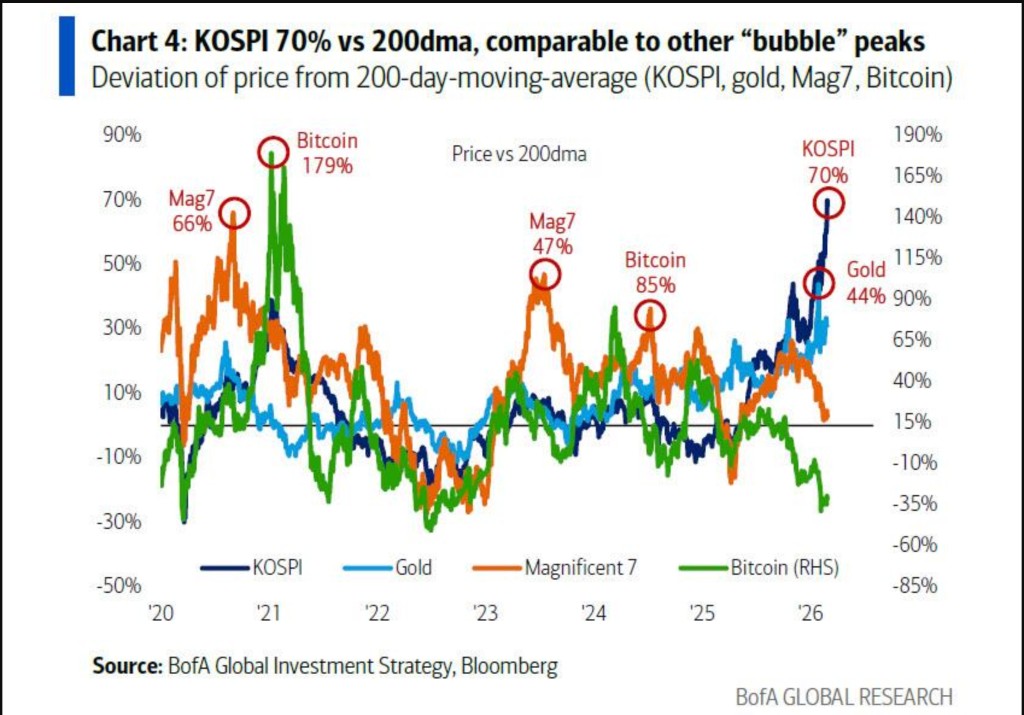
Hartnett has turned his attention to the strong rebound in emerging markets and expressed clear concerns about the overvaluation of the South Korean stock market. He pointed out that SK Hynix's stock price has increased fivefold in the past 10 months, and if it rises another 18%, the increase will be comparable to Cisco's sixfold bubble from October 1998 to March 2000.
He compared the current overbought level of the KOSPI index to gold in January 2026, Bitcoin in March 2024, and the "Mag7" in July 2023—all of which experienced significant corrections afterward. Hartnett warned that the reversal of the current South Korean market may simultaneously drag down the Nikkei index (currently at historical highs) and the renminbi exchange rate.
End of the Solo Dance in U.S. Stocks? International Stocks to Outperform Long-Term
Despite a cautious short-term outlook, Hartnett's long-term framework remains optimistic about non-U.S. markets. He believes that international stocks will overall outperform U.S. stocks in the second half of the 2020s, driven primarily by fiscal expansion, populist policies, and the end of the deflationary era.
He cited data indicating that currently, markets outside the U.S. account for only 38% of the total global stock market capitalization of $97 trillion, while the U.S. accounts for as much as 62%—this structural imbalance provides long-term revaluation space for international stocks.
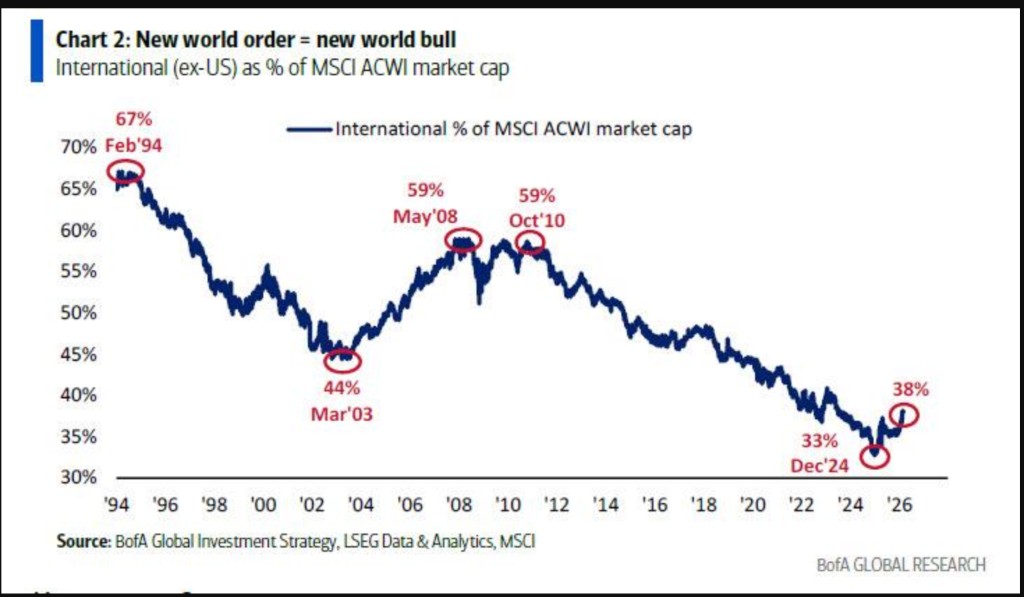
Additionally, the impact of AI on the labor market is gradually becoming evident (e.g., Block recently laid off 40% of its workforce, attributing the reason to AI), combined with the potential negative impact of corporate revenues on U.S. GDP and the S&P 500 index, U.S. stocks will pose relatively unfavorable factors compared to the EAFE and emerging market indices, which have a higher proportion of manufacturing and resource sectors.
Comprehensive Net Inflows, Underlying Divergences Emerge
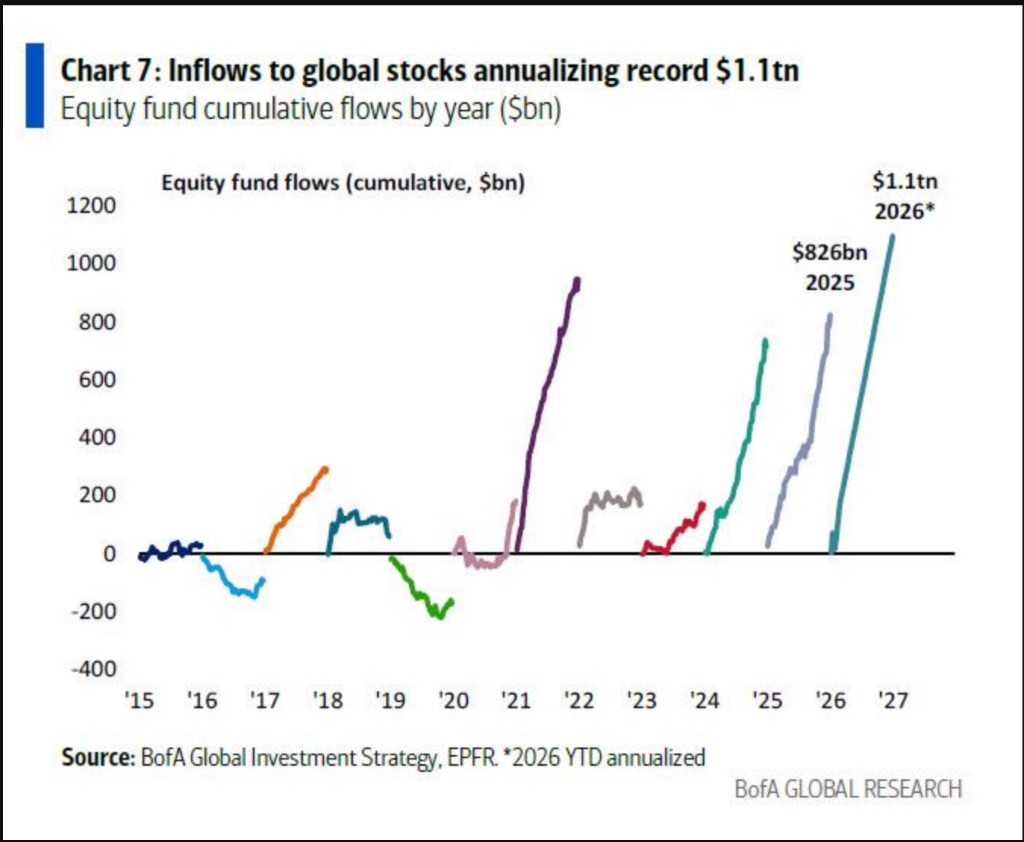
At the end of the report, Hartnett disclosed the latest weekly global capital flow data, showing net inflows across various asset classes: $38.1 billion into stocks, $38 billion into cash, $16.8 billion into bonds, $6.2 billion into gold, and $300 million into cryptocurrencies.
Notably, investment-grade bonds saw a weekly inflow of $9.6 billion, the lowest in nearly seven weeks, but the year-to-date total has reached a record $708 billion; the South Korean market saw a weekly inflow of $3.7 billion, with a cumulative inflow of $21 billion year-to-date, exceeding the inflow scale of any complete year in history. The continuous influx of funds alongside technical warning signals makes the market outlook increasingly ambiguous.