


Berkshire's "new king" states: These four stocks "will never change," implying no further reduction in Apple?
Berkshire's new CEO Greg Abel, in his first letter to shareholders, explicitly listed Apple, American Express, Coca-Cola, and Moody's as "core holdings," indicating that these positions will be held long-term and not easily reduced. Previously, the position in Apple had been reduced by about 80%, marking the end of that phase. The four stocks together account for more than half of Berkshire's investment portfolio, and the holding costs are extremely low
Berkshire Hathaway's new CEO Greg Abel outlined the investment blueprint for the post-Buffett era in his first letter to shareholders. He characterized Apple, American Express, Coca-Cola, and Moody's as the company's "core holdings," suggesting that these positions will remain stable for the long term and will not be easily reduced.
Abel stated in the letter that these four companies are targets that Berkshire "fully understands, highly recognizes their management, and expects to continue compounding growth over decades," and he clearly indicated that there will be "limited operations" regarding these holdings. Data shows that these four stocks account for more than half of Berkshire's approximately $300 billion stock investment portfolio; when adding the holdings in five Japanese trading companies of about $35 billion, the nine core stocks together account for two-thirds of the overall portfolio.
It is noteworthy that American Bank and Chevron, which are among Berkshire's top five holdings, did not appear on the aforementioned core holdings list. Meanwhile, Abel did not specify a particular individual responsible for daily stock investment decisions in the letter, leaving significant uncertainty regarding Berkshire's future investment strategy.
Four "Permanent Holdings" Serve as a Moat
Both Coca-Cola and American Express have been held by Berkshire for over 40 years, and Moody's holding history also exceeds 20 years. For a long time, these stocks have been viewed by the market as typical "permanent holdings," partly due to their extremely low holding costs.
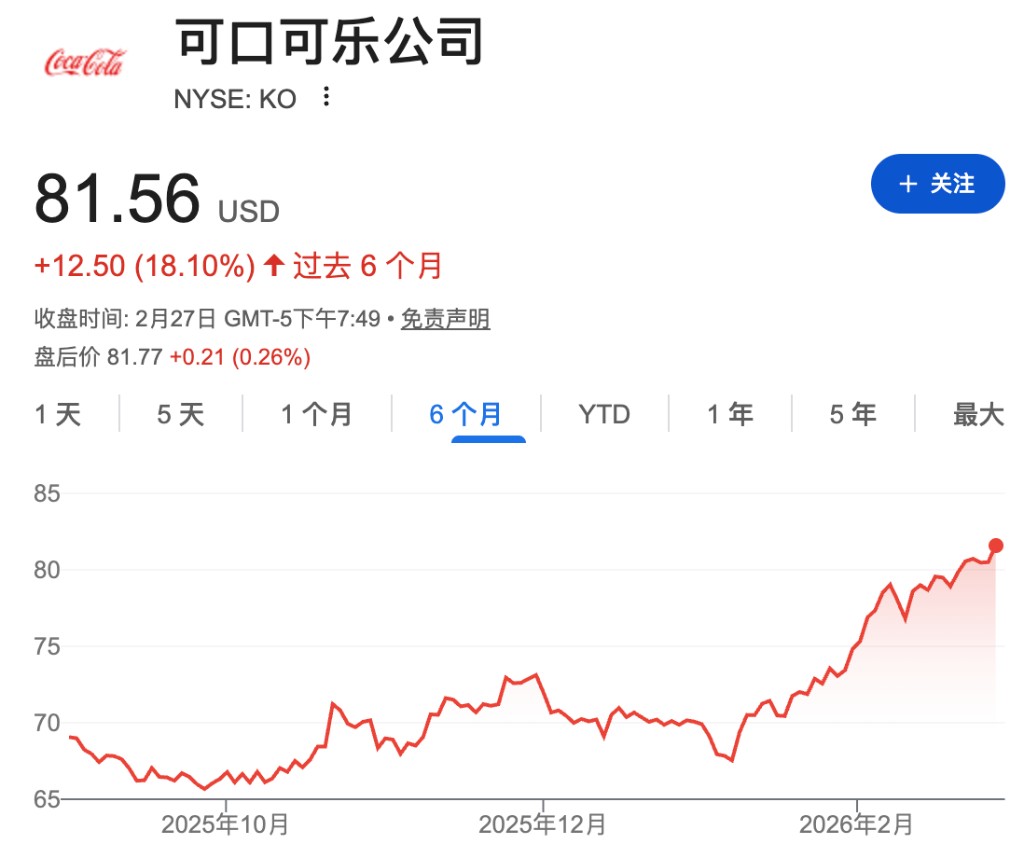
For example, Berkshire's average purchase cost for Coca-Cola in the late 1980s was about $3 per share, while the stock closed at $81.56 last Friday, reaching an all-time high. The holding history for Apple is about ten years, with Berkshire's average cost around $27 per share, roughly one-tenth of the current stock price of $264.
It is important to note that the Apple position has previously undergone significant reductions. Buffett has cumulatively reduced his holdings from peak levels by about 80% over the past few years, holding 227 million shares by the end of 2025. Abel's latest statement indicates that the Apple position will no longer be further reduced. An analysis by Barron's pointed out that when Berkshire reduced its Apple holdings, it seemed to prioritize selling the higher-cost shares to lower the tax burden from large-scale reductions in 2024.
American Bank and Chevron Not on the List
The absence of American Bank and Chevron from the core holdings list has drawn market attention. Data shows that over the past 18 months, Berkshire has reduced its American Bank holdings by about half to 517 million shares, corresponding to a market value of about $28 billion; the market value of Chevron holdings is approximately $20 billion.
Abel mentioned in the letter that Berkshire holds "meaningful positions" in "a few other companies," and the capital allocation for these positions will be "more dynamic," with the potential to become core holdings in the future. This statement leaves room for interpretation in the market but also indicates that the two stocks mentioned are currently still in an observation phase rather than a locked-in status
Concerns Over Investment Portfolio Management Structure, Abel's Role Sparks Discussion
Abel made it clear in his letter that “the ultimate responsibility for investment decisions rests with me as CEO,” and revealed that Buffett will still work in the office five days a week, available for consultation on capital allocation (including stock investments) “at any time.”
However, Abel himself lacks experience in portfolio management and also needs to oversee more than 50 subsidiaries under Berkshire. At the investment manager level, Ted Weschler has served as an investment manager for Berkshire since 2012, and Abel stated that he will continue to manage about 6% of the investment portfolio, which is roughly the same as before.
This arrangement shows a significant discrepancy from Berkshire's public statement when Weschler was recruited in 2011. At that time, Berkshire stated in a press release that after Buffett no longer served as CEO, Todd and Ted would be responsible for managing all of Berkshire's stock and debt investment portfolios with the assistance of an additional manager. Another investment manager, Todd Combs, left last December to take an investment position at JP Morgan.
Barron's pointed out that currently, Berkshire does not have a dedicated manager responsible for the daily management of the overall investment portfolio. Coupled with Abel's characterization of “permanent holdings,” some observers believe that future new stock investments may no longer be the main source of value creation for Berkshire, which is significant for a company that initially built its foundation on successful stock investments
