


"Cloud King" has fallen behind? Amazon's "AI strategy": "low cost" is the core, not competing with cutting-edge models, focusing on self-produced chips and customized models

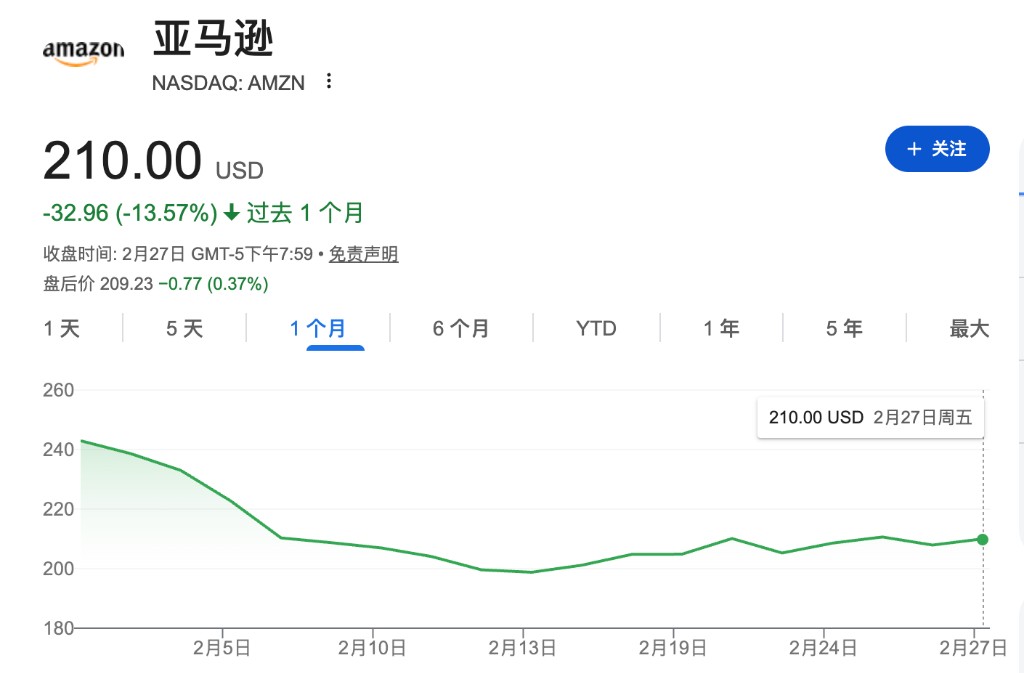
Amazon's new AI head Peter DeSantis bluntly stated that "AI has a cost problem." He plans to build cost barriers relying on self-developed chips to provide customized solutions at 50% lower inference costs than competitors. This shift comes as its AI business faces pressure: the flagship model Nova's benchmark testing lags behind, the core technology team is in turmoil, and AGI lab head David Luan left this week. Despite Amazon's plan to invest $200 billion to enhance AI infrastructure, its stock price has still fallen 14% since January
Amazon is attempting to reshape its competitive position in the artificial intelligence field with a low-cost strategy. After falling behind competitors with its flagship AI model, the e-commerce and cloud computing giant appointed a new head of AI and established cost-effectiveness as a core competitive weapon.
According to The Wall Street Journal, Amazon's new head of the AI department, Peter DeSantis, candidly stated during his first public appearance after taking office: "AI has a cost problem." He believes that to truly achieve a comprehensive transformation in artificial intelligence, the existing cost structure must undergo fundamental adjustments.
DeSantis's core strategy relies on Amazon's self-developed chips to develop generative AI models at costs lower than competitors, focusing on providing customized, cost-effective solutions for enterprise clients. This approach sharply contrasts with the "high-profile route" taken by competitors like OpenAI and Anthropic, who release cutting-edge models every few months.
He emphasized that Amazon's goal is not to chase the speed of model iteration but to provide customers with a more cost-effective way to meet their AI needs while keeping technology updated. This shift comes at a time when Amazon's AI business is under pressure. Its flagship model, Nova, has fallen behind competitors in independent benchmark tests, while the core technology team has experienced turmoil: former AI scientist Rohit Prasad left in December last year, and this week, AGI lab head David Luan also announced his departure.
The pressure at the capital level is also intensifying. Amazon plans to invest $200 billion in capital expenditures this year, with most of it directed towards AI infrastructure, raising concerns among some investors about the speed of cash consumption. The company's stock price has fallen about 14% since January.
New Leader Takes Charge, Low-Cost Strategy Becomes Core
Veteran technology executive Peter DeSantis took over the AI department in December last year. DeSantis joined the company in 1998 and has served for nearly 28 years, being a core driver of Amazon Web Services (AWS) infrastructure development, recognized internally for his deep technical background.
Amazon CEO Andy Jassy stated when announcing the appointment that DeSantis has a "track record of solving problems at the boundaries of technological possibilities," and this promotion is seen as an important signal of Amazon's commitment to enhancing its foundational AI capabilities.
He emphasized that Amazon's self-developed Nova model has entered a mature stage, capable of reducing deployment costs while accelerating development. This move aims to address enterprise clients' general concerns about the cost-effectiveness of current AI model training and chip investments, as high computing costs are becoming a major barrier to adopting AI services.
Self-Developed Chips Are Key to Cost Reduction
This strategy is based on Amazon's self-developed AI chips, Trainium and Inferentia, with the former specifically designed for training models and the latter for querying results. Amazon stated that its chips are cheaper because they are tailored for specific tasks, being up to 50% less expensive than similar products from competitors. ** DeSantis stated:
"If we can build models on our own chips, we can do it at a fraction of the cost of pure AI model providers,"
Based on this, Amazon launched the Nova Forge product, allowing enterprise customers with specific needs to build customized generative AI models without paying for the premium versions of ChatGPT, Claude, or Gemini. Technology consultant and veteran CIO Tim Crawford noted that more and more enterprises are being attracted to specialized models like Nova because they are cheaper, faster, and can be customized for industry-specific tasks such as cybersecurity threat detection. He pointed out that enterprise CIOs are increasingly focused on the "relationship between results and price," placing greater emphasis on cost-effectiveness.
The actual use case from Boston-based drug development company Nimbus Therapeutics confirms this logic. The company's director of computational chemistry, Leela Dodda, stated that after testing multiple AI models, the company chose Amazon Nova, partly because it is easier to train, costs less than competitors, and has a faster response time. He noted that one impressive aspect is Nova's low price; in the company's tests, Nova's accuracy was comparable to a version of Anthropic's Claude, but at only one-tenth the price.
Huge Capital Expenditures Raise Investor Concerns
Amazon's planned capital expenditures of $200 billion this year—roughly equivalent to the total of the past two years—have raised alarms among some investors. Analysts expect that in the first quarter alone, Amazon will consume about $9 billion in cash. The company's stock price has declined since January, reflecting market doubts about whether this spending pace can translate into sufficient new business.
In response, DeSantis referenced Amazon's historical precedents. He stated that in Amazon's early days, critics believed the company could not compete with large chain retailers; similarly, when investing in AWS data centers, analysts were also pessimistic. "I don't think anyone views these two things that way anymore," he said.
Notably, Amazon also announced a $50 billion investment commitment to OpenAI this Friday, demonstrating that while it is betting on its low-cost approach, it is still diversifying its AI ecosystem. In terms of talent competition, Amazon faces significant pressure as well; according to data from market research firm Levels.fyi, the average base salary for Amazon software engineers and research scientists is lower than that of Meta, OpenAI, Apple, and Anthropic, and the company has recently undergone two rounds of layoffs, with approximately 30,000 white-collar employees leaving. DeSantis expressed confidence in the existing team and believes the company can continue to attract top talent
