


Analyzing the unemployment data of American college graduates, JP Morgan's conclusion: It's not that AI is too strong, but that college degrees are not sufficient

Recently, the unemployment rate of the labor force with a college degree in the United States has risen sharply, and the market generally attributes this to the impact of AI on white-collar industries such as technology and finance. However, JPMorgan Chase found that even when high-educated individuals are dispersed into non-white-collar industries, their unemployment rate increase remains the same; moreover, the unemployment rate in industries most affected by AI has stabilized over the past two years. The overall demand for "college skills" in the U.S. macroeconomy may be declining
When "AI taking jobs" becomes a concern, JPMorgan Chase offers a colder conclusion: the rising unemployment rate among U.S. college graduates may not necessarily be driven by AI, but rather reflects a weakening of the "educational advantage" itself.
According to news from the Wind Trading Desk, on February 27, Abiel Reinhart, an analyst from JPMorgan Chase's North American Economic Research team, analyzed the abnormal rise in the unemployment rate of U.S. college graduates in a recent report: this rise seems more like a cooling of overall demand for college-educated labor, rather than an over-concentration of college graduates in a few industries like technology or the widespread substitution effects brought by AI.
Over the past two years, changes in the U.S. technology sector have coincided with the AI boom: JPMorgan Chase pointed out that employment and wages in the technology sector have continued to decline since peaking at the end of 2022, coinciding with the Federal Reserve's interest rate hike cycle and the release of ChatGPT, sparking debates over "AI vs interest rate hikes/post-pandemic over-hiring."
The core question for JPMorgan Chase is: the rising unemployment rate among U.S. college graduates is due to "industry drag" (such as technology and finance) or a "general weakening of demand for educational skills"?
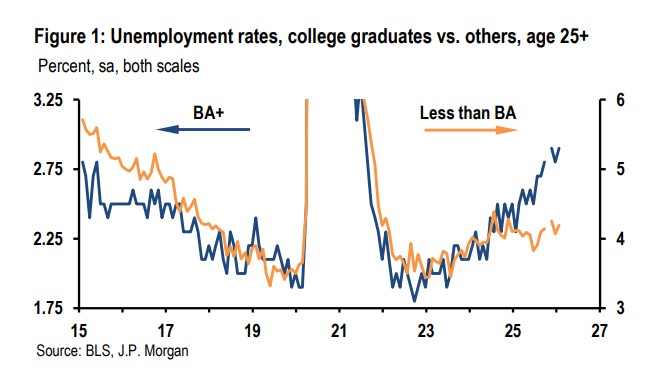
Not specific industry shocks, but overall demand weakness
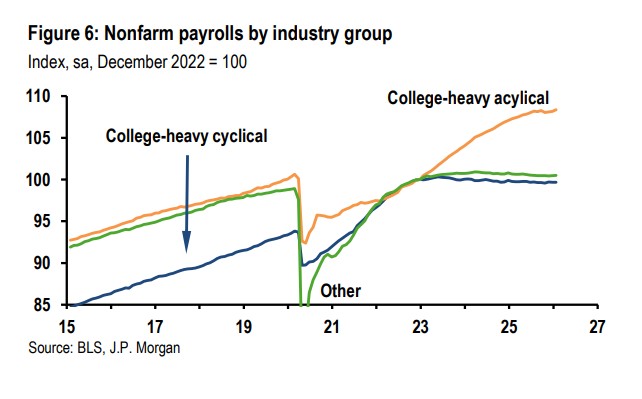
To clarify the truth, JPMorgan Chase categorized the U.S. job market into three types:
-
Non-cyclical, college-intensive industries: healthcare, education, government;
-
Cyclical, college-intensive industries: professional services, finance, information (the report suggests this group may have higher exposure to AI);
-
Other industries.
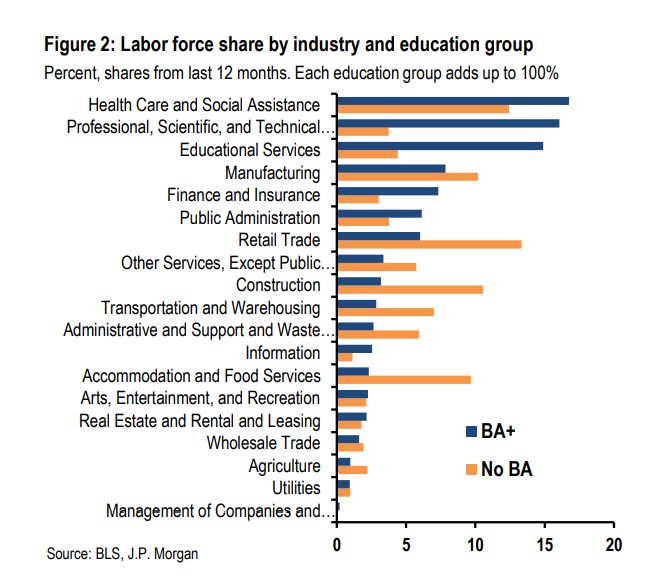
The common assumption in the market is that college graduates prefer to cluster in specific industries like technology and information, and the decline of these industries has led to the rise in unemployment rates among highly educated individuals. However, JPMorgan Chase's calculations overturn this assumption.
Analyst Abiel Reinhart stated in the report: "We found that even if the industry distribution of college graduates is identical to that of those without a college education, the unemployment rate for college-educated individuals still rises by almost the same magnitude."
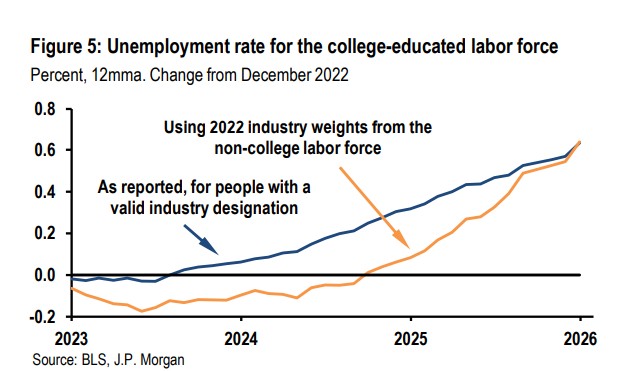
This means that the recent rise in unemployment rates among highly educated individuals is not because they "entered the wrong industry," but rather that the overall demand for college skills in the market is weakening.
Is AI being scapegoated?
If AI is causing a wave of white-collar unemployment, then the unemployment rates in high-risk industries like information technology and finance should continue to soar. But that is not the case. JP Morgan utilized CPS microdata analysis to discover that since the end of 2022, the unemployment rate in cyclical high-education industries (professional services, finance, information) has indeed increased the most. However, the 12-month moving average of this data has flattened out over the past one to two years. Coincidentally, the unemployment rate of non-college-educated workers in these industries has also shown a similar flattening trend.
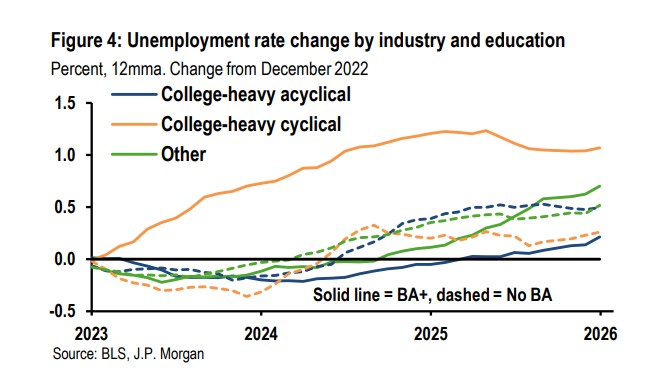
In contrast, the unemployment rate of highly educated workers has recently continued to rise in "other industries" and "non-cyclical high-education industries (healthcare, education, government)," which have relatively lower AI exposure. For example, recent significant layoffs in the federal government have pushed up the unemployment rate in the latter.
Based on this, JP Morgan concludes: The flattening of unemployment rates in cyclical, college-educated, and potentially higher AI exposure industries makes it harder to assert that "AI has caused widespread disruption to the demand for college skills."
In other words, if AI is a "broad impact," the group of industries most under pressure should not have stabilized so early.
Looking at Employment Growth: Weakness Beyond "White-Collar Industries"
JP Morgan also emphasizes that the unemployment rate does not equate to employment trends: even if job growth in certain industries is weak, it may transmit unemployment pressure to other industries through hindered cross-industry mobility.
Under the non-farm employment metric, the cumulative performance of "cyclical, college-educated industries" has still been the weakest since the end of 2022; however, the report points out that the cumulative employment growth in industries with a "lower proportion of college graduates" has also been almost equally weak, and when compared to pre-pandemic levels, the latter's performance is even worse.
This further shifts the narrative from "technology/AI single-point impact" back to a more macro explanation: Under overall demand cooling, a college degree is no longer significantly more resistant to cycles.
This also reaffirms JP Morgan's core logic: "These results refute the view that the disproportionate rise in unemployment rates among college-educated individuals is primarily due to specific industry impacts."
What Might This Affect?
For the market, the implications of JP Morgan's analysis are that if the rise in unemployment among college graduates is cross-industry and unemployment in higher AI exposure industries has flattened, then the market needs to reassess two points:
-
Is the white-collar labor market "generally loosening"? This could affect wage growth, service sector inflation stickiness, and the Federal Reserve's judgment framework on "soft landing/reinflation."
-
Is the "degree premium" experiencing a temporary decline? A thinner protective cushion of a college degree on employment will impact recruitment strategies, employee bargaining power, and the pace of talent mobility between industries
