Is the European natural gas crisis just beginning? Morgan Stanley: Currently only pricing in a 1-2 week interruption; if Qatar halts production for months, prices could double!
Morgan Stanley expects that in an extreme scenario, if the shutdown of Ras Laffan evolves into a months-long situation, there is a risk that the European gas price benchmark TTF could soar to 100 euros, a situation that may approach the squeeze market of 2022. However, the European fundamentals are more robust than in 2022, and Qatari LNG only accounts for a small portion of the total supply to Europe. If disturbances in the Middle East continue, even if Europe turns to Asia to grab cargo, the supply-demand imbalance will not be as severe as in 2022
The European natural gas market is being repriced due to geopolitical shocks from the Middle East.
According to the Wind Trading Desk, Morgan Stanley's latest report indicates that the European gas benchmark TTF has surged significantly due to the stagnation of LNG transport in the Strait of Hormuz and production shutdown news from Qatar's Ras Laffan. However, the current price mainly reflects expectations of disruptions lasting 1 to 2 weeks (baseline scenario). In extreme cases, if the Ras Laffan shutdown evolves into a months-long situation, there is a risk of TTF soaring to 100 euros, potentially approaching the squeeze market conditions of 2022.
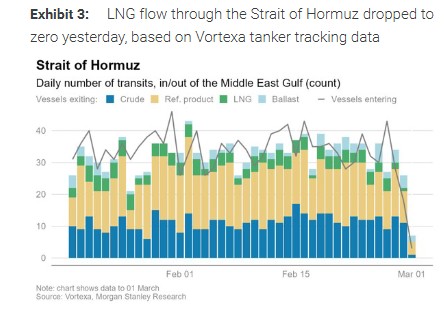
The latest disturbances stem from a combination of supply and logistics issues. Based on Vortexa tanker tracking data, LNG flows in the Strait of Hormuz briefly dropped to zero, compounded by news of shutdowns at Qatar's largest liquefied natural gas infrastructure, leading to a 60% surge in TTF over two days.
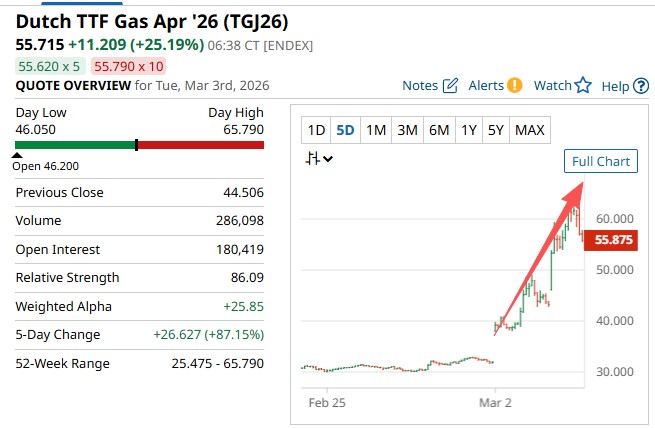
In its baseline scenario, Morgan Stanley expects the market is pricing in "1 to 2 weeks of Gulf LNG export disruptions." The firm has raised its short-term TTF forecast to around 45 euros/MWh and believes that if Qatar's production quickly recovers and traffic through the strait gradually resumes, TTF may maintain a range of 45–50 euros/MWh in the near term.
For Europe, Morgan Stanley believes that the European fundamentals are more robust than in 2022, and Qatari LNG accounts for only a small portion of Europe's total supply. If Middle Eastern disruptions persist, even if Europe turns to Asia to secure supplies, the supply-demand imbalance will be far less severe than in 2022.
Strait "standstill" combined with Ras Laffan shutdown intensifies supply concerns
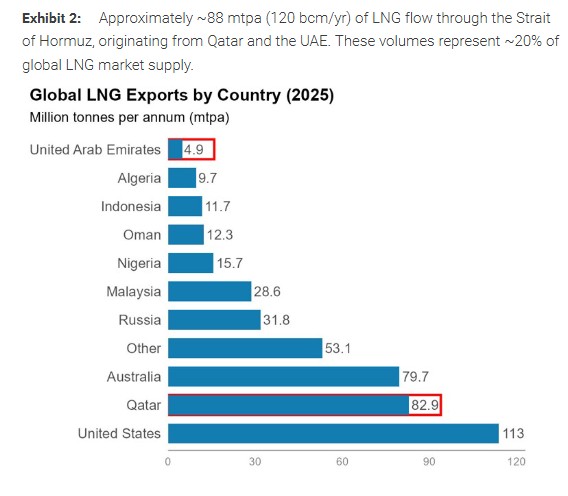
In a report dated March 3, Morgan Stanley stated that approximately 88 million tons (about 120 billion cubic meters/year) of LNG are transported through the Strait of Hormuz annually, accounting for about 20% of global LNG supply, primarily from Qatar and the UAE. Unlike crude oil, Qatar and the UAE's gas lacks alternative export routes, and once the strait becomes "nearly impassable" for tankers, supply shocks cannot be alleviated through rerouting.
What makes the market even more sensitive is the shutdown at Ras Laffan itself. Morgan Stanley points out that Ras Laffan has 14 liquefaction production lines with an annual capacity of 77 million tons, making it the world's largest LNG export facility. Multiple media outlets have reported that the facility was attacked by drones, but the energy research consultancy Energy Aspects suggested another possibility in its statement that day: shipping disruptions and insufficient storage capacity forced Qatar Energy to reduce or halt production. Regardless of the reason, shutdowns of this scale are uncommon in the industry, and the pace of restart has become a core variable in price trajectories Apart from Qatar, Israel also experienced supply disruptions last weekend. Reports indicate that the Israeli government requested the temporary shutdown of the Leviathan and Karish gas fields on February 28, while Tamar seems to still be operational, leading to a suspension of exports to Egypt and Jordan, which partially resumed on March 2. Morgan Stanley estimates that the immediate disruption to Egypt could be in the range of 20-30 billion cubic meters per day. The report cites Platts data stating that Egypt has issued LNG tenders due to the interruption of gas from Israeli pipelines, planning to procure 20 shipments between June and September, with an additional 3 shipments in March.
Why TTF Reacts More Intensively: Tight Balance, Little Buffer, Difficult to Redirect
Morgan Stanley provides four explanations for why natural gas is more prone to amplified volatility compared to crude oil.
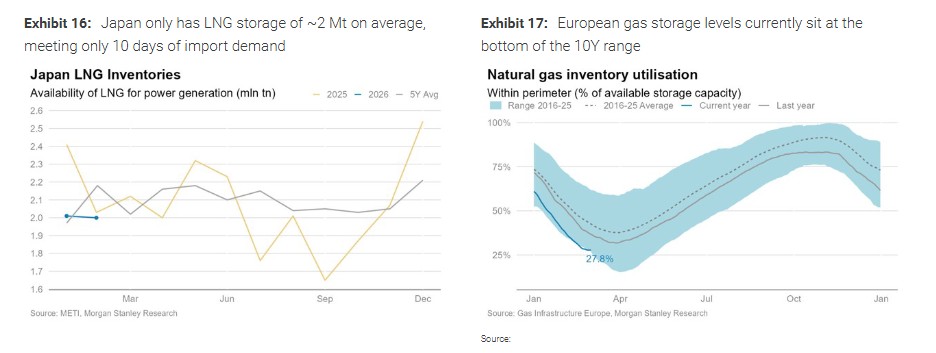
First, the fundamentals were more "tight" before the event occurred. The report states that the global LNG market has been generally balanced in recent months, with limited new supply during winter, while demand in Europe and Asia has improved year-on-year. In Europe, heating and power generation demand has been relatively strong, and LNG imports have lagged, resulting in inventories being at a 10-year low.
Second, there has been a substantial reduction in gas supply, rather than just logistical constraints. The shutdown of Ras Laffan and the Israeli gas fields means a decrease in available supply, making the impact more visible.
Third, the system buffer is thinner and difficult to redirect. The report emphasizes that LNG storage is inherently challenging, with major importing countries having limited LNG reserve days; for example, Japan's average reserves can only cover about 10 days of demand. Additionally, Qatar and the UAE lack alternative export routes that bypass the strait. Other major suppliers in Europe also lack "spare capacity," with Norway and North African pipeline gas already at high levels.
Fourth, prior to the event, TTF's pricing for geopolitical risks was relatively low. Morgan Stanley estimates that on February 27, TTF only accounted for a geopolitical premium of 2-3 euros per megawatt-hour, implying a probability of severe disruptions of less than 10%, while the crude oil market had previously factored in a higher probability. The result was a "catch-up" revaluation of natural gas after the event occurred.
Scenario Simulation: Benchmark Pricing 1-2 Weeks, Key Focus on Ras Laffan Restart Window
Morgan Stanley believes that the market is currently aligned with "Scenario 2," which assumes the disruption lasts for 1 to 2 weeks and uses this as the baseline scenario.
-
Scenario 1 (24-48 hours): If Qatar's production and exports are restored within 48 hours, TTF may fall back to around 35 euros per megawatt-hour in 2 to 3 weeks. The report states that Energy Aspects believes Qatar has the capability to restart liquefaction within 3 to 6 hours, making rapid recovery feasible.
-
Scenario 2 (1-2 weeks, baseline): The report defines the main impact during this phase as the "fleet efficiency impact." Their calculations show that if the average 18-day voyage is delayed by one week, it equates to a significant reduction in the capacity of the relevant fleet, resulting in an effective loss of about 7% of global market capacity, translating to approximately 2.8 Mt/month of deliverable volume. Corresponding prices may see TTF fluctuate around 45-50 euros per megawatt-hour, with JKM around 16-18 dollars per million British thermal units. Since about 89% of the affected cargo was originally destined for Asia, replenishment in Asia will create more direct competition with Europe, pushing TTF towards a higher marginal pricing level In this baseline scenario, Morgan Stanley estimates that Europe could face a monthly loss of approximately 2.3 million tons of LNG supply (including diversion to Asia and reduced direct arrivals to Europe), which would drag down inventory trajectories. The report predicts that if normalcy is restored by the end of March, inventories may still recover to about 70%-75% by summer, thus price pressure will be more concentrated at the front end of the curve, with TTF still having room to decline in summer, but the risk premium will be harder to fully dissipate than before.
If Qatar's production halt "extends": 60-80 for one month, potentially leading to a 2022-style squeeze over several months
Morgan Stanley focuses tail risks on the duration of the Ras Laffan production halt.
-
Scenario 3 (Severe disruption for one month): If the Strait is shut down for several weeks, combined with supply constraints from Ras Laffan and Das Island in the UAE, global LNG monthly supply losses could reach 6.8 Mt. The report estimates that Europe's potential monthly supply gap could reach about 5.5 million tons, and TTF may need to rise to €60-80/MWh to trigger demand contraction and rebalance.
-
Scenario 4 (Ras Laffan production halt for several months): The report points out that unplanned outages at large LNG facilities are often not quickly recoverable, citing historical outages at Freeport LNG and Hammerfest LNG as examples that illustrate that repairs may take a long time. In the case of unclear damage and repair timelines at Ras Laffan, if the production halt lasts for 2 to 3 months, Europe's gas storage replenishment in summer will be significantly hindered, and prices may further rise and exceed €100/MWh, potentially reaching the high range seen in 2022 under longer production halt scenarios. Measured against the current level of about €45/MWh, this implies that prices have the potential to "double," but the premise is that the halt duration escalates from "weeks" to "months" or even "quarters."
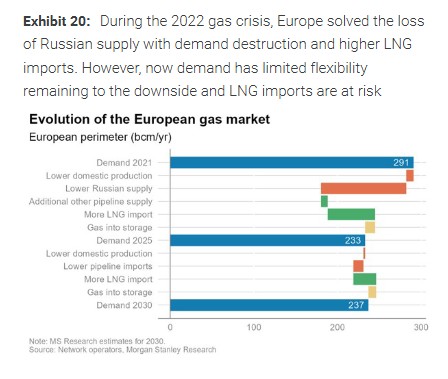
Supply-demand imbalance is far less severe than in 2022, should Europe be too worried?
For Europe, Morgan Stanley's core judgment is clear: the Middle Eastern LNG risks in 2026 are close to the scale of the impact from the Russian gas supply cut in 2022, but the transmission paths are completely different.
In 2022, Europe lost about 130 billion cubic meters/year of Russian gas, accounting for 40% of supply, which was a direct supply cut crisis. At that time, TTF quickly doubled and surged above €200/MWh in summer.
Even if Qatar faces a long-term production halt this time, the potential impact is about 120 billion cubic meters/year, which is close in scale, but Europe's direct exposure is only about 4% (as Qatar only accounts for a small portion of total supply to Europe).
The key point is: 40% of Europe's gas sources come from LNG, and LNG is the marginal pricing source. If Middle Eastern disturbances persist and LNG shifts to Asia, even if Europe must raise prices to secure supplies— prices may fluctuate dramatically, but the supply-demand imbalance will be far less severe than in 2022.