Why does gold react with such volatility in the face of a crisis?

As the conflict between the U.S. and Iran escalates, why is gold experiencing an unusual decline? Deutsche Bank's latest research report breaks the illusion that "crises must lead to price increases": the safe-haven premium of gold is highly uncertain and lagging. The real hard logic for going long on gold currently lies in its price resilience demonstrated under a strong dollar trend, reflecting that there is demand support for gold independent of the dollar
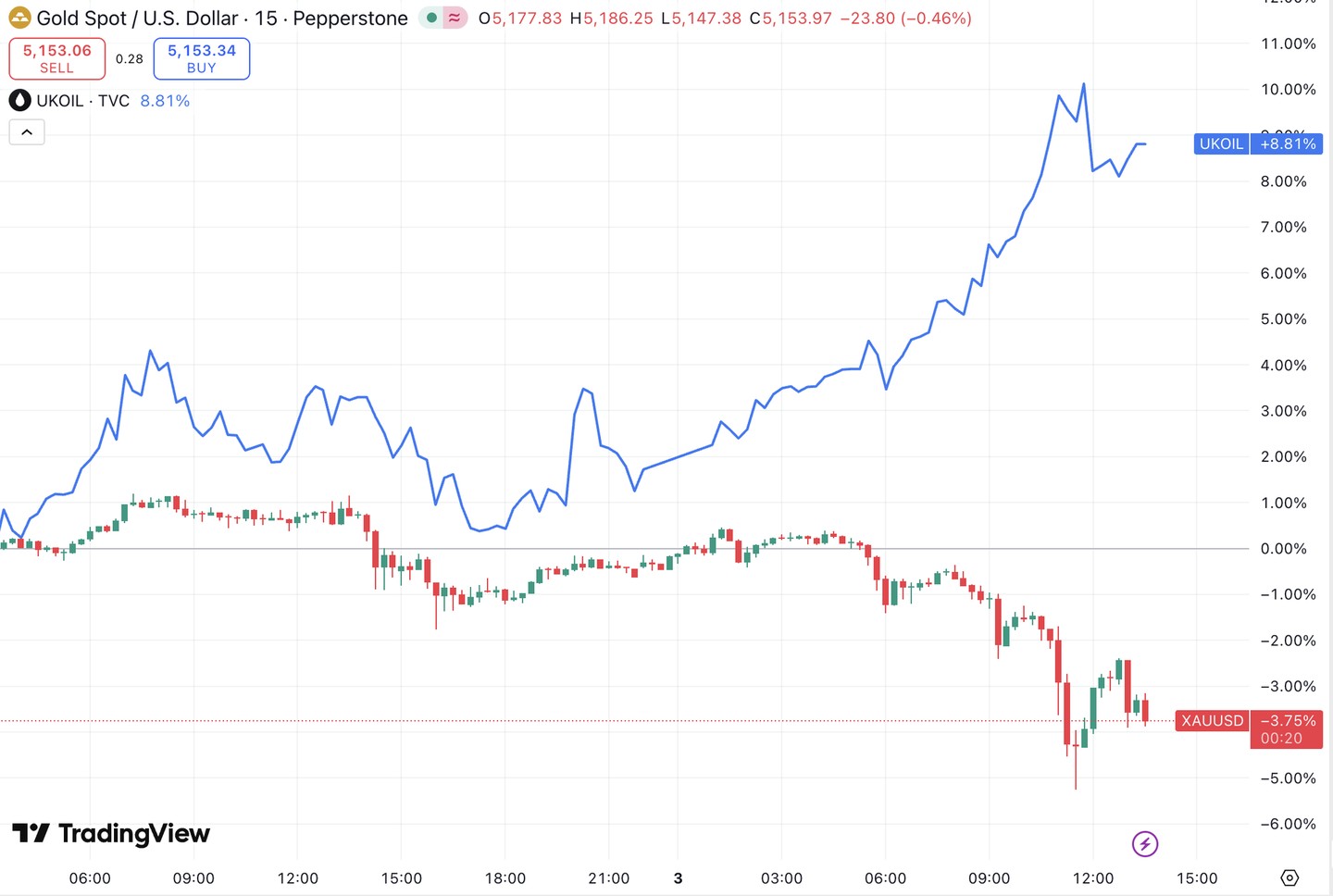
On March 3rd, the conflict between the U.S. and Iran intensified, leading to increased market risk aversion, a decline in the stock market, and a surge in oil prices, while the core safe-haven asset, gold, rose by 4.9% at one point.

According to the Chasing Wind Trading Desk, Deutsche Bank released a report titled "Crisis Premium of Gold Changes" on March 3, 2026, which pointed out that the response of gold to geopolitical crises is highly uncertain; on average, it is indeed positive, but the dispersion of individual events is extremely large, and investors should avoid treating "crises must push gold prices" as an ironclad rule.
More importantly, gold has shown a positive outperformance relative to the implied level of the dollar, and this structural signal is more convincing than the crisis premium itself, providing investors with a more robust long logic. Currently, gold prices still exhibit a certain degree of resilience against the strong performance of the dollar this week.
Gold in Crisis: Average Positive, but Price Response Takes 1 to 2 Weeks
Whenever geopolitical tensions rise, the market instinctively turns its attention to gold. However, Deutsche Bank research analyst Michael Hsueh pointed out that this intuitive logic of "crisis aversion = buy gold" is statistically much weaker than one might imagine.
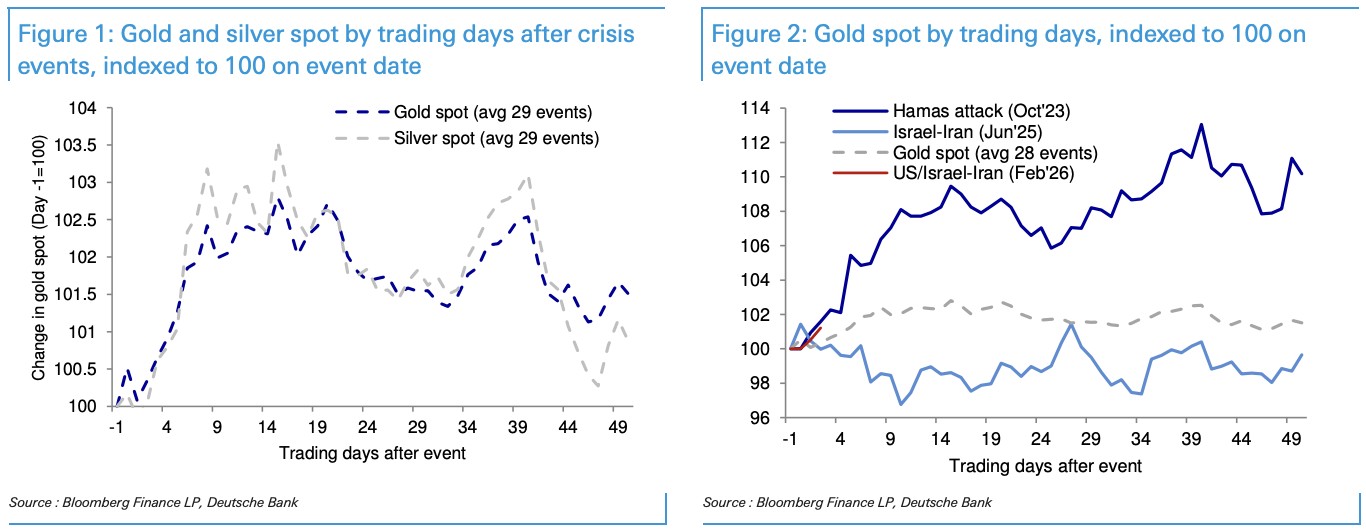
The research team analyzed the performance of gold following 29 crisis events since 1987 and reached the following core conclusions:
-
The response of gold to crises typically takes 1 to 2 weeks to fully manifest, rather than being immediate;
-
The reliability of gold's crisis response is relatively low, with significant dispersion between individual events; this remains true even after residual analysis excluding traditional value-driven factors;
-
Although silver tends to follow gold's trend, its excess performance is limited and is not a superior vehicle for crisis trading.
Extreme Dispersion of Events: Averages Conceal the Truth
Behind the average line of the 29 crisis events lies a sobering fact: in 24 of the 29 events, gold experienced a phase decline below the initial price on the day of the event within the first 25 trading days. In other words, even when a crisis erupts, holding gold is by no means a guaranteed profitable trade.
A comparison of two recent events most intuitively reveals this difference:
-
The October 2023 Hamas attack: Gold surged significantly after the event;
-
The June 2025 Israeli airstrike on Iran: Gold's response was relatively mild;
-
The maximum price difference between the two at different time points reached 10% to 13%, far exceeding the historical peak of crisis risk premium—approximately 2.7% to 2.8% during the 15th to 20th trading days.
It is noteworthy that the peak of gold's crisis premium often does not appear in the early stages of the event but gradually emerges in the weeks following the crisis stimulus. This means that investors should not overinterpret or act hastily due to short-term price fluctuations.

More Convincing Signals: Positive Breakthrough of Gold Relative to the Implied Level of the US Dollar
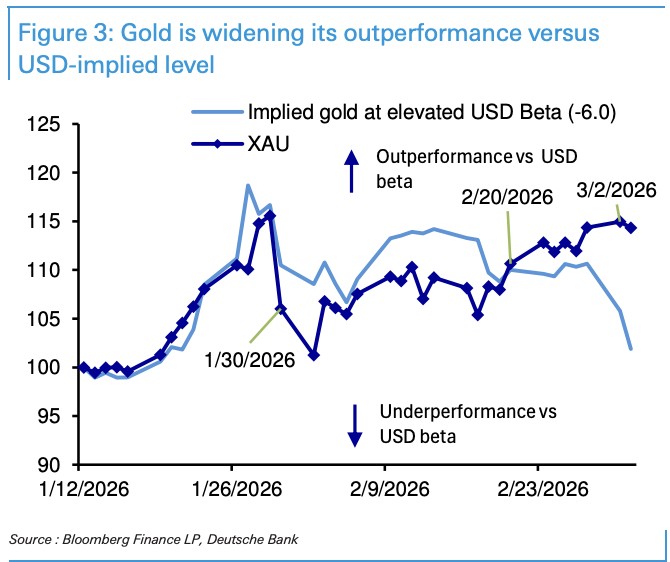
Compared to the unstable variable of crisis premium, Deutsche Bank believes that there is a more solid basis for going long on gold at present—the positive divergence of the implied gold price relative to the US dollar that occurred last week is further expanding.
Analysts have found through a comparative model of the rolling beta coefficient of gold and the US dollar that gold has been consistently outperforming the pricing level implied by the dollar beta since last week, and this gap has further widened this week as the dollar strengthens. The appreciation of the dollar should theoretically suppress gold prices, but the trading price range of gold still shows considerable resilience.
This "positive crossover" means that gold is no longer solely relying on the traditional dollar/interest rate logic to maintain its price; there is demand support that exists independently of the dollar's trend. Deutsche Bank believes this forms a more solid foundation for building a bullish preference for gold, while the potential overlay of crisis risk premium will serve as an additional upward catalyst.

Further Confirmation of Gold Crisis Premium by Fair Value Model
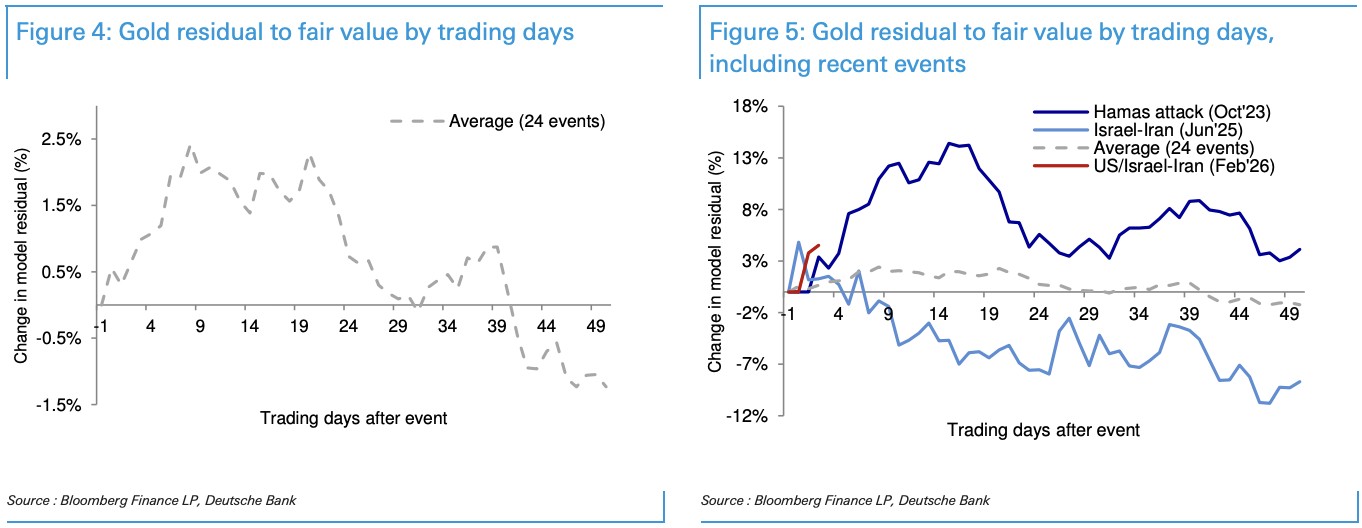
To isolate the direct impact of crisis sentiment on gold prices, Deutsche Bank's research team also analyzed the residuals of the gold relative fair value model. This means assessing the additional premium brought about by crises while excluding traditional driving factors such as the dollar and interest rates.
The conclusion is highly consistent with spot analysis: the fair value residual of gold tends to expand after crisis events, with the most significant expansion concentrated in the first 8 trading days. After that, this premium tends to decline, even entering a discount range.
This again indicates that: the elasticity of gold prices brought about by crises is real, but its timeliness is limited, and individual differences are significant. For the current US/Israel-Iran situation, the key observation point is that not all crisis-related reactions are realized within the first couple of days; there remains considerable uncertainty in the subsequent evolution path.

Investment Insights: Rationally View Crisis Premium and Focus on Structural Signals
In summary of the above analysis, Deutsche Bank maintains a recent positive preference for gold, but the logical support has the following priority ranking:
-
Primary Basis: The positive surpassing of the implied level of gold relative to the US dollar, which is a more stable and sustainable structural signal;
-
Secondary Catalyst: The potential accumulation of geopolitical crisis premium, which typically peaks 1 to 2 weeks after the event occurs;
-
Risks to be aware of: The high uncertainty of crisis premiums; historically, in over 80% of crisis events, gold has shown a phase of trading below the event benchmark price within the first 25 trading days.
For investors, the "ups and downs" of gold during a crisis reveal the essence of historical patterns: it is an effective crisis hedging tool, but it does not guarantee stable and predictable returns in every crisis.
In the current context where gold shows relative independence from the dollar's movements, the logic of going long on gold is relatively clear, but position management and timing are equally crucial